
Image: Wikimedia Commons / Notezik, CC0 — Bloch sphere diagram showing a qubit state with angles θ and φ (illustrative diagram explaining the state the new readout reconstructs, not the proposed Andreev device).
📌 KEY HIGHLIGHTS
- A study in Physical Review B proposes reading an Andreev qubit from its own supercurrent, rather than from a helper qubit.
- The qubit's state is encoded in the current: its steady part and oscillation size reveal the 0/1 mix, and the oscillation's start time reveals the phase.
- A SQUID sensor picks up the current's magnetic field from a safe distance, so the measurement barely disturbs the qubit.
- Simulations with realistic noise reached 99.52%, 99.81% and 99.85% accuracy — inside the range quantum error correction needs.
- Honest limit: this is theory, not a built device. The proposed geometry does not exist yet.
What happened?
One of quantum computing's oldest headaches is that reading a qubit usually destroys the very thing you wanted to read. A qubit lives in a superposition of 0 and 1, but a direct measurement forces it to pick one — collapsing the superposition and wiping out the information stored in the mix. To get around this, physicists developed "quantum nondemolition" (QND) measurements, which mostly work by copying the qubit's information onto auxiliary helper qubits, called ancillas, and measuring those instead. It works, but every ancilla costs extra hardware, extra preparation and extra measurements — overhead that grows painful as machines scale to thousands of qubits.
A team led by José Carlos Egues of the São Carlos Institute of Physics at the University of São Paulo (IFSC-USP) in Brazil, with Yugui Yao of the Beijing Institute of Technology in China, has proposed a different route, published in Physical Review B and covered by phys.org, the São Paulo Research Foundation (FAPESP) and other outlets on 23–25 October 2026. Their idea: skip the helper qubits entirely and read the signal the qubit produces by itself — an oscillating supercurrent that carries a fingerprint of its state. The work is entirely theoretical, but the authors argue it uses only parameters taken from existing systems, so no future materials breakthrough is needed to try it.
Andreev qubit supercurrent readout explained: how the readout works
The qubit at the centre of the proposal is an Andreev qubit, named after Soviet physicist Alexander Andreev, who in 1964 described the quantum process at the boundary between normal and superconducting materials. In this device the qubit lives in a quantum dot — a nanoscale trap for electrons — formed in an indium arsenide nanowire with superconducting material on both sides. The Andreev states trapped in that tiny junction can encode 0, 1 and any superposition of the two.
Here is the key property the team exploits. When the qubit sits in a superposition, the supercurrent circulating through it — a current that flows with zero resistance — gains an oscillating component. That oscillation comes from quantum interference between the states making up the superposition, and it is an alternating current produced without any applied voltage: the qubit's own evolution drives it, unlike the usual AC Josephson effect, which needs a voltage. In effect, the microscopic quantum dynamics announce themselves as a macroscopic, measurable current.
Reading that current means reading the state. Any qubit state can be drawn as a point on the Bloch sphere, fixed by two angles: one sets the proportion of 0 and 1 in the mix, the other sets the phase relationship between them. The study shows both angles are written into the supercurrent. The steady (constant) part of the current and the size of the oscillation reveal the 0/1 proportion; the moment the oscillation starts reveals the phase. Measure how the current varies over time, and you can reconstruct the original state.
The measurement itself is deliberately hands-off. The Andreev qubit sits in a closed superconducting loop, and a SQUID — a superconducting quantum interference device, an exquisitely sensitive magnetic-field sensor — is placed nearby. The circulating supercurrent creates a varying magnetic field, and the SQUID senses it. Egues compares the setup to two compasses: the qubit is one compass, the SQUID the other, and because the coupling between them is very weak, the sensor's back-action on the qubit stays tiny. Simulations that included measurement noise and the detector's feedback put the readout accuracy at 99.52%, 99.81% and 99.85%, depending on how many measurements were combined — figures that sit within the thresholds quantum error-correction schemes require.
Old readout vs the supercurrent readout
| Step | Ancilla-based QND readout | Supercurrent readout (proposed) |
|---|---|---|
| Helper qubits | Needed — ancillas prepared, coupled and measured | None — the qubit's own current is the signal |
| After each measurement | Qubit must be re-prepared / reset | No reset needed — successive measurements can track the state as it evolves |
| What is measured | The ancilla, to spare the original qubit | The magnetic field of the qubit's own supercurrent, via a SQUID |
| Status | Established technique in labs | Theoretical proposal; geometry not yet built |
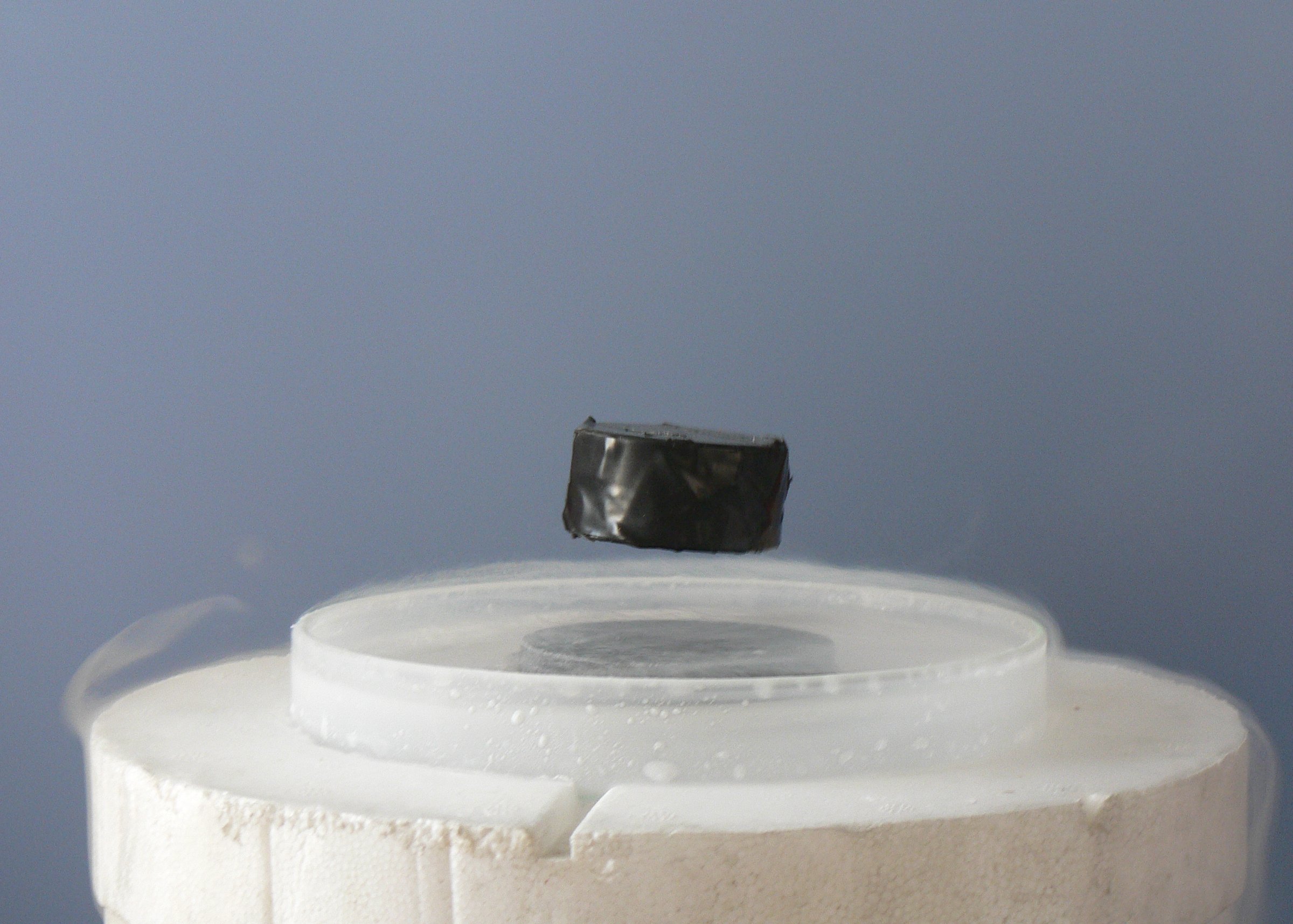
Image: Wikimedia Commons / Mai-Linh Doan, CC BY-SA 3.0 — Meissner effect: a magnet levitating above a superconductor (illustrative photo of superconductivity, not the proposed Andreev device).
Why it matters for World readers
Readout is one of the quiet bottlenecks in quantum computing. Error correction — the machinery that will let quantum computers run long, useful calculations — needs repeated, gentle measurements to catch errors as they happen. If every one of those measurements demands helper qubits and resets, the machine's overhead balloons. A readout that needs neither would simplify the architecture of Andreev-qubit processors and, because no reset is required, could watch a qubit's state evolve continuously rather than sampling it in snapshots.
There is a second, more fundamental point. The proposal predicts a new physical effect in its own right: an alternating-current-like supercurrent generated purely by a qubit's coherent evolution, with no external voltage. If an experiment confirms that current, it would be a striking macroscopic signature of microscopic quantum dynamics — the quantum world leaving a readable trace in an ordinary electrical signal. That is also why the claim deserves its careful framing: the physics is derived and simulated, not yet observed in this device.
Should you care?
FAQs
Why does measuring a qubit destroy its state? In quantum mechanics, a direct (projective) measurement forces a qubit in a superposition of 0 and 1 to settle on one definite value. The superposition — and the information stored in its exact mix and phase — is gone after that measurement, which is why physicists developed gentler, "nondemolition" techniques that measure a proxy instead of the qubit itself.
What is an Andreev qubit? It is a qubit built from Andreev states, quantum states trapped at the nanoscale boundary between superconducting materials. In this proposal the states live in a quantum dot formed in an indium arsenide nanowire connected to superconductors on both sides, and they can encode 0, 1 and their superpositions.
What is a SQUID and why does this readout need one? A SQUID (superconducting quantum interference device) is an extremely sensitive magnetic-field sensor. Here it sits near the qubit's superconducting loop and detects the tiny varying magnetic field produced by the circulating supercurrent — reading the qubit's state without touching the qubit itself.
Has this readout been demonstrated in a real device? No. The study is entirely theoretical. Its simulations used realistic parameters from existing systems and included noise and detector feedback, reaching up to 99.85% simulated accuracy — but the proposed loop-and-SQUID geometry has not been built yet, and the predicted supercurrent signature awaits experimental confirmation.
What happens next for this idea? An experimental team must fabricate the proposed geometry, confirm the voltage-free oscillating supercurrent, and show the state can be reconstructed from it at the simulated accuracy. Only then could it compete with established ancilla-based readout in real Andreev-qubit hardware.
Takeaway
Reading a qubit without destroying it may not need extra helper qubits after all — the qubit's own supercurrent could carry the message. The theory is elegant and the simulated numbers clear error-correction bars, but until a lab builds the device, it remains a promising proposal, not a proven tool.
Follow World Tech on TechByCountry for tomorrow's update.
📸 Get tech in the last 24 hours on Instagram — follow @_techinlast24hrs for daily posts (9 AM–9 PM) and reels at 12:30 PM & 8:30 PM.
Sources
- Physical Review B — Xian-Peng Zhang et al., "Andreev qubit readout from dynamic interference supercurrent" (DOI: 10.1103/6gkt-hghj)
- phys.org — "Supercurrent enables the reading of quantum information without destroying it" (25 October 2026)
- FAPESP Agency — "Supercurrent enables the reading of quantum information without destroying it"
- arXiv:2409.17008 — "Non-collapsing electric readout of arbitrary Andreev qubits" (preprint)
- ScienMag — "Supercurrent readout could spare quantum bits from measurement collapse"
Related TechByCountry explainers: electrons trapped in metal could aid quantum tech, Quantinuum's Helios error-correction record, and TokenGate's learned token pruning for LLMs.
Comments
Post a Comment