Ather Energy 122 Crore Expansion Explained: First Quarterly Profit and 2.25 Lakh Units More Capacity (India)

Image: Wikimedia Commons — Illustrative image: an electric scooter on display. Ather's announcement is a factory-expansion plan, not a new scooter launch, so there is no new product photo; this image illustrates the electric two-wheelers at the centre of the story.
TL;DR — Ather Energy 122 crore expansion explained: On 26 October 2026, Ather Energy's board approved about ₹122 crore of new factory spending to add 2.25 lakh units of annual electric-scooter capacity, as the Bengaluru company also reported its first quarterly profit. Hosur gains 75,000 units a year by December 2026, and the new Factory 3.0 in Maharashtra rises to 6.5 lakh units planned capacity by mid-2028.
📌 KEY HIGHLIGHTS
- What happened: Ather's board approved roughly ₹122 crore (including taxes) of capacity expansion across two plants on 26 October 2026.
- How much capacity: An extra 2.25 lakh electric two-wheelers a year — Hosur up 75,000 units, Factory 3.0 up 1.5 lakh units — taking combined planned capacity to about 11.45 lakh units a year.
- Why now: Hosur is running at 98% of peak capacity, and Ather has just turned profitable — a ₹1.26 crore net profit in Q2 FY27 against a ₹154 crore loss a year earlier.
- What it costs buyers: Nothing directly — this is factory capacity, not a price cut. But it removes the production bottleneck that has capped how many scooters Ather can deliver.
- What to watch: Hosur's extra capacity lands by December 2026; Factory 3.0's expansion completes by Q2 FY28. Both dates are company targets, not delivered capacity yet.
What happened?
Ather Energy, India's listed electric-scooter maker, had a busy Monday. Alongside its September-quarter results, its board signed off on a capacity-expansion plan worth approximately ₹122 crore, funded through a mix of debt and internal accruals. The plan covers the company's existing Hosur factory in Tamil Nadu and its under-construction Factory 3.0 at AURIC in Chhatrapati Sambhajinagar, Maharashtra.
The timing is the story. Ather reported a net profit of ₹1.26 crore for the quarter ended 30 September 2026, its first quarterly profit on this run, after a ₹154 crore loss in the same quarter last year. Revenue from operations jumped 63% to ₹1,464 crore from ₹899 crore, on quarterly volumes up 42% year on year to 93,211 units. A company that was losing money while demand outran its factory can now fund expansion from a profitable base — and the market noticed, with the shares closing about 10% higher at ₹1,518 on 26 October, according to Angel One.
Ather Energy 122 crore expansion explained: the numbers
The ₹122 crore splits into two projects, and the table below is the whole plan at a glance:
| Plant | Capacity change | Spend and deadline |
|---|---|---|
| Hosur, Tamil Nadu | 4.2 lakh → 4.95 lakh units a year (+75,000) | Up to ₹58 crore; extra capacity by December 2026 |
| Factory 3.0, Chhatrapati Sambhajinagar | 5 lakh → 6.5 lakh units a year planned (+1.5 lakh) | Up to ₹64 crore; expansion by Q2 FY28 |
| Combined | 9.2 lakh → about 11.45 lakh units a year (+2.25 lakh) | About ₹122 crore total, debt + internal accruals |
Two details inside the Hosur number matter. First, the plant is already running at 98% of peak capacity, so the extra 75,000 units relieve a real constraint rather than building ahead of demand. Second, ₹53 crore of the Hosur spend goes to a new battery line meant to cover different demand scenarios and reduce supply-chain risk, due by the third quarter of FY28. Factory 3.0, meanwhile, is still under construction: its Phase 1 is on track to begin commercial production in phases from December 2026, so the 6.5 lakh figure is planned capacity after expansion, not output today.
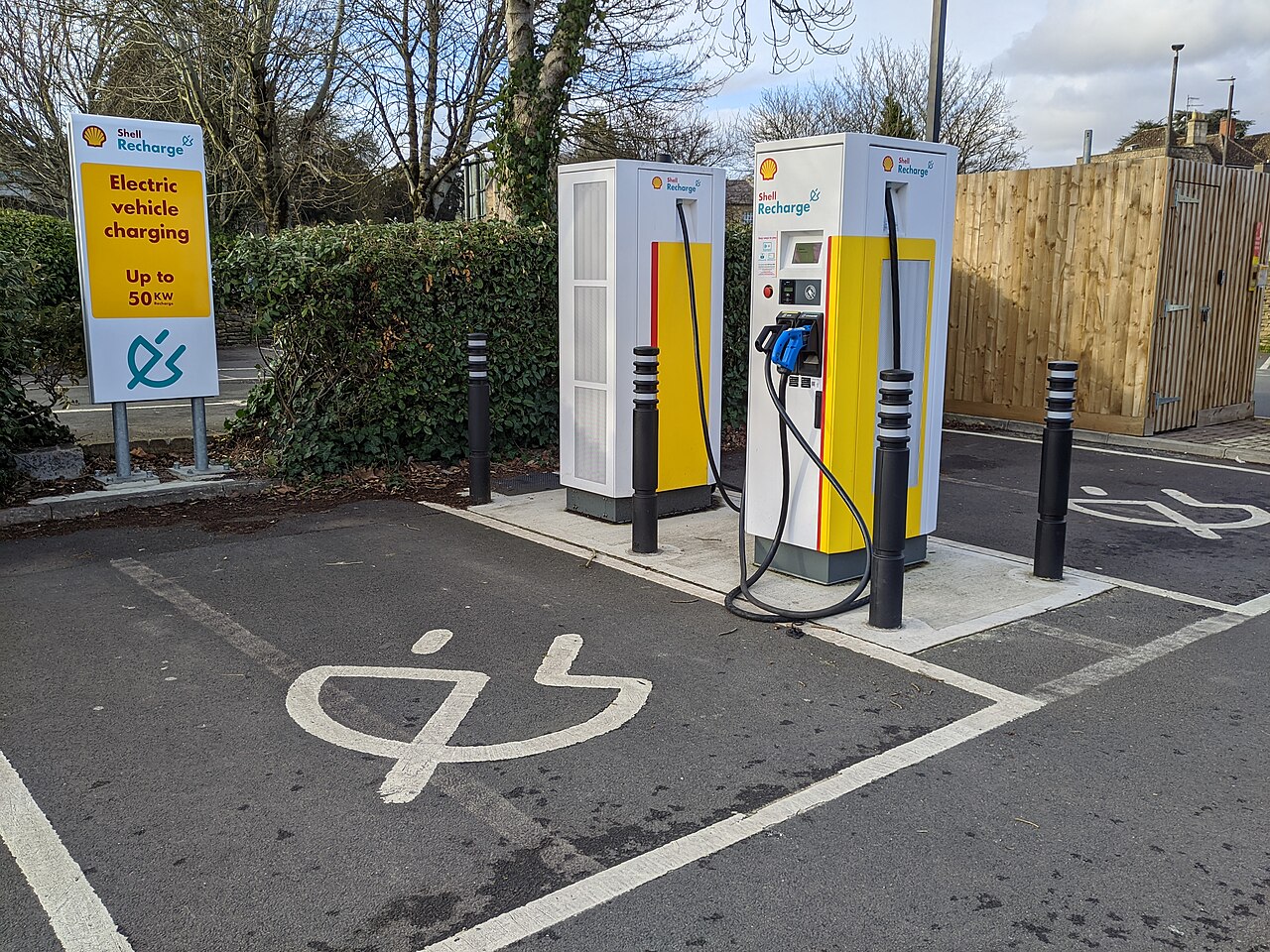
Image: Wikimedia Commons — Illustrative image: electric-vehicle charging bays. Ather's expansion is about building more scooters; charging infrastructure is the ecosystem that growth depends on.
Why it matters for India readers
For buyers, the practical effect is availability, not price. Ather's order book has been growing faster than its factory: pre-orders more than doubled year on year to 1.80 lakh units, according to the company's results coverage. When a factory runs at 98% of peak, waiting periods stretch and popular variants sell out. The Hosur addition arriving by December 2026 is timed for exactly that pressure point, ahead of the next buying season.
For India's EV industry, the expansion is a confidence signal. Ather is the rare Indian EV maker to reach quarterly profit while still scaling — most rivals are still burning cash for growth. A profitable company choosing to spend ₹122 crore on capacity, rather than on discounts, suggests it believes demand is durable rather than subsidy-driven. That is also why the announcement sits alongside big-ticket business moves covered here recently, including Salesforce's $5.66 billion Braze acquisition and S&P Global's acquisition of OpenZeppelin: in each case, a company with momentum is buying or building capacity for the next phase rather than celebrating the last one.
Should you care?
Verdict: ✅ Yes, if you are shopping for a premium electric scooter or tracking India's EV industry — Ather's capacity crunch is easing, and a profitable quarter makes the expansion credible. ⏳ Wait and watch if: you expect a price cut — this announcement changes how many scooters Ather can build, not what they cost, and Factory 3.0's full capacity is still nearly two years away.
FAQs
What is Ather Energy's ₹122 crore expansion plan? A board-approved plan to add 2.25 lakh units of annual electric two-wheeler capacity: 75,000 more units a year at Hosur by December 2026, and 1.5 lakh more at the under-construction Factory 3.0 in Maharashtra by Q2 FY28, for about ₹122 crore funded by debt and internal accruals.
When will Ather's new capacity come online? Hosur's extra 75,000 units are due by December 2026, and Factory 3.0's Phase 1 starts commercial production in phases from December 2026, with the full expanded capacity of 6.5 lakh units a year expected by Q2 FY28.
Is Ather Energy profitable now? For the September 2026 quarter, yes: a ₹1.26 crore net profit against a ₹154 crore loss a year earlier, with revenue from operations up 63% to ₹1,464 crore. One profitable quarter is a milestone, not a guarantee — the company must repeat it as it spends on expansion.
Will Ather scooters get cheaper after the expansion? Not on this announcement. It adds factory capacity, which should ease waiting times and stock shortages, but Ather has announced no price change. Compare current on-road prices and festive offers rather than waiting for a cut that has not been promised.
Where are Ather's factories? Hosur in Tamil Nadu, its existing plant, and Factory 3.0 at AURIC in Chhatrapati Sambhajinagar, Maharashtra, which is under construction with Phase 1 production starting from December 2026.
Takeaway: Ather has turned its first quarterly profit and is spending ₹122 crore to make sure its factories can keep up with demand — 2.25 lakh more scooters a year by mid-2028. For buyers, that means shorter waits, not lower prices; for the industry, it is proof that an Indian EV maker can grow and make money at the same time.
Follow India on TechByCountry for tomorrow's update.
📸 Get tech in the last 24 hours on Instagram — follow @_techinlast24hrs for daily posts (9 AM–9 PM) and reels at 12:30 PM & 8:30 PM.
Sources
- Autocar Professional — Ather Energy to invest ₹122 crore in manufacturing capacity expansion (26 October 2026)
- EVreporter — Ather Energy approves ₹122 crore manufacturing capacity expansion (26 October 2026)
- Upstox — Ather Energy turns profitable in Q2, reports net profit of ₹1.26 crore, revenue rises 63% (26 October 2026)
- Angel One — Ather Energy share price advances 10% following Q2 FY27 results (26 October 2026)
Comments
Post a Comment