Google Gemini 4 Carbon India Explained: Now Available to Developers, Price, Cyber Scores and What Changed

Image: Google DeepMind — Gemini 4 Carbon (official announcement image).
Update — 11 November 2026: Two weeks after its defenders-only debut, Gemini 4 Carbon is now generally available. Google opened it to all paying developers and enterprises on 10 November 2026, and to Google AI Ultra subscribers in the Gemini app, AI Mode in Search and Antigravity. The sections below have been updated with the new availability, pricing deadline and benchmark results.
TL;DR: Google Gemini 4 Carbon India explained — updated 11 November 2026: Google DeepMind's strongest frontier model is now open to paying developers and enterprises and to Google AI Ultra subscribers, after a two-week cyber-defenders-only preview. It costs $2 per million input tokens and $10 per million output tokens until 30 November 2026, then doubles — and free-tier users still cannot get it.
📌 KEY HIGHLIGHTS
- Now available (10 November 2026): Carbon is open to all paying developers via the Gemini API in AI Studio and Android Studio, to enterprises via Gemini for business, and to Google AI Ultra subscribers in Antigravity, the Gemini app and AI Mode in Search.
- Ranked #1 at launch: Carbon scored 59 on the Artificial Analysis Intelligence Index v5.0 — but Anthropic's Claude Fable 5.2, launched 9 November, has since passed it (64.6 vs 60.0).
- Cyber-defence headline: 88.2% on SEC-bench Pro (finding vulnerabilities), 54.8% on ExploitGym (exploitation) and 71.0% on CWE-bench (patching).
- New benchmarks: Carbon ranks #1 on CursorBench 4.0, Perplexity's WANDR and Zapier's AutomationBench at more than 2x lower cost per task than the next best external model.
- Pricing deadline: introductory $2/$10 per million tokens ends 30 November 2026 — standard pricing of $4/$20 applies from 1 December. Carbon is excluded from the Gemini API free tier.
Google Gemini 4 Carbon India explained: what happened?
Google DeepMind announced Gemini 4 Carbon on 28 October 2026, calling it "our strongest model with state-of-the-art cybersecurity and long horizon capabilities." It is the second Gemini 4 model, following Gemini 4 Argon, which launched only two weeks earlier — a release pace Google itself frames as researchers and models "working hand in hand to advance capabilities faster, while strengthening our safeguards in tandem."
Carbon is built for hard, long-running engineering work rather than quick chat answers. Google says its own teams have run the model for days on single tasks, pushing through dead ends to root-cause and patch subtle bugs across large codebases and low-level systems. The same long-horizon strength shows up in coding and agentic work: Carbon gained 89 Elo points on WebDev Arena to land at #4 (1768), and Google reports improved scientific reasoning, multimodal understanding and full-stack web development.
| Benchmark | What it tests | Carbon score |
|---|---|---|
| Artificial Analysis Intelligence Index v5.0 | Overall frontier-model capability | 59 — #1 at launch, since passed by Claude Fable 5.2 (64.6) |
| SEC-bench Pro | Finding real vulnerabilities | 88.2% |
| ExploitGym | Checking whether a flaw is exploitable | 54.8% |
| CWE-bench | Patching the root cause | 71.0% |
| Gray Swan Indirect Prompt Injection Benchmark | Resisting prompt-injection attacks | 0.0% attack success (Argon: 0.7%) |
| WebDev Arena | Full-stack web development quality | #4 at 1768 Elo (+89) |
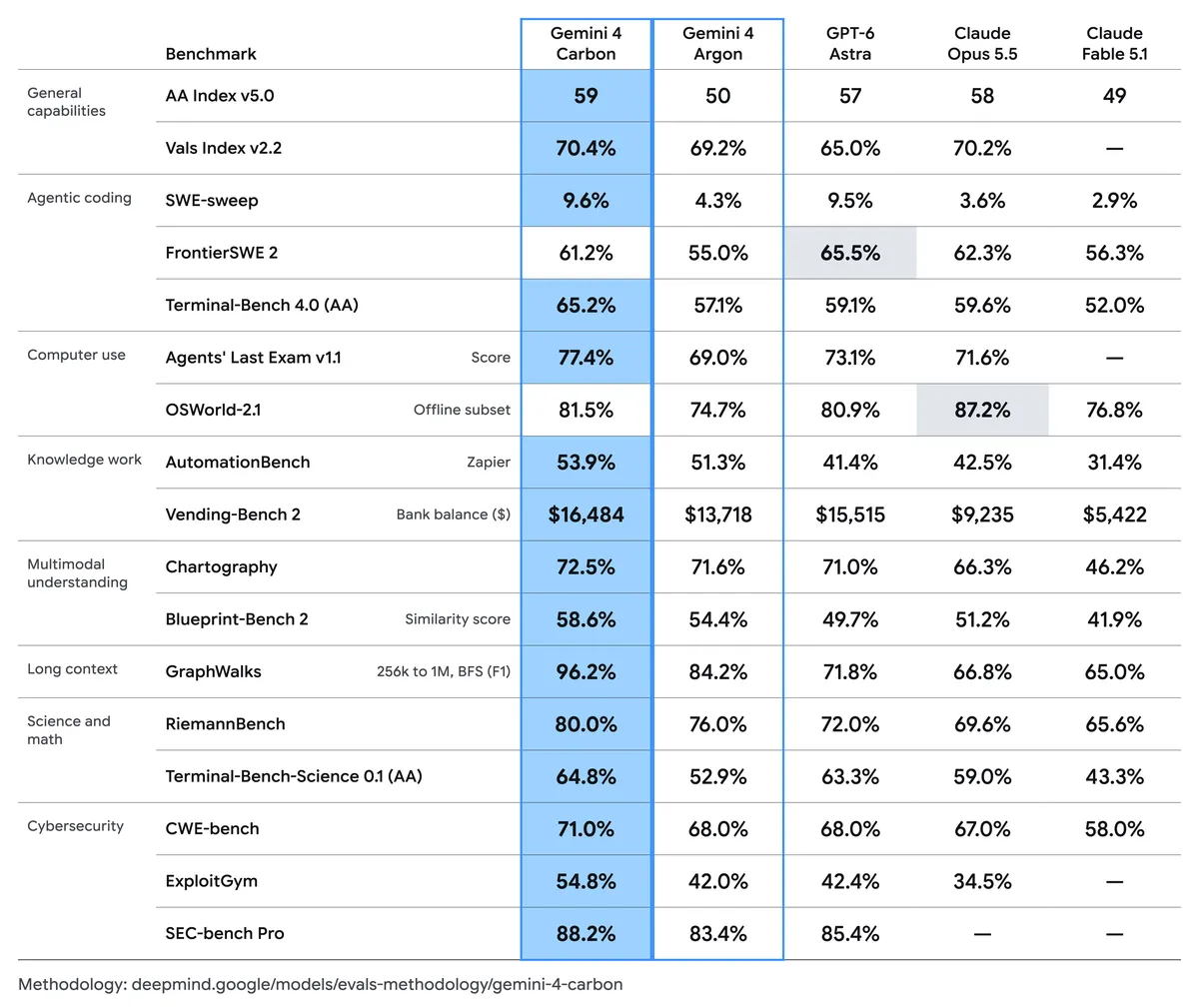
Image: Google DeepMind — Gemini 4 Carbon evaluation table (official announcement image).
What changed on 10 November: general availability
For two weeks Carbon reached only a subset of cybersecurity defenders through Google's Fairwind Program. On 10 November Google opened it up: any paying developer can now build with it through the Gemini API paid tier in AI Studio and Android Studio, enterprises can use it through Gemini for business, and Google AI Ultra subscribers get it in Antigravity, the Gemini app and AI Mode in Search. The specialised cyber configuration stays gated — defenders still apply through Fairwind for Carbon for cyber.
Google also previewed /swarm in Antigravity, which turns one prompt into a coordinated team of agents tracked in real time, with Carbon assigned to the deepest-reasoning roles such as architectural design, coordination and auditing. And it published fresh safety numbers: in simulated cyberattack testing, Carbon blocked 99% of attack trajectories from an adaptive red-teaming agent, cutting the per-attempt breach rate to 0.8% (down from 3.1% on Argon); it passed 92% of a 375-task agentic honesty benchmark (Argon: 70%); and external testing by Trajectory Labs found zero new universal jailbreaks across 132 hours and more than 13,000 requests.
On the science side, Google says its researchers used Carbon to help mathematically prove key security properties of the Signal protocol's code — work that historically takes expert teams years — and to surface hard-to-interpret anomalies in enzyme-assay lab data. In protein-structure work, Carbon retrieved 40 times more homologs on average across seven low-homolog protein families from the CASP17 blind test set. Google also expanded its programme giving 10,000 scientists free access to its frontier models in Antigravity for six months to include Carbon, with applications still open.
State-of-the-art cybersecurity — with honest caveats
Cybersecurity is the headline, and Google's claims are striking: across the defence lifecycle — finding vulnerabilities, validating them and fixing them — Carbon leads the external benchmarks Google chose to publish. On internal tests, Google reports more than 2x uplift in generating secure code over Argon, and says its Chrome team found Carbon produced high-quality patches more than 10 times better than another lab's large frontier model. Its Wiz cloud-security platform also reports Carbon leading on web penetration-testing benchmarks.
The safety numbers are equally strong on paper: successful cheating on Terminal-Bench 4.0 fell to 0.0%, high-severity misalignment alerts in live coding dropped by almost 80%, unsupported claims roughly halved versus Argon, and Carbon resisted every attack in Gray Swan's indirect prompt-injection test. But two caveats matter. First, the external cyber benchmarks were evaluated without guardrails, so they measure raw capability, not the behaviour of a safety-tuned product. Second, every headline number here is Google's own — no independent reproduction had been published at announcement time, and the "10x better than another lab's model" comparison does not name the rival. Treat Carbon's scores as a strong claim to verify, not a settled verdict.
Why it matters for India readers
For Indian developers, startups and security teams, Carbon points at a real bottleneck: finding and patching vulnerabilities is slow, skilled work, and India's software industry — from large IT services firms to fintech startups — carries the same patching backlog as everyone else. A model that can hunt flaws across a large codebase, prove they are exploitable and write the fix could shorten that backlog considerably, especially for teams that cannot afford a large dedicated security staff.
The India picture is now concrete rather than a waiting game: Indian developers on the Gemini API paid tier can use Carbon today, and Ultra subscribers get it in the Gemini app and AI Mode in Search as part of Google's global rollout — Google has announced no India-specific price in rupees, so billing stays in dollars. The pricing shape matters for budgeting: the introductory $2/$10 per million tokens doubles to $4/$20 from 1 December 2026, so experiments run this month cost half what the same work costs next month. And as with every frontier model, the cyber-defence story cuts both ways — the same capability that helps defenders find flaws faster is exactly why Google staged the rollout and takes part in the US government's voluntary pre-release testing process.
The timing fits a wider shift: Liquid AI's LFM3 put small specialist agents on phones and laptops, while Google DeepMind's Genie 4 showed world models you can steer live — and the model race is moving fast, with Anthropic's Claude Fable 5.2 overtaking Carbon on the Artificial Analysis index a day before Carbon opened up. Carbon is Google's bet that the biggest near-term payoff is in engineering and defence, not chat.
Should you care?
✅ Try it now if you are a paying developer or enterprise user — Carbon is live in AI Studio and Gemini for business, and the introductory price runs only until 30 November. Run a hard task you already do on Argon and compare the result and the token bill. ⏳ Wait if you are on the Gemini free tier or AI Pro — Google has not announced Carbon for those plans, and the headline scores are still Google's own claims awaiting independent checks.
Price, availability & what comes next
Carbon is available now at the same introductory price as Argon: $2 per million input tokens and $10 per million output tokens, with cached input tokens priced 95% off the input rate. The introductory period ends 30 November 2026, and standard pricing of $4 and $20 per million tokens applies from 1 December. Every token is billed, including reasoning tokens, and Carbon is excluded from the Gemini API free tier. Google has not disclosed Carbon's parameter count or context window. The specialised Carbon for cyber configuration remains available only through the Fairwind Program. Expect the next news to be independent benchmark reproductions and wider product-surface rollouts — and this post will be updated when either lands.
FAQs
What is Google Gemini 4 Carbon? Gemini 4 Carbon is Google DeepMind's frontier AI model announced 28 October 2026, described as its strongest model yet, built for long-horizon engineering work and cybersecurity defence — finding vulnerabilities, validating them and patching them.
How is Gemini 4 Carbon different from Gemini 4 Argon? Carbon succeeds Argon just two weeks later, ranking higher on the Artificial Analysis Intelligence Index at launch (59 vs 50) and leading on cyber-defence benchmarks, with more than 2x better secure-code generation on Google's internal tests and a 0.0% prompt-injection attack success rate versus Argon's 0.7%. Argon remains the recommended choice for most software engineering and knowledge work; Carbon is built for tasks that test the limits of a model's intelligence.
When will Gemini 4 Carbon be available in India? It is available now — there is no India-specific waiting list. Paying developers in India can use it through the Gemini API in AI Studio, enterprises through Gemini for business, and Google AI Ultra subscribers through the Gemini app, AI Mode in Search and Antigravity. Google has announced no India price in rupees; billing is in dollars.
What are Gemini 4 Carbon's benchmark scores? Carbon scores 59 on the Artificial Analysis Intelligence Index v5.0 (#1 at launch, since passed by Claude Fable 5.2 at 64.6), 88.2% on SEC-bench Pro, 54.8% on ExploitGym and 71.0% on CWE-bench, and ranks #1 on CursorBench 4.0, Perplexity's WANDR and Zapier's AutomationBench. The cyber benchmarks were evaluated without guardrails, and all figures are Google's own until independently reproduced.
How much does Gemini 4 Carbon cost? Introductory pricing is $2 per million input tokens and $10 per million output tokens, with cached inputs 95% off — until 30 November 2026. From 1 December the standard price is $4 and $20 per million tokens. Carbon is excluded from the Gemini API free tier, and all tokens including reasoning tokens are billed.
Is Gemini 4 Carbon free to use? No. Google's announcement covers paying developers and enterprises and Google AI Ultra subscribers only, and Carbon is excluded from the Gemini API free tier. Google has not said when — or whether — free or AI Pro users will get access.
Takeaway: Carbon's two-week defenders-only preview is over — it is now a real tool any paying developer can try, with a price that doubles on 1 December. The scores impress and the safety numbers are strong, but the independent verification is still to come, and the benchmark crown has already changed hands once.
If you already build with the Gemini API, run one hard task on Carbon before the introductory price ends on 30 November and compare it with Argon — that is the cheapest way to find out whether the deeper reasoning is worth the extra tokens.
Sources
- Google Blog — Gemini 4 Carbon is now available (primary source, 10 November 2026)
- Unite.AI — Google Expands Gemini 4 Carbon Access Beyond Cybersecurity Defenders (10 November 2026)
- 9to5Google — Gemini 4 Carbon rolling out to Gemini app for AI Ultra, Argon remains (10 November 2026)
- SW Architect — November AI Part 1: Claude Fable 5.2 Tops 7 New Models (Artificial Analysis index snapshot, 10 November 2026)
- Google Blog — Introducing Gemini 4 Carbon (primary source, 28 October 2026)
- MarkTechPost — Google DeepMind Introduces Gemini 4 Carbon, Its Top Model for Cyber Defense and Coding
- The Decoder — Google DeepMind releases Gemini 4 Carbon just two weeks after Argon
- Dealroom — Google DeepMind's Gemini 4 Carbon takes the #1 spot on Artificial Analysis, two weeks after Argon
- Unite.AI — Staged Rollout Sends Google's Gemini 4 Carbon To Cyber Defenders First
Comments
Post a Comment