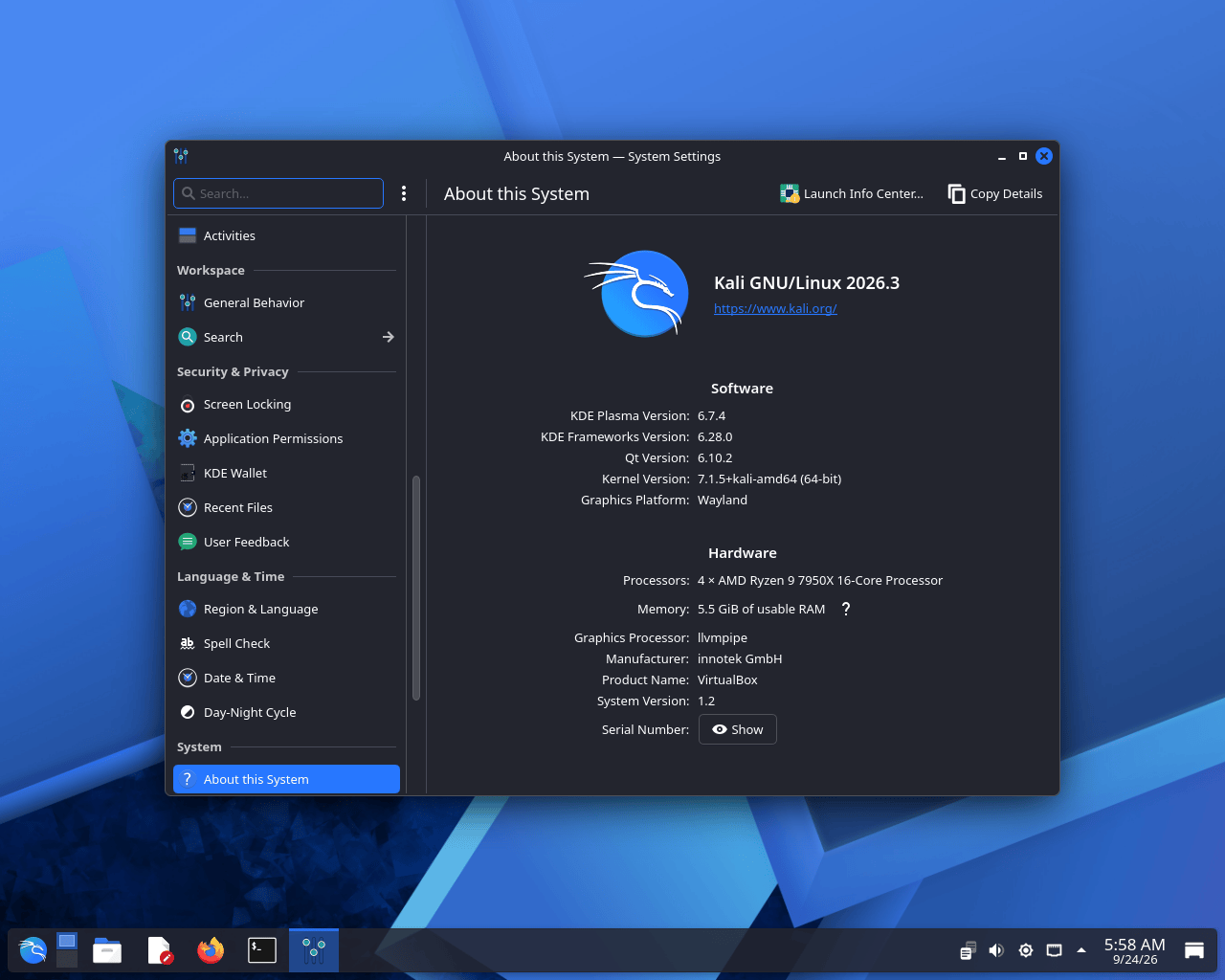
Image: Kali Linux — KDE Plasma 6.7 desktop in Kali Linux 2026.3 (official release image, kali.org).
TL;DR — The Kali Linux 2026.3 release explained in one line: the third Kali release of 2026, out on 26 October, adds six new penetration-testing tools, moves the kernel from 6.19 to 7.1.5, refreshes the desktop with KDE Plasma 6.7, and rebuilds how official Kali images are made — and existing users upgrade with a single apt command, no reinstall needed.
📌 KEY HIGHLIGHTS
- Kali Linux 2026.3 was released on 26 October 2026, four months after 2026.2 — the third release of the year for the Debian-based security distribution.
- Six new tools join the repositories: dalfox, katana, qsreplace, rustscan, sdrangel and snaffler-ng, covering web testing, crawling, port scanning, radio and SMB-share auditing.
- The Kali kernel jumps from 6.19 to 7.1.5 across 126 package updates, and KDE Plasma moves to 6.7 with per-screen virtual desktops.
- Official build scripts are now consistent across platforms and can run inside a Docker or Podman container — ending the old "build Kali on Kali" chicken-and-egg problem.
- Kali NetHunter gains wardriving on the TicWatch Pro 3 smartwatch, an experimental WearHunter phone-to-watch control feature, and NFC access from the chroot.
Kali Linux 2026.3 release explained: what is new
Kali Linux is the free, Debian-based distribution built for penetration testing, red teaming, security auditing and network research. Unlike a general-purpose desktop Linux, it ships with hundreds of security tools preinstalled, and it is the system many security students and professionals reach for first when they need a ready-made testing lab. Kali follows a rolling model with periodic snapshot releases: 2026.3 is the third snapshot of 2026, following 2026.1 in March and 2026.2 in June, and it is the version fresh downloads now carry.
The headline theme of this release is not a single tool but the build system itself. Kali's team has refreshed the public build scripts that generate every official image on its download page, giving each script the same features, command-line arguments, structure and look. Each refreshed script ships with a build-in-container.sh helper that detects Docker or Podman, creates a build container and runs the build inside it, so builders no longer need a Kali machine just to build Kali. The refresh is incomplete — the remaining scripts are targeted for Kali 2026.4 — and the team apologised for any continuous-integration pipelines the changes broke.
The six new tools in Kali Linux 2026.3
As with every Kali release, the new tools are the part most existing users will notice first. All six are available from Kali's network repositories after upgrading:
| Tool | What it does | Best for |
|---|---|---|
| dalfox | Powerful open-source cross-site scripting (XSS) scanner focused on automation | Web application testing |
| katana | Next-generation crawling and spidering framework | Discovering web content and endpoints |
| qsreplace | Accepts URLs on standard input and replaces all query-string values with a value you supply | Parameter and fuzz testing |
| rustscan | Modern, fast port scanner written in Rust | Network reconnaissance |
| sdrangel | Qt-based software-defined radio front end for various devices | Radio signal analysis |
| snaffler-ng | SMB share credential and sensitive-data scanner | Internal network assessments |
Beyond the new tools, the release carries 126 package updates in total. The kernel move from 6.19 to 7.1.5 brings broader support for recent hardware and drivers — on a standard AMD64 install, uname -r reports 7.1.5+kali-amd64. On the desktop side, KDE Plasma 6.7 adds per-screen virtual desktops, quicker Overview navigation, more Wayland protocol support, and performance and power optimisations for integrated Intel graphics. Xfce 4.20 remains the default desktop, so the Plasma update mainly affects users who choose the KDE edition. Kali has also refreshed the icons of its pre-installed tools, making them easier to recognise in the application menu.

Image: Kali Linux — Kali NetHunter wardriving support on the TicWatch Pro 3 (official release image, kali.org).
NetHunter: wardriving on your wrist
Kali NetHunter, the mobile penetration-testing platform, gets one of the release's most eye-catching additions: wardriving support on the TicWatch Pro 3 series. Working with contributor Qazy Anwar, the team updated the libnexmonkali library so the watch's internal wireless hardware can run in monitor mode, letting tools in the Kali chroot such as the aircrack-ng suite and Kismet work from a wristwatch. It is a niche feature, but it shows where NetHunter is heading — smaller, quieter, more portable testing hardware.
Two more NetHunter additions stand out. WearHunter, currently experimental, lets you control a NetHunter-enabled smartwatch from your phone using ADB over Wi-Fi or Bluetooth. NFC Arsenal now gives the Kali chroot direct NFC access, so Mifare Classic cards can be read, cloned and edited without an external adapter. KernelSU support is also added, and new NetHunter kernels arrive for devices including Google Pixel, Motorola, Sony Xperia and Xiaomi models.
Why it matters for India readers
For readers in India, Kali 2026.3 is a practical upgrade rather than a headline-grabbing one — and that is a good thing. India has a large and growing community of cybersecurity learners, bug-bounty hunters and security professionals, and Kali is the standard lab many of them train on. A free upgrade that adds a modern XSS scanner, a fast port scanner and a crawler to the default toolbox, plus a newer kernel for recent laptops, directly improves that everyday lab.
One rule never changes with a new Kali release: these tools are for systems you own or have written permission to test. Scanning a network, probing a website or reading an SMB share without authorisation is illegal in India and elsewhere, however freely available the tool is. Kali's own documentation and community stress authorised testing, and this release changes nothing about that boundary.
Should you care? Our verdict
✅ Upgrade if you already run Kali — it is one command, it adds six genuinely useful tools, and the kernel and desktop updates are all upside for a testing lab. Download fresh if you are starting out — 2026.3 is the current image, so there is no reason to install 2026.2 and then update. Wait only if you depend on a custom build pipeline: the build-script refresh may require edits to scripts written against the older layout, and Kali itself says the refresh completes with 2026.4.
How to upgrade to Kali Linux 2026.3
Existing Kali Rolling users do not need a fresh install. Kali's official upgrade path is:
sudo apt update && sudo apt -y full-upgrade
Afterwards, check the version with grep VERSION /etc/os-release (it should report 2026.3) and uname -r (7.1.5 on AMD64), then reboot if the system flags it. New users can take the fresh images from Kali's download page; weekly builds are also available, though Kali notes they skip the full quality checks of the standard release images.
FAQs
What is Kali Linux 2026.3?
Kali Linux 2026.3 is the third 2026 snapshot release of Kali Linux, the Debian-based distribution for penetration testing and security research, released on 26 October 2026. It adds six new tools, kernel 7.1.5, KDE Plasma 6.7 and refreshed image build scripts.
How do I upgrade to Kali Linux 2026.3?
On an existing Kali Rolling install, run sudo apt update && sudo apt -y full-upgrade and reboot if prompted. No reinstall is needed; verify with grep VERSION /etc/os-release, which should show 2026.3.
What are the six new tools in Kali Linux 2026.3?
Dalfox (XSS scanner), katana (web crawler), qsreplace (query-string value replacer), rustscan (fast port scanner), sdrangel (software-defined radio front end) and snaffler-ng (SMB share credential and sensitive-data scanner).
Is Kali Linux 2026.3 free?
Yes. Kali Linux is free and open source, and its images, weekly builds and build scripts are all publicly available. You only need your own hardware or a virtual machine to run it.
Do I need permission to use Kali's tools?
Yes — only test systems you own or have written authorisation to test. Unauthorised scanning, probing or data access is illegal, even though the tools themselves are freely available.
Takeaway: Kali Linux 2026.3 is a builder's release as much as a tester's one — six new tools and a newer kernel for the lab, plus a build system finally designed for containers. Upgrade, verify the version, and keep every test authorised.
Follow World Tech on TechByCountry for tomorrow's update.
📸 Get tech in the last 24 hours on Instagram — follow @_techinlast24hrs for daily posts (9 AM–9 PM) and reels at 12:30 PM & 8:30 PM.
Sources
- Kali Linux 2026.3 Release (Build-Scripts Refresh) — Kali Linux blog, 26 October 2026 (primary source: build-scripts refresh, KDE Plasma 6.7, six new tools, 126 package updates, kernel 6.19 to 7.1.5, NetHunter updates, upgrade commands)
- Kali Linux Release History — kali.org (release date 26 October 2026; 2026.2 on 29 June 2026; Xfce 4.20.8)
- Kali Linux 2026.3 ships kernel 7.1.5, brings wardriving to the TicWatch Pro 3 — Help Net Security, 26 October 2026 (independent corroboration of kernel, tools and NetHunter details)
- Related TechByCountry reading: Python 3.15.2 security release explained, Rust 1.99.1 FFI bool bug fix explained, and .NET October 2026 out-of-band security update explained.
Comments
Post a Comment