Microcavity Polariton Superfluid Bose Insulator Explained: The Quantum Fluid That Forgets How to Flow (World Tech)
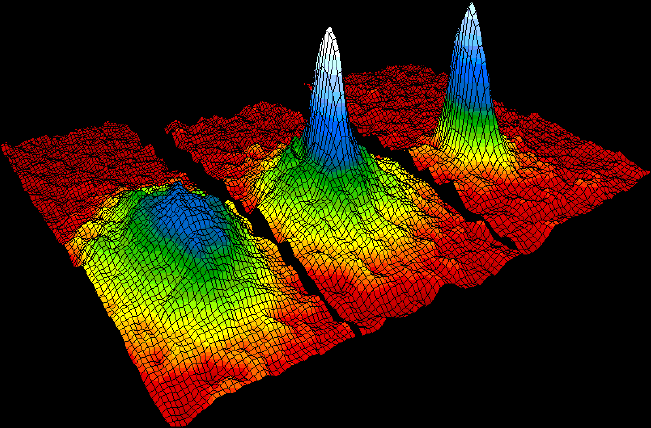
Illustrative image: velocity-distribution data showing a gas of rubidium atoms condensing into a Bose-Einstein condensate — the same class of quantum coherence at the heart of the polariton story. Image: Wikimedia Commons / NIST/JILA/CU-Boulder, public domain (PD US NIST).
📌 KEY HIGHLIGHTS
- Published 24 October 2026: Sanjib Ghosh's paper "Dynamical superfluid and Bose-insulator phases in quantized microcavity lattices" appeared in Communications Physics (Nature Portfolio), after peer review.
- The system: exciton-polaritons — hybrid particles that are part light, part matter — trapped in a lattice of semiconductor microcavities.
- The switch: at weak nonlinearity the fluid flows as a coherent superfluid; past a threshold (interaction-to-tunnelling ratio g/K around 1) phase coherence collapses into a dynamical Bose-insulating phase.
- The surprise: the transition vanishes entirely if each lattice site has only one quantum level — the extra internal levels are what make it possible.
- Honest status: this is a theoretical result (mean-field modelling plus a driven-dissipative model), not yet an experiment — but the author argues near-term microcavity experiments can test it.
What happened?
On 24 October 2026, Communications Physics published a single-author paper by Sanjib Ghosh of The Chinese University of Hong Kong, Shenzhen, and the Beijing Academy of Quantum Information Sciences. The paper asks a deceptively simple question: what happens to a quantum fluid when the particles inside it can occupy not just one energy level at each lattice site, but several?
The fluid in question is made of exciton-polaritons. An exciton is a bound electron-hole pair in a semiconductor; trap light (a photon) together with an exciton inside a tiny mirrored cavity — a microcavity — and the two merge into a new quasiparticle that is half light, half matter. Polaritons are bosons, so they can pile into the same quantum state and form a Bose-Einstein condensate: a cloud of particles moving as one. In that state they can flow without friction — a superfluid.
Ghosh's lattice is a row of microcavity wells, each holding several quantized energy levels, like rungs of a ladder. Polaritons can tunnel between neighbouring wells, and they also interact with each other inside a well. The whole story is a tug-of-war between two strengths: the tunnelling rate K, which spreads coherence across the lattice, and the nonlinear interaction strength g, which scrambles it.
Microcavity polariton superfluid Bose insulator explained: the mechanism
At weak nonlinearity (g/K below about 1), the polaritons sit almost entirely in the lowest energy level of each well. The condensate fraction — the share of particles marching in lockstep — stays near 1, and the fluid is a robust superfluid with a single global phase, the hallmark of broken U(1) symmetry. The higher levels are not idle: they quietly stabilise the superfluid, smoothing out fluctuations.
Turn the interactions up, and the picture flips. Strong nonlinearity pushes polaritons into the excited levels, and the levels start mixing. That mixing acts like random noise injected directly into the phase of the fluid at each site. The relative phase between sites begins to wander like a drunkard's walk — Brownian phase diffusion — until it is completely randomised, spread evenly across the full range from −π to π. Global coherence is gone, even though each site can still host its own little local condensate. That is the dynamical Bose insulator: locally condensed, globally incoherent — much like the pseudogap phases seen in superconductors, where pairs survive but superconductivity does not.
The numbers tell the story cleanly. In the model, the condensate fraction drops sharply at g/K around 1. At strong coupling (g/K = 4.5 in the paper's example) it decays over time, and the leftover fraction shrinks as 1/L with system size L — the signature that, in a large system, the insulating state wins completely. And the control experiment is decisive: give each site only one level (Q = 1) and the phase diffusion constant is exactly zero at every interaction strength. No levels, no transition.

Illustrative image: a laser experiment on an optical table in a photonics laboratory — the kind of setup used to study light-matter particles like polaritons. Image: Wikimedia Commons / Physics Department, Ateneo de Manila University, CC BY 2.0.
Weak vs strong: the two phases at a glance
| Property | Weak nonlinearity (g/K < 1) | Strong nonlinearity (g/K >> 1) |
|---|---|---|
| Where polaritons sit | Almost all in the lowest level | Spread across many excited levels |
| Condensate fraction | Near 1 — macroscopic coherence | Decays; scales as ~1/L (insulating in large systems) |
| Phase behaviour | Fluctuations confined to about ±0.001 | Brownian diffusion; phase fully randomised to ±π |
| Symmetry | U(1) symmetry broken (superfluid) | U(1) symmetry restored (insulator) |
| Single-level sites (Q = 1) | Superfluid | Still no phase diffusion — transition absent |
Why it matters for readers following quantum tech
First, it reframes what counts as a "knob" for quantum phases. Traditionally, flipping a superfluid into an insulator means changing temperature, lattice depth or particle density — external dials. Here the dial is internal: the ladder of energy levels inside each site, something engineers can design into a microcavity lattice. The paper also checks the idea survives realistic driven-dissipative conditions (continuous pumping balancing loss), with pump strengths of 0.3 meV (weak regime) versus 2.3 meV (strong regime) producing the same two behaviours.
Second, it matters for quantum simulation. Polariton lattices are already used as analogue simulators — light-based chips that mimic hard quantum problems. A controllable superfluid-to-insulator switch is a new primitive for such simulators, and the same phase-coherence physics underpins quantum error correction: the field's central challenge, as shown by NVIDIA's 104-qubit JUPITER quantum simulation and Iceberg Quantum's Pinnacle 1.2 decoder. Understanding exactly how coherence dies is as valuable as knowing how to protect it.
Third, the author makes a testable claim. Deep microcavity lattices with several quantized levels per site, and condensates occupying multiple internal modes, have both already been demonstrated in recent experiments, with level spacings well above the polariton linewidth. That is why Ghosh argues the effect "can realistically be realized in near-term microcavity lattice systems" — the next paper to watch for is an experimental one.
Should you care?
FAQs
What is an exciton-polariton?
An exciton-polariton is a quasiparticle that is half light, half matter: it forms when a photon trapped in a semiconductor microcavity couples strongly to an exciton (a bound electron-hole pair). Because polaritons are bosons, they can condense into a single quantum state and flow as a superfluid — and because they are part light, they are extremely light and fast.
What is a Bose insulator?
A Bose insulator is a state of bosons in which global phase coherence is lost, so the system cannot flow as a superfluid — even though bosons may still be locally condensed at individual sites. It is the insulating counterpart of a superfluid, related to the Mott insulator seen in ultracold-atom experiments, where atoms stop moving freely between lattice wells.
What exactly flips the polariton fluid from superfluid to insulator in this paper?
The interaction strength. When the nonlinear interaction g grows past the tunnelling strength K (around g/K = 1), polaritons spill into excited energy levels inside each lattice site. Mixing between those levels injects random phase noise, the phase diffuses until fully randomised, and long-range coherence collapses — a dynamical Bose-insulating phase.
Has this superfluid-to-Bose-insulator transition been observed in an experiment?
Not yet. This is a theoretical prediction, published after peer review in Communications Physics. The author argues it should be testable soon, because microcavity lattices with multiple quantized levels per site and multi-mode condensates have already been demonstrated experimentally.
Takeaway: A quantum fluid's flow can be switched off from the inside — not by cooling or trapping, but by letting its particles climb an internal ladder of energy levels until their shared rhythm dissolves into noise. Watch for the experiment that tries it for real.
Follow World Tech on TechByCountry for tomorrow's research update.
📸 Get tech in the last 24 hours on Instagram — follow @_techinlast24hrs for daily posts (9 AM–9 PM) and reels at 12:30 PM & 8:30 PM.
Sources
Ghosh, S. — "Dynamical superfluid and Bose-insulator phases in quantized microcavity lattices", Communications Physics (published 24 October 2026)
Same paper, arXiv preprint (full text, methods and figures)
Wisevoter — "Researchers Demonstrate Superfluid Phases in Polariton Lattices" (24 October 2026, coverage note)
Comments
Post a Comment