Re:Build 2.1 Billion Funding Explained: General Catalyst and JPMorganChase Bet Big on US Manufacturing

Illustrative image: a vehicle assembly line — Re:Build manufactures hard-tech products across sectors including vehicles, but this is not a Re:Build facility photograph. Image: Wikimedia Commons / Bahnfrend, CC BY-SA 3.0.
TL;DR: Re:Build 2.1 billion funding explained in one line: the US manufacturing company raised $2.1 billion on 27 October 2026, led by General Catalyst and JPMorganChase's Strategic Investment Group, to expand its capacity to build hard-tech products and launch new industrial startups — the largest US startup funding round of the week, and a major bet on making things in America again.
📌 KEY HIGHLIGHTS
- The round: $2.1 billion in new financing, announced 27 October 2026, led by General Catalyst and JPMorganChase's Strategic Investment Group. Other investors and the valuation were not disclosed.
- The company: Re:Build, founded in 2020 in Framingham, Massachusetts, partners with industrial firms to design, engineer and manufacture products at scale — and incubates industrial startups of its own.
- The scale: its network employs more than 2,100 people in the US and operates over 2.4 million square feet of manufacturing capacity; it says it has launched hundreds of products and production systems.
- The famous spinout: Re:Build incubated EV startup Slate Auto, which has since raised about $1.4 billion for a stripped-down, customisable pickup truck.
- The catch: no valuation, no investor-by-investor breakdown and no detailed spending schedule were disclosed — and reshoring momentum alone does not guarantee execution.
Re:Build 2.1 billion funding explained: what happened?
Re:Build Manufacturing, a Massachusetts-based company that describes itself as "America's answer to Shenzhen", announced on Tuesday 27 October 2026 that it had raised $2.1 billion in new financing. The round was led by General Catalyst and JPMorganChase's Strategic Investment Group. The company said it will use the money to "expand Re:Build's capacity to manufacture hard tech products and launch new industrial startups", so that "the most innovative products can be made in America for generations to come".
Crunchbase's roundup of US funding for the week of 24–30 October 2026 puts Re:Build at the top of the list — ahead of Kalshi's $1 billion Series G, Bedrock Robotics' $600 million Series C and the rest of the week's big rounds. It is one of the largest late-stage deals ever for a US engineering and manufacturing company, according to Dealroom.
Re:Build was founded in 2020 by Jeff Wilke, Amazon's former consumer chief executive, along with Miles Arnone and William Barker. Wilke framed the mission in blunt terms: "We started Re:Build because the deindustrialization of America is an economic failure and national security risk." General Catalyst chief executive Hemant Taneja echoed that view, saying rebuilding American industrial capacity is "one of the most important economic and national security imperatives of our time". General Catalyst first invested in Re:Build in 2024, including a recent $120 million commitment.
How Re:Build works: two models, one factory network
Re:Build operates in two related ways. First, it partners with established industrial companies and product developers to design, engineer and manufacture products at scale, staying involved from the earliest design stage. Its pitch is a process it calls Manufacturing Constrained Design: production requirements are built into the design phase, rather than discovered as expensive problems after the product is finished.
Second, it incubates startups in what it calls critical, underserved markets — giving founding teams capital, engineering support and access to its production network instead of leaving them to build factories from scratch. Its startup portfolio includes Slate, Neon Aero and Ensorcell. The company says the new capital will support manufacturing and new ventures across aerospace and defense, electrification, medical products, energy and environmental technology, and robotics and automation — and that it aims to create tens of thousands of US jobs over the next decade.
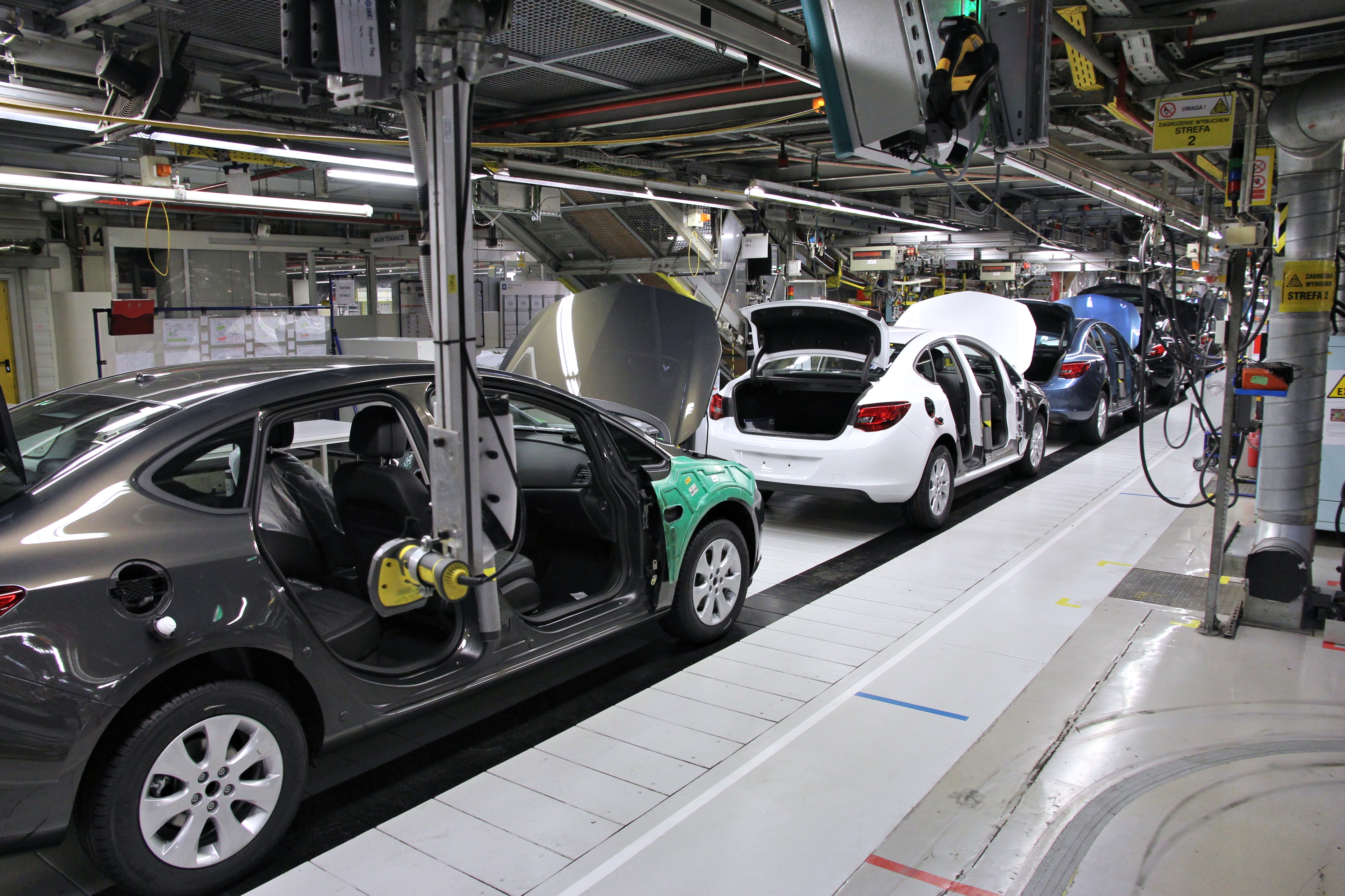
Illustrative image: a modern car factory assembly line in Gliwice, Poland — scaled production is the bottleneck Re:Build's model is built to solve. Image: Wikimedia Commons / Marek Ślusarczyk, CC BY 3.0.
| Target sector | What Re:Build plans there |
|---|---|
| Aerospace and defense | Hard-tech products and production systems, including unmanned aircraft systems |
| Electrification and energy | Battery systems and energy products, building on its EV supply-chain work |
| Medical products | Manufacturing capacity for medical equipment and devices |
| Robotics and automation | Production automation and robotics hardware at scale |
The Slate Auto connection
The clearest proof point for Re:Build's model is Slate Auto. Wilke and Arnone came up with the electric-truck concept in 2022 and spun it out as an independent company in 2023 so it could attract outside capital. Re:Build says it supported Slate's electrical architecture, battery systems, supplier work, production automation and advanced composite components. Slate has since raised at least $1.4 billion, including funding from Bezos' family office, for an ultra-low-cost, bare-bones pickup that buyers can customise.
Read the company's production claims carefully, though: Re:Build's case study describes a production concept exceeding 100,000 vehicles a year with an approximately two-minute takt time. That is a design target from the project, not evidence that Slate has reached those production levels — and Slate's $1.4 billion is separate money, raised by Slate, not part of this $2.1 billion round.
Why it matters for USA Tech readers — and what it means for India
The round lands as capital floods into rebuilding US manufacturing and supply chains, partly as a hedge away from China. JPMorganChase linked its investment to strengthening critical supply chains, with Todd Combs, head of its Strategic Investment Group, saying Re:Build's platform could help address complex industrial production challenges. The same week's funding table shows how concentrated that bet has become:
| Company | Round (week of 24–30 Oct 2026) | Sector |
|---|---|---|
| Re:Build | $2.1 billion | Manufacturing |
| Kalshi | $1 billion Series G, $40 billion valuation | Prediction markets |
| Bedrock Robotics | $600 million Series C, $4.1 billion valuation | Construction automation |
| Serval | $150 million Series C, $3 billion valuation | Enterprise AI coding agents |
| Foundry Robotics | $100 million Series A | Autonomous factories |
For India readers, be precise: Re:Build has announced no India operations, no India hiring and no India pricing — this is a US industrial story. The relevance is as a signal: India's own manufacturing push, from production-linked incentives to its industrial startup ecosystem, is chasing the same prize — turning design and engineering talent into scaled production at home. Read it alongside our Kalshi $1 billion Series G explainer, our Serval $150 million Series C explainer and our Upwind $400 million Series C explainer for the rest of the week's biggest rounds.
Should you care?
✅ Verdict: Yes, as a signal — $2.1 billion is the week's biggest vote that American manufacturing can be rebuilt company by company, not just subsidised. But judge it on factories and products shipped, not on the cheque size: no valuation was disclosed, no spending schedule was published, and policy uncertainty plus skilled-worker shortages remain real constraints on the reshoring story.
FAQs
What is Re:Build Manufacturing?
Re:Build is a US manufacturing company founded in 2020 that partners with industrial firms to design, engineer and manufacture hard-tech products at scale, and incubates industrial startups by giving them capital, engineering support and access to its factory network. It employs more than 2,100 people and operates over 2.4 million square feet of manufacturing capacity in the US.
Who led Re:Build's $2.1 billion funding round?
General Catalyst and JPMorganChase's Strategic Investment Group led the financing, announced on 27 October 2026. Other investors were not disclosed, and neither was the company's valuation.
What will Re:Build do with the $2.1 billion?
The company says the capital will expand its capacity to manufacture hard-tech products and launch new industrial startups across aerospace and defense, electrification, medical products, energy and environmental technology, and robotics and automation — with a goal of creating tens of thousands of US jobs over the next decade.
What is Re:Build's connection to Slate Auto?
Re:Build incubated Slate Auto as an internal EV venture, conceived in 2022 and spun out in 2023, and supported its electrical architecture, battery systems, supplier work and production automation. Slate has since raised about $1.4 billion independently for a low-cost customisable pickup; that money is separate from Re:Build's $2.1 billion round.
Takeaway: The week's biggest funding round is not an app or an AI model — it is a factory network. Whether Re:Build becomes "America's answer to Shenzhen" will be decided by what rolls off its production lines, not by the size of this cheque.
Follow USA Tech on TechByCountry for tomorrow's update.
📸 Get tech in the last 24 hours on Instagram — follow @_techinlast24hrs for daily posts (9 AM–9 PM) and reels at 12:30 PM & 8:30 PM.
Comments
Post a Comment