SoftBank Quantum Materials Platform Japan Explained: Six Companies Join Forces to Speed Up New Materials Discovery

Illustrative image: a superconducting quantum computer. Image: Wikimedia Commons / OJB Quantum, CC BY 4.0. This is NOT hardware from the new six-company project — the project builds a software and simulation platform, not a single machine — but it shows the quantum technology family the work belongs to.
TL;DR: SoftBank quantum materials platform Japan explained in one line: six Japanese companies — TOPPAN, AISIN, Asahi Kasei, SoftBank, AGC and DIC — have won backing from Japan's NEDO agency to build a materials-development platform that combines quantum computing with AI, aiming to discover better batteries, displays and superconductors faster than today's slow, expensive trial-and-error methods.
📌 KEY HIGHLIGHTS
- Announced 28 October 2026: six companies jointly announced a NEDO-selected project, "Research and Development of Innovative Materials Development Platforms Using Quantum Technology."
- The goal: a next-generation platform that mixes quantum-computing calculations with AI such as machine learning, moving materials research from demonstration to real industrial use.
- Timeline: fiscal 2026 (ending March 2027) through fiscal 2028, under NEDO's post-5G infrastructure programme.
- Target materials: next-generation batteries, optical materials for displays and sensors, and superconducting materials for future devices.
- The honest limit: this is a research platform, not a product — no new material, price or launch date has been announced yet.
SoftBank quantum materials platform Japan explained: what happened?
On 28 October 2026, six Japanese companies announced that their joint proposal has been selected by the New Energy and Industrial Technology Development Organization (NEDO), Japan's national energy and industrial technology agency. The companies are TOPPAN Holdings, AISIN Corporation, Asahi Kasei Corporation, SoftBank Corp., AGC Inc. and DIC Corporation, and they have signed a joint agreement to build the platform together.
The project was chosen under NEDO's solicitation for the "Research and Development Project of the Enhanced Infrastructures for Post-5G Information and Communication Systems" — the same broad programme family behind Japan's push to link quantum computers with supercomputers and AI infrastructure. The work runs from fiscal 2026, the year ending March 2027, through fiscal 2028.
What the six companies are actually building is a way of working, not a gadget. The platform will combine quantum-computing calculations with AI tools, test the resulting predictions by synthesising real materials in the lab, and feed the experimental results back in to improve the predictions. The stated end goal is a "continuously evolving" platform that gets better as more data flows through it — and that works across industries, not just for one company's products.
Why materials discovery is so slow — and why quantum plus AI might fix it
Finding a new material today is slow for two opposite reasons, and the SoftBank announcement names both. Data-driven AI methods can predict promising materials from historical data, but they need large amounts of high-quality, high-precision training data that often does not exist. Physics-based simulation, meanwhile, can compute a material's properties from first principles — but the more accurate and larger the calculation, the more the computing cost explodes.
Quantum computers offer a way through because molecules and electrons obey quantum mechanics: in principle, a quantum machine can simulate their behaviour more naturally than a classical one. The catch, which the announcement states plainly, is that today's machines are limited in qubit count and error rates, so large-scale calculations on quantum hardware alone are "still not a reality."
The project's answer is hybrid: use quantum calculations where they help, use AI to fill the gaps and correct for the hardware's limits, and keep real lab experiments in the loop to check the predictions. Rather than targeting one specific material, the methods will be applied across many industrially important materials systems, with each company verifying the approach in its own area of strength and with specialist quantum institutions involved.
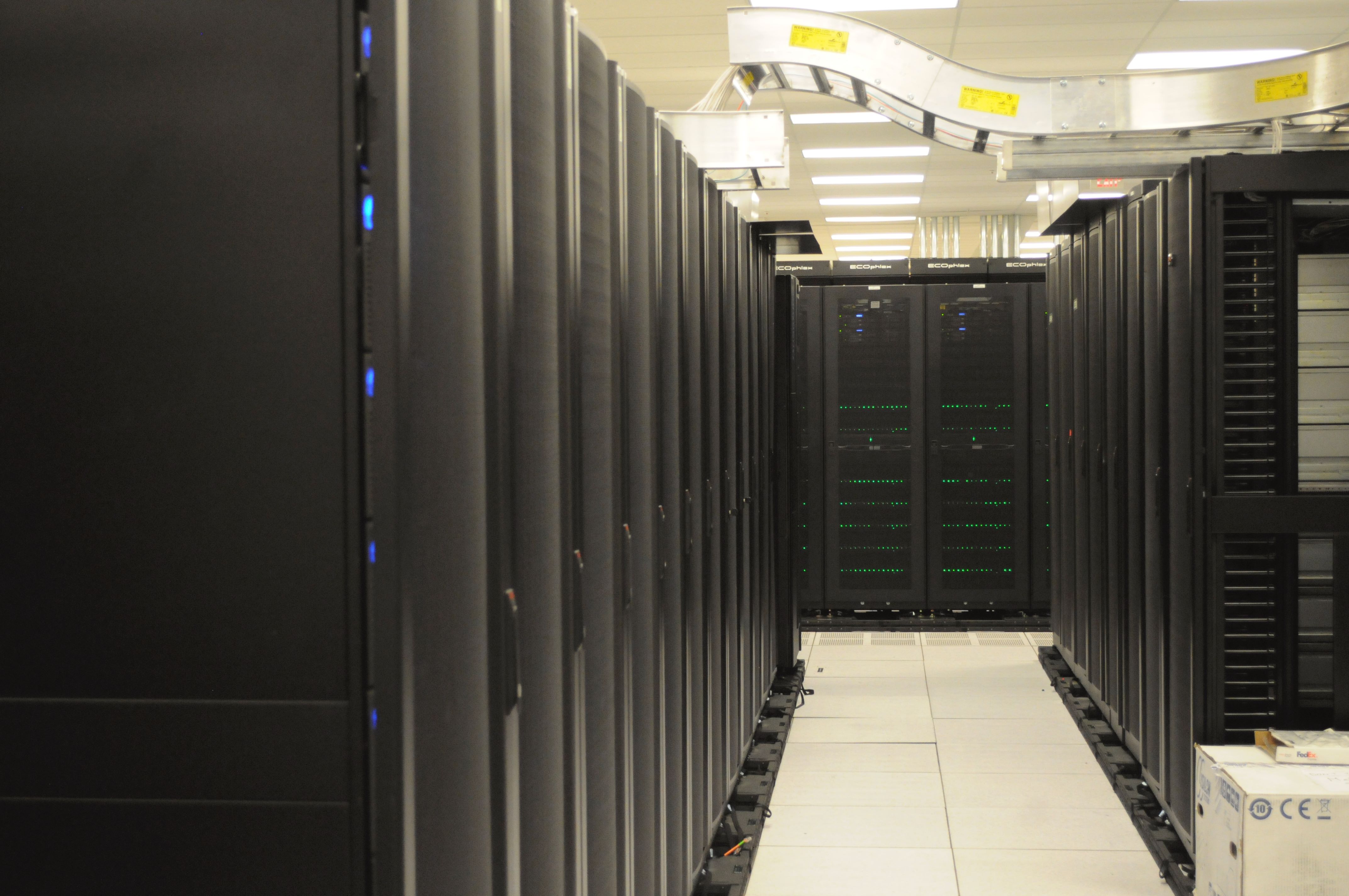
Illustrative image: server racks in a data centre — the kind of computing infrastructure that quantum-AI hybrid platforms run on. Image: Wikimedia Commons.
Who does what: the six companies
Each partner takes a different slice of the materials world, which is the point: the platform is meant to prove itself across sectors, not in one lab.
| Company | Role in the project |
|---|---|
| TOPPAN Holdings | Hybrid quantum-classical methods for additive materials; combined quantum-AI methods; experiment feedback |
| AISIN | Quantum-computing verification for superconducting materials; comparison with conventional methods; practical-implementation timelines |
| Asahi Kasei | Applicability studies for organic compounds such as electrolytes, polymers and inorganic materials such as electrodes, with experimental feedback |
| SoftBank Corp. | A computing platform connecting quantum computers with supercomputers to generate high-quality materials data, plus AI data-utilisation technology; demonstrations including next-generation batteries |
| AGC | Quantum + computational-science + AI methods for inorganic materials such as optical glass and organic electronic materials; design guidelines |
| DIC | Quantum, simulation and data-science integration to predict key properties before synthesis, for colorants and semiconductor materials |
The project has three formal workstreams: verifying where quantum computing applies across high-demand materials; developing the quantum-AI utilisation technologies themselves; and the simulation-to-experiment loop — synthesising materials from simulation results, measuring them, and comparing experiment against prediction to improve accuracy and prove practical benefit.
Why it matters for India readers
No India-specific announcement comes with this project, and this post claims none. The relevance is in what the platform is trying to speed up: the batteries in phones and electric vehicles, the display and sensor materials in consumer electronics, and the semiconductor materials in chips — all of which India imports, assembles or is trying to manufacture more of under its semiconductor and electronics ambitions.
There is also a timing lesson. Japan is funding this as infrastructure — a shared, cross-industry platform under a government agency, not six separate corporate labs. India's National Quantum Mission and its materials-research institutes are watching exactly this model: whether quantum-AI hybrid tools can shorten the years-long path from a promising compound to a manufacturable material. If the Japanese platform works, its methods will spread through papers, partnerships and vendor tools; if it stalls, it will still show where the real bottlenecks are — data quality, hardware limits, or the experiment loop.
For context on the week's quantum race, see our coverage of IBM's quantum L-coupler advance toward fault-tolerant computing, Quantinuum's Helios error-correction record, and the TetraMem MLX300 tapeout and the efficient-AI-hardware race.
Should you care? ✅ Worth watching — not a product yet
Verdict: ✅ This project matters because it is quantum computing's most honest pitch yet: not a machine that beats classical computers tomorrow, but a practical, government-backed attempt to make today's imperfect quantum hardware useful for real industrial problems. ⏳ But judge it on results, not announcements — no new material has been discovered, no timeline for commercial use has been given, and the real test is whether the simulation-to-experiment loop beats conventional methods on cost and accuracy by 2028. Watch for the first verified material results, not the next press release.
FAQs
What is the SoftBank quantum materials platform? It is a joint R&D project by TOPPAN, AISIN, Asahi Kasei, SoftBank, AGC and DIC, selected by Japan's NEDO agency, to build a materials-development platform combining quantum-computing calculations with AI, running from fiscal 2026 through fiscal 2028.
What materials will it work on? Next-generation battery materials, optical functional materials for new displays and sensors, and superconducting materials for next-generation devices — plus each company's own domains, from electrodes and electrolytes to optical glass, colorants and semiconductor materials.
Why combine quantum computing with AI instead of using one alone? Because each has a weakness the other offsets: AI needs high-quality training data that is often scarce, physics simulations get too expensive at high accuracy and scale, and today's quantum computers are too small and error-prone for large calculations alone. The hybrid approach uses each where it is strongest.
When will it produce results? The project runs through fiscal 2028, and its deliverable is a working platform and verified methods, not a consumer product. The first signs of success would be published verification results showing the quantum-AI loop outperforming conventional materials development on a real material.
Takeaway: Six Japanese giants, one government-backed bet: that quantum computing plus AI can cut years off discovering the materials inside tomorrow's batteries, screens and chips. The science is real, the timeline is three years, and the proof will be in the lab results.
Follow World Tech on TechByCountry for tomorrow's update.
📸 Get tech in the last 24 hours on Instagram — follow @_techinlast24hrs for daily posts (9 AM–9 PM) and reels at 12:30 PM & 8:30 PM.
Comments
Post a Comment