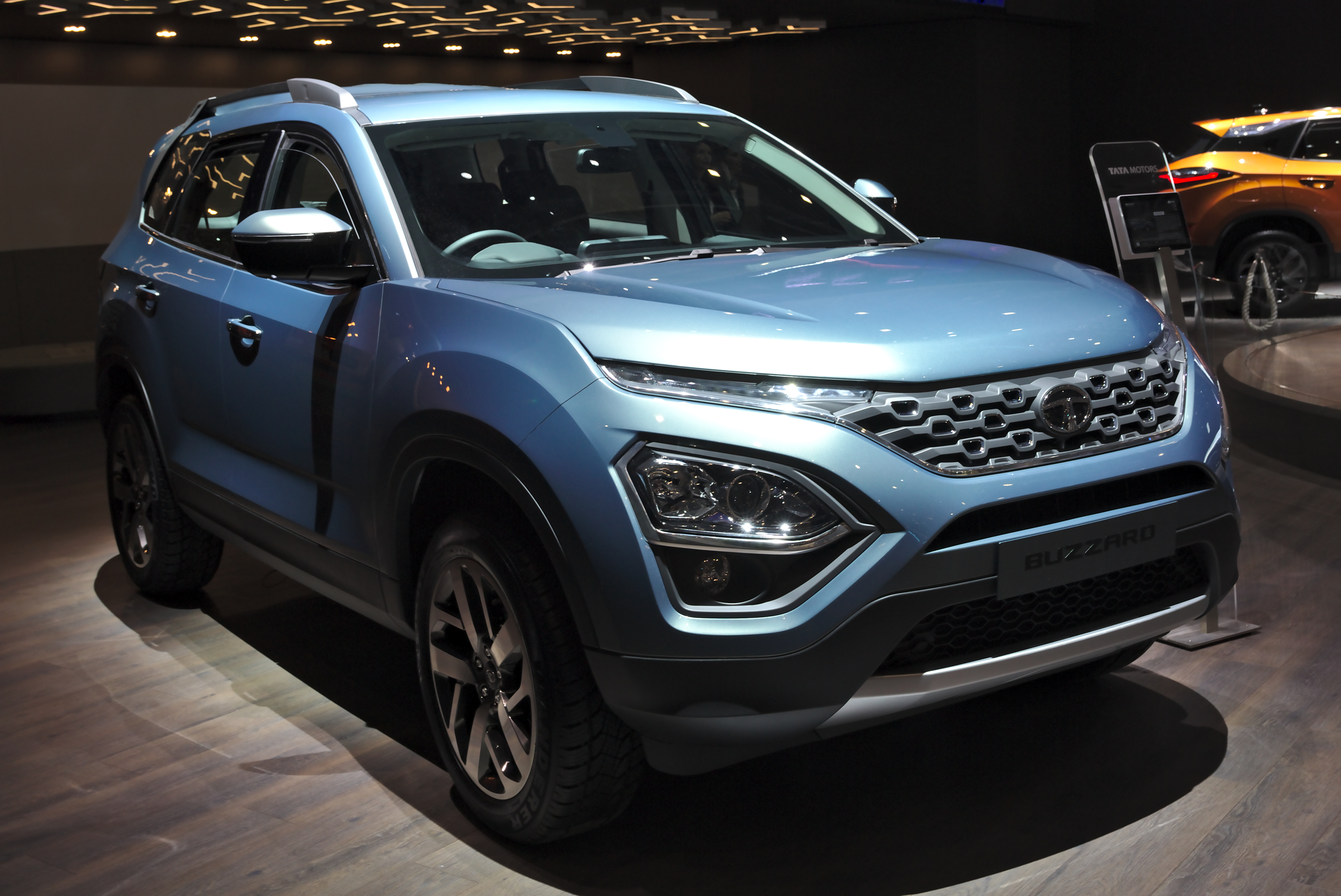
Illustrative image: the Tata Buzzard concept at Geneva 2019 — the seven-seat SUV that became the current Tata Safari. This is NOT a Safari EV photo: Tata has not officially revealed the electric Safari yet. Image: Wikimedia Commons
TL;DR — The Tata Safari EV launch January 2027 India price story in one line: reports on 29 October 2026 say Tata Motors will launch its first three-row electric SUV in January 2027, on the Acti.ev+ platform shared with the Harrier EV, in six- and seven-seat form, at an expected ₹20–32 lakh — but Tata itself has confirmed none of these details yet, so treat every figure below as reported, not official.
📌 KEY HIGHLIGHTS
- Reported launch: January 2027 in India — a shift from earlier 2026 coverage that expected a Diwali 2026 debut.
- What it is: Tata's first three-row EV, built on the Acti.ev+ platform, offered in 6-seat and 7-seat layouts.
- Reported batteries: 65 kWh and 75 kWh packs, with reports suggesting a larger 80 kWh option for top trims.
- Expected price: around ₹20 lakh at entry, rising to roughly ₹30–32 lakh for top variants (all reported, ex-showroom).
- Main rivals: the Mahindra XEV 9S (from ₹19.95 lakh) and the MG Hector Tomahawk EV (₹19.49 lakh) — both already on sale.
Tata Safari EV launch January 2027 India price: what happened?
Multiple auto outlets reported on 29 October 2026 that the Tata Safari EV is now expected to launch in January 2027. The significance is the timing as much as the car: through much of 2026, coverage had pointed to a festive-season 2026 debut for Tata's flagship electric SUV. The new reports move that window into early 2027 — and they agree on the shape of the product even though Tata has not announced anything itself.
The Safari EV matters because it fills the most obvious gap in India's EV market: a proper family-sized, three-row electric SUV from the country's biggest EV seller. Tata already leads India's electric passenger-car segment with roughly a 40% share, but its current EV range tops out at the five-seat Harrier EV. The Safari EV would be its first electric car with a third row — aimed squarely at buyers who need seven seats and do not want to pay luxury prices for them.
Reported specs: platform, batteries and range
Reports agree the Safari EV will use Tata's Acti.ev+ platform, the same base as the Harrier EV. That matters for two reasons: it supports both rear-wheel drive and dual-motor all-wheel drive, and it leaves a flat floor that makes a genuine third row possible — the reason the Safari EV can offer six- and seven-seat layouts where a converted petrol car would struggle.
| Detail | What reports say (not Tata-confirmed) |
|---|---|
| Launch window | January 2027 (reported 29 Oct 2026; earlier coverage expected Diwali 2026) |
| Platform | Acti.ev+ |
| Seating | 6-seater and 7-seater versions |
| Battery options | 65 kWh and 75 kWh; some reports suggest an 80 kWh top-trim option |
| Claimed range | Up to 627 km (75 kWh, RWD, on Harrier EV figures); reports estimate 500–550 km overall |
| Realistic range | Around 450–500 km, per reports — claimed figures are laboratory-cycle numbers |
| Drivetrain | RWD expected on most variants; dual-motor AWD expected on top trims |
| Expected price | Around ₹20 lakh entry; ₹30–32 lakh top end (reported, ex-showroom) |
The range numbers need a careful read. The 627 km figure is the Harrier EV's claimed range on its 75 kWh pack — reports cite it as the benchmark the Safari EV should match, not as a Safari EV test result. The Safari EV is a bigger, heavier three-row car, so its real-world range on the same battery would likely be lower; the 450–500 km realistic estimate in the reports is the more honest planning number. Likewise, the 80 kWh pack is described in reports as a possibility for top trims, not a confirmed option — if it arrives, it would give the Safari EV the largest battery of any Tata EV and a headline edge over the XEV 9S's 79 kWh top pack.

Illustrative image: an EV charging station's instruction panel — public fast charging will decide how usable a big-battery family EV really is on highway trips. Image: Wikimedia Commons / Pamsimhaho, CC0
Design and features: familiar Safari, EV-specific touches
Reports say the Safari EV will look largely like the diesel Safari buyers already know, with the usual EV conversions: a closed-off grille, aero-optimised alloy wheels, refreshed lighting and EV-specific badging. Inside, the expected headline is a triple-screen dashboard layout — digital instruments, a central touchscreen and a passenger entertainment screen — similar to what Tata offers on the Sierra EV.
The rest of the expected equipment list reads like the Harrier EV's: ventilated front seats, a panoramic sunroof, dual-zone climate control, a powered tailgate, a 540° surround-view camera, a Level 2 ADAS suite, wireless phone charging and connected-car tech with multiple drive modes. Reports also point to Tata's TiDAL electronics architecture, which enables over-the-air updates and features such as auto park assist. None of this is confirmed — but none of it is a stretch either, since it mostly carries over hardware Tata already ships.
Why it matters for India readers
India's seven-seat EV choice is still thin, and that is exactly why the Safari EV's timing matters. Right now, a family that wants three rows and an electric motor has essentially two mainstream options: the Mahindra XEV 9S, which starts at ₹19.95 lakh and offers 59, 70 and 79 kWh batteries with up to 679 km claimed range, and the MG Hector Tomahawk EV, which starts at ₹19.49 lakh with a single 69.2 kWh battery and 517 km claimed range — and which crossed 10,000 bookings in under two months. Both are already selling; the Safari EV arrives into a fight that is no longer empty.
Tata's advantage is brand trust and service reach, plus the Safari name itself — a badge Indian families have known since 1998. Its risk is price: if the Safari EV starts much above ₹20 lakh, the Hector Tomahawk EV undercuts it, and the XEV 9S already offers more battery choice. If Tata holds the reported ₹20 lakh entry point, the Safari EV becomes the most accessible proper seven-seat EV from India's biggest EV brand — and a genuine reason for diesel-Safari owners to switch. For context on how Tata is already electrifying at scale, see our Tata–Amazon 3,000 electric trucks explainer, and for the wider EV freight shift, our AMPSTAR electric trucks explainer. For another big EV launch from this cycle, read our 2026 Li Auto Li i6 launch explainer.
Should you care? ✅ / ⏳
Verdict: ⏳ Wait if you can — the Safari EV is not on sale, nothing is confirmed, and January 2027 is still a reported window that could move again. ✅ But if you need a seven-seat EV now, do not wait on a rumour: the XEV 9S and Hector Tomahawk EV are real, priced and selling today, and a test drive of both will tell you more than any spec sheet. Revisit the Safari EV when Tata confirms the date and price.
FAQs
When will the Tata Safari EV launch in India? Reports on 29 October 2026 say the Tata Safari EV is expected to launch in January 2027. Tata Motors has not confirmed a launch date, and earlier coverage had expected a Diwali 2026 debut, so the window should be treated as reported, not official.
What is the expected price of the Tata Safari EV in India? Reports put the expected price at around ₹20 lakh for the entry variant, rising to roughly ₹30–32 lakh for top trims, ex-showroom. These are pre-launch estimates; Tata will confirm real prices closer to launch.
What battery and range will the Tata Safari EV offer? Reports suggest 65 kWh and 75 kWh battery packs, with a possible 80 kWh option for top trims. Claimed range is estimated at 500–627 km depending on the pack, while reports put realistic range at around 450–500 km. No figure is Tata-confirmed yet.
Is the Tata Safari EV a 7-seater? Yes, according to reports — the Safari EV is expected to be Tata's first three-row EV, offered in both six-seat and seven-seat configurations, built on the Acti.ev+ platform shared with the Harrier EV.
Should I wait for the Safari EV or buy the Mahindra XEV 9S or MG Hector Tomahawk EV now? If you need a car now, buy from what exists: the XEV 9S (from ₹19.95 lakh, up to 679 km claimed) and Hector Tomahawk EV (₹19.49 lakh, 517 km claimed) are on sale today. Wait for the Safari EV only if you specifically want a Tata seven-seater and can wait until at least January 2027 — and until Tata confirms its price.
TAKEAWAY: The Safari EV is Tata's most important EV launch since the Harrier EV — but today it is still a well-sourced report, not a product. January 2027, ₹20–32 lakh, 65–80 kWh: useful planning numbers, all awaiting Tata's confirmation.
Follow India Tech on TechByCountry for tomorrow's update.
📸 Get tech in the last 24 hours on Instagram — follow @_techinlast24hrs for daily posts (9 AM–9 PM) and reels at 12:30 PM & 8:30 PM.
Sources
- RushLane — Tata Safari EV Launch Expected In Jan 2027, Details (29 Oct 2026)
- CarLelo — Next-Gen Tata Nexon and Safari EV Launch Expected in Early 2027 (29 Oct 2026)
- NewsBytes — Tata Motors readies Safari EV for January 2027 India launch (29 Oct 2026)
- Udaipur Kiran — Tata Safari EV Expected to Launch in January with Powerful Battery Options (29 Oct 2026)
- Cartoq — MG Hector Tomahawk EV Crosses 10,000 Bookings (rival prices and specs cross-check)
Comments
Post a Comment