Ultrafast Quantum Gates 6.8 Nanoseconds Explained: 99.98% Accuracy and the R2D Trick That Stops Qubits Leaking

Illustrative image: Wikimedia Commons / OJB Quantum, CC BY 4.0 — a superconducting quantum computer. This is not the Jülich transmon qubit used in the experiment; it illustrates the superconducting hardware family the record belongs to.
TL;DR — Ultrafast quantum gates 6.8 nanoseconds explained: researchers at Forschungszentrum Jülich ran quantum operations in just 6.8 nanoseconds at over 99.98% accuracy, using a new R2D pulse-shaping method that stops fast microwave pulses from knocking qubits into unwanted higher energy states. The catch: it has only been shown on one isolated qubit so far.
📌 KEY HIGHLIGHTS
- 6.8 nanoseconds per operation: about the time light takes to travel two metres — far faster than the several tens of nanoseconds typical for superconducting qubits.
- Over 99.98% accuracy: the two fundamental operations measured 99.981% and 99.989% accurate, with leakage to higher states below 0.002% per operation.
- The new R2D method: builds on the decade-old DRAG correction and cuts unwanted multiphoton transitions by more than 20 times.
- The hidden problem it solves: very fast pulses can push a qubit not one but two or three energy levels too high — an effect the team says had previously been overlooked.
- Honest limit: tested on a single isolated transmon qubit only; two-qubit gates and larger processors are still untested.
Ultrafast quantum gates 6.8 nanoseconds explained: what happened?
On 27 October 2026, researchers from Jülich, Aachen and Cologne reported a new speed record for quantum gates in Nature Communications. Working at the Peter Grünberg Institute for Functional Quantum Systems (PGI-13) and Quantum Control (PGI-8) at Forschungszentrum Jülich, the team performed elementary computing operations on a single superconducting transmon qubit in just 6.8 nanoseconds each — with measured accuracies of 99.981% and 99.989%. The work was done as part of the large-scale collaborative project QSOLID, on a qubit fabricated at the Helmholtz Nano Facility at Jülich.
Speed matters in quantum computing because qubits are fragile: they hold their quantum states for only a limited time. The faster each operation runs, the more operations fit into that window — and that is what complex algorithms and resource-hungry quantum error correction both need. Until now, the trade-off seemed unavoidable: shorter pulses must be stronger, and stronger pulses cause more errors. This result shows the trade-off can be pushed much further than assumed.
The problem: fast pulses make qubits overshoot
A superconducting qubit is usually described as having two states, 0 and 1. In reality it has more energy levels above them. Drive it gently and it stays between the two floors it is meant to use. Drive it hard and fast, and it can overshoot — the researchers' own analogy is an elevator meant to travel only between the ground floor and the first floor, but pushed so briskly that it flies past.
The Jülich team found something worse: strong, rapid microwave pulses can push the qubit not just one level too high but two or three levels higher, through so-called multiphoton transitions — an effect they say had previously been overlooked. These stray excitations are particularly treacherous because they can persist across several computational steps and corrupt quantum error correction itself, the very machinery meant to catch errors.
The fix is pulse shaping with exceptional precision. The new method, called R2D, builds on DRAG, the correction technique that has been standard practice for more than a decade. Like a frequency filter, R2D suppresses exactly the frequency components that would excite the higher levels, so the pulse still performs the intended operation while barely touching the unwanted transitions. Compared with the previous standard method, it reduces the probability of unwanted multiphoton transitions by a factor of more than 20. To measure leakage this small, the team also developed a new amplified leakage error (ALE) technique that can resolve leakage down to one part in a million.
| Measure | Typical superconducting gates | New Jülich result |
|---|---|---|
| Gate duration | Several tens of nanoseconds | 6.8 nanoseconds |
| Measured accuracy | High, but speed costs accuracy | 99.981% and 99.989% (two operations) |
| Leakage to higher states | Grows with shorter, stronger pulses | Below 0.002% per operation |
| Multiphoton transitions | Previously overlooked effect | Probability cut by more than 20× vs standard method |
| Test device | — | One transmon qubit, 5.323 GHz, anharmonicity −225 MHz |
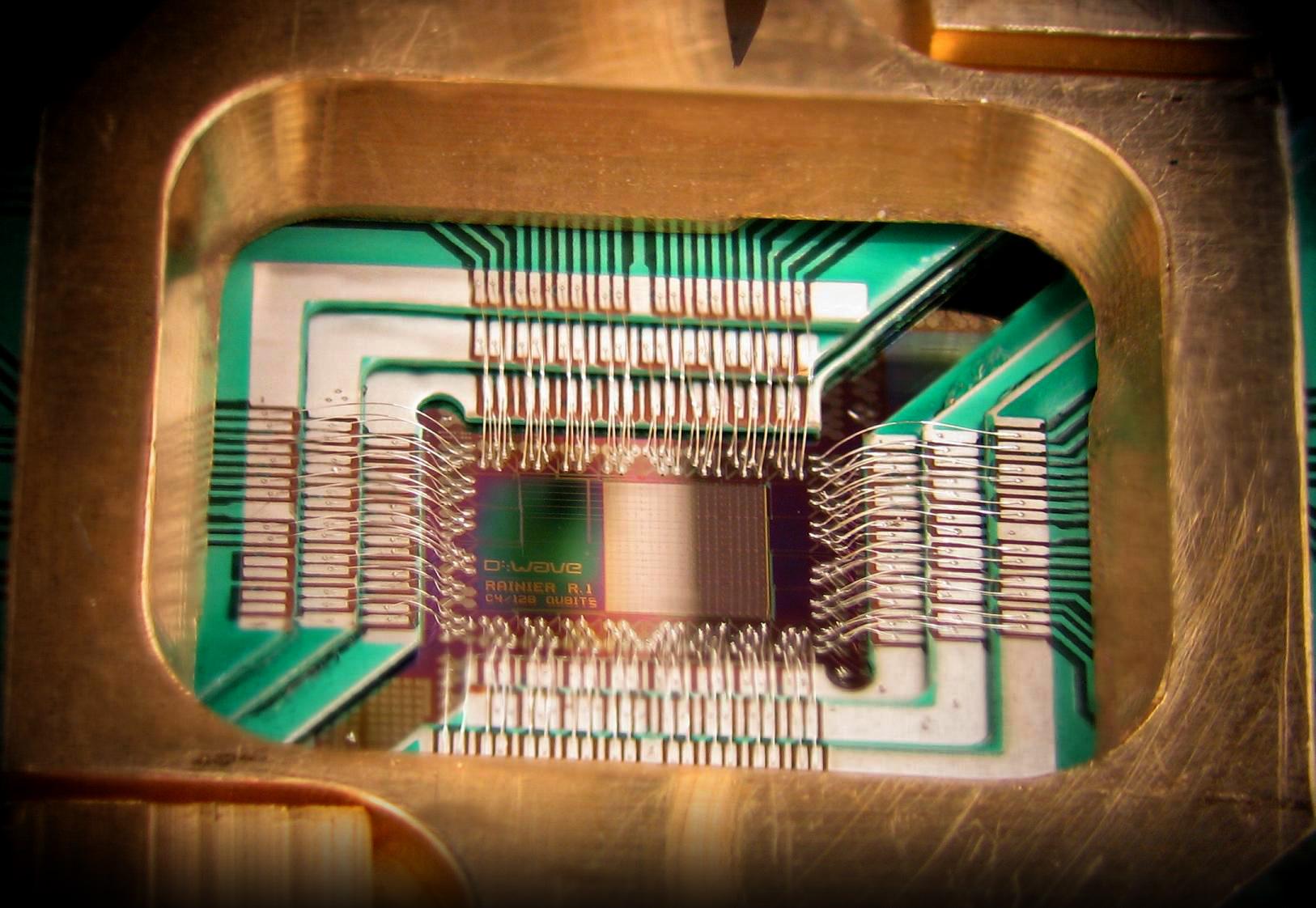
Illustrative image: Wikimedia Commons / D-Wave Systems, CC BY 3.0 — a superconducting quantum chip close-up. This is a D-Wave chip, shown to illustrate transmon-style superconducting hardware; it is not the Jülich device used in the experiment.
Why it matters for World Tech readers
Quantum computing's biggest bottleneck is not raw qubit count — it is error correction. Useful, fault-tolerant machines will need thousands of physical qubits cooperating to protect each logical qubit, and every operation must be both fast and clean enough for that machinery to work. A method that delivers both at once, on the most commercially mature qubit platform, is therefore a genuine step rather than a laboratory curiosity. It also complements the other quantum hardware news this week: the Pasqal 256-qubit quantum magnet result showed a neutral-atom processor revealing physics theory could not predict, while the IBM Quantum L-coupler result attacked the wiring problem between chips. Jülich attacks the speed problem inside a single qubit. Three different bottlenecks, three different answers, one week.
For readers in India, the relevance is direct even though the experiment is German: India's quantum programmes, research labs and the growing quantum-startup scene all build on the same superconducting platform and face the same error-correction wall. Faster, cleaner gates mean more useful computation per qubit lifetime, which is exactly what resource-constrained programmes need. And for students, the R2D idea itself is the lesson — sometimes the breakthrough is not a new device but a smarter way to drive the device you already have, as also shown by the SKKU SAG VAN-Flow AI framework story, where asking for help only when stuck cut compute to a third.
Should you care?
✅ Verdict: A real record with a clearly stated limit — worth knowing, not worth overclaiming. If you follow quantum hardware, R2D is a technique to remember: it removes a hidden error source and proves extreme speed and high accuracy can coexist. But no one should read this as "quantum computers just got 10× faster" — that claim waits on two-qubit gates and full processors.
What it does not prove yet
The researchers are explicit: the method has so far been tested on a single, isolated qubit. Real processors need gates between pairs of qubits and thousands of qubits operating together, where crosstalk and calibration errors multiply. Whether R2D survives that scale-up is the next experiment, not a conclusion of this paper. The 6.8-nanosecond figure is also a single-qubit gate time, not a full algorithm runtime — a useful quantum computer still needs error correction overhead that dwarfs individual gate times. Treat this as a solved sub-problem on the road to fault tolerance, not the arrival itself.
FAQs
What is a quantum gate? A quantum gate is a basic operation on a qubit, the quantum equivalent of a logic gate in a classical computer. Gates rotate or flip a qubit's state; strings of gates form quantum algorithms. Their speed and accuracy set how much computation fits before the qubit's fragile state decays.
Why does quantum gate speed matter? Qubits keep their quantum states for only a limited time. Faster gates mean more operations fit into that window, which matters both for complex algorithms and for error correction, the resource-intensive process that will make quantum computers reliable enough for real work.
What is the R2D method and how is it different from DRAG? R2D is a pulse-shaping method that extends DRAG, the standard qubit-control correction used for more than a decade. While DRAG suppresses leakage to the next energy level, R2D additionally suppresses multiphoton transitions that jump two or three levels — an effect the Jülich team says had been overlooked — cutting their probability by more than 20 times.
How accurate are the new ultrafast quantum gates? The two fundamental operations tested measured 99.981% and 99.989% accurate, with the probability of leaking to a higher energy state below 0.002% per operation. These are single-qubit results on one isolated transmon qubit; two-qubit accuracy has not yet been reported.
When will this reach real quantum computers? Not yet known. The team must show R2D works in larger processors and for two-qubit gates, where errors behave differently. The paper demonstrates the physics and the control method; engineering it into a full processor is the next phase of the QSOLID project and the wider field.
TAKEAWAY: Jülich's 6.8-nanosecond gates prove that quantum operations can be both extremely fast and extremely accurate — once you shape the pulse to stop the qubit overshooting. The record is real, the limit is stated, and the next test is scale.
Follow World Tech on TechByCountry for tomorrow's update.
📸 Get tech in the last 24 hours on Instagram — follow @_techinlast24hrs for daily posts (9 AM–9 PM) and reels at 12:30 PM & 8:30 PM.
Sources
- Y. Gao et al., Ultrafast single-qubit gates through multi-photon transition removal, Nature Communications (2026), DOI: 10.1038/s41467-026-78373-4
- Phys.org — Quantum gates set speed record at 6.8 nanoseconds with over 99.98% accuracy (27 October 2026)
- Quantum Zeitgeist — Peter Grünberg Institute's Quantum Gate Hits 99.98% Speed Record (27 October 2026)
Comments
Post a Comment