Virgin Galactic Apeiron Delta-Class Spaceship Commercial Flights 2027 Explained: Twice-a-Week Trips for 6 Passengers
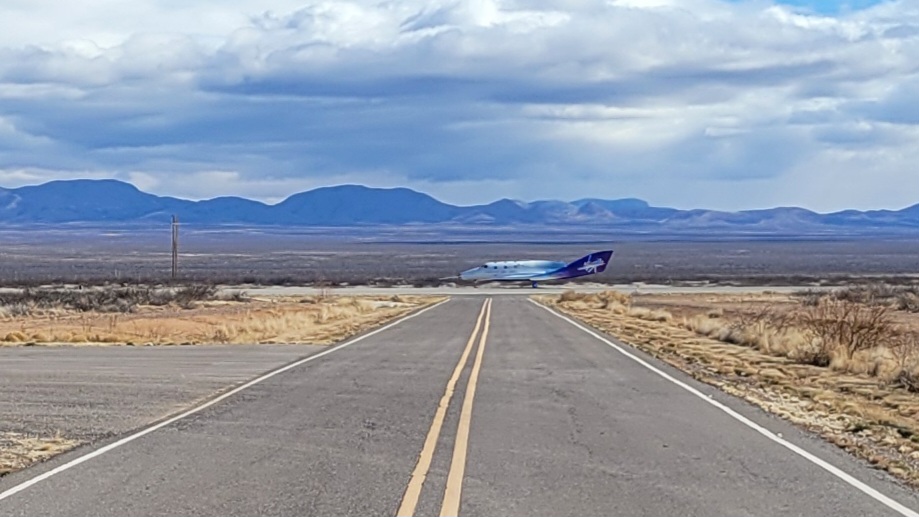
Illustrative image: VSS Unity landing at Spaceport America — Virgin Galactic's retired predecessor spaceship at the same New Mexico base where Apeiron has now arrived. (Image: Wikimedia Commons)
UPDATE — 3 November 2026: Flight details of Apeiron's first trip are now confirmed: the captive-carry ferry flight on 28 October 2026 covered 358 miles (576 km) from Phoenix-Mesa Gateway Airport to Spaceport America in 1 hour 28 minutes, departing 10:29 a.m. and landing 11:58 a.m. Mountain Standard Time. Pilot-in-command Mike "Sooch" Masucci and pilot Dan Alix flew carrier aircraft VMS Eve, with Tori Crichton aboard as flight test engineer. The name Apeiron was picked by public vote from 276 staff and ticket-holder submissions, with voting from 27 August to 3 September 2026; the other finalists were Horizon, Explorer and Ascend. Virgin Galactic chief executive Michael Colglazier summed up the day: "This morning, we gave Apeiron a name. This afternoon, Apeiron came home." Apeiron still has not flown solo — glide flights, rocket-powered tests and regulatory approval remain ahead of the early-spring-2027 passenger target.
📌 KEY HIGHLIGHTS
- Unveiled 28 October 2026: Virgin Galactic named its first Delta-class spaceship Apeiron — ancient Greek for "the boundless" — chosen by public vote from 83 countries and six continents.
- Now at its home base: Hours after the reveal, carrier aircraft Eve flew Apeiron under its wing from the Mesa, Arizona factory to Spaceport America, New Mexico — a captive-carry ferry flight, not a spaceflight.
- Built for frequency: Six passengers per flight, designed for twice-a-week flying and a lifetime of more than 500 missions — a pace predecessor VSS Unity never approached.
- First passengers targeted for early Q2 2027: Avionics software validation and glide plus rocket-powered test flights come first; the date has already slipped from late 2026.
- About 675 people hold reservations, with seats sold this year at $750,000 each — and with Blue Origin's New Shepard paused, Virgin Galactic could soon be the only crewed suborbital option flying.
What happened?
Virgin Galactic has not flown anyone to space since June 2024, when it retired VSS Unity after its seventh commercial flight to concentrate on its next-generation Delta class. On Wednesday 28 October 2026, that wait took a visible step forward: the company unveiled the first Delta-class spaceship at its Spaceship Factory in Mesa, Arizona, and gave it a name chosen by the public.
Apeiron (pronounced "App-Err-On") beat three other finalists — Horizon, Explorer and Ascend — in a vote that drew thousands of responses from 83 countries across six continents. "Apeiron, the Boundless, captures the ambition of human spaceflight and the possibilities it opens for humanity," said chief executive Michael Colglazier. "The extraordinary response to the public vote made choosing this name even more meaningful."
That same afternoon, the story moved from reveal to reality. Apeiron was mated to VMS Eve, Virgin Galactic's twin-fuselage carrier aircraft, departed Phoenix-Mesa Gateway Airport at 10:29 a.m. MST, and landed at Spaceport America at 12:59 p.m. MDT. Pilot in Command Michael Masucci and Pilot Dan Alix flew Eve, with Flight Test Engineer Tori Crichton on board. To be clear: this was a captive-carry ferry flight. Apeiron rode beneath Eve the whole way and did not fly under its own power or go to space. Its arrival matters because it marks the handover from manufacturing to flight-test preparation — the phase where the ship must still prove itself.
Apeiron vs VSS Unity: what actually changed?
The Delta class is a clean-sheet redesign built around one idea: turnaround. Unity was a superb demonstrator but a slow operator — about one commercial flight a month at its peak. Apeiron is engineered to be serviced, refuelled and reflown quickly, with simpler manufacturing and maintenance, better thermal protection for re-entry, and a modular design meant to cut the work needed between flights.
| Feature | VSS Unity (retired) | Apeiron (Delta class) |
|---|---|---|
| Passengers per flight | 4 | 6 |
| Designed flight rate | ~1 commercial flight per month | Twice a week (up to 8 a month) |
| Vehicle lifetime | 7 commercial flights total | More than 500 missions |
| Commercial service | June 2023 – June 2024 | Targeted early Q2 2027 |
| Ticket price (latest) | $450,000 at launch era | $750,000 per seat |
The flight profile itself stays familiar: Eve carries the spaceship to around 45,000 feet, releases it, the rocket motor fires, passengers get a few minutes of weightlessness and a view of Earth, then the ship glides back to a runway landing. Apeiron is a suborbital vehicle — it goes to the edge of space, not into orbit around Earth. Unity reached about 88.5 km (55 miles) on its first tourist flight, above the 50-mile line US agencies use to recognise spaceflight but below the 100 km Kármán line used internationally; Apeiron's powered test flights will show how high the new ship actually goes.

Image: Wikimedia Commons — VMS Eve, Virgin Galactic's carrier aircraft, after the Galactic 07 mission. Eve carries Apeiron to release altitude before the spaceship fires its rocket motor.
Why it matters for USA readers
Spaceport America is America's commercial spaceport, and Virgin Galactic is the country's only company selling suborbital space tourism seats right now. That position is about to get lonelier: Blue Origin has flown 92 people to the edge of space on New Shepard since 2021, but paused its suborbital programme in January 2026 after its 17th crewed flight, for at least two years, to focus on Moon missions. If Apeiron holds its schedule, Virgin Galactic will have the crewed suborbital market largely to itself in 2027.
There is also a queue with real money behind it. Around 675 people hold reservations, and more than 100 of them have begun the first phase of expedition readiness. A second Delta-class spaceship is already being assembled at the Mesa factory and is expected to enter commercial service in late Q2 or early Q3 2027, which would double the fleet just as the first ship finds its rhythm.
The honest caveat: this is still a plan, not a service. Virgin Galactic's own Q2 2026 filing flagged "substantial doubt about its ability to continue as a going concern," and the schedule has already slipped twice — from late 2026, to February 2027, and now to early Q2 2027 — as avionics software integration and validation took longer than expected. Apeiron must still complete avionics validation, glide tests and rocket-powered tests before anyone pays to ride it.
Should you care?
Price, availability & alternatives
Seats sold this year went for $750,000 each, and Virgin Galactic has said it will step prices up as flights resume — so the current price is a floor, not a promise. There is no public booking window for new buyers beyond joining the reservation queue, and no exact date for the first commercial flight beyond "early Q2 2027" (April–June). The company's Q3 2026 earnings call in November 2026 is the next scheduled programme update.
Alternatives today are thin. Blue Origin's New Shepard is paused. Orbital trips — such as private missions on SpaceX vehicles — cost tens of millions of dollars and are a different category entirely. For most would-be space tourists, the realistic choice in 2027 is Virgin Galactic or wait.
FAQs
When will Virgin Galactic fly passengers again?
Virgin Galactic targets early Q2 2027 for Apeiron's first commercial flight, after avionics software validation and glide plus rocket-powered test flights at Spaceport America. The date has slipped twice already, so treat it as a target, not a guarantee.
How much does a Virgin Galactic ticket cost?
Seats sold in 2026 went for $750,000 each. Virgin Galactic has said prices will rise as flights resume, and around 675 people already hold reservations.
How many passengers does Virgin Galactic Apeiron carry?
Six passengers per flight, up from four on the retired VSS Unity. The Delta-class ships are also designed to fly twice a week for more than 500 missions each.
Does Virgin Galactic Apeiron go into orbit?
No. Apeiron is a suborbital spaceplane: it climbs to the edge of space, gives passengers a few minutes of weightlessness, then glides back to a runway. It does not circle the Earth like an orbital spacecraft.
Takeaway: Apeiron is Virgin Galactic's best shot yet at turning space tourism from an occasional event into a routine service — six seats, twice a week, starting (it hopes) in early Q2 2027. The ship is real and home at Spaceport America; the test flights will tell us whether the schedule is too.
Follow USA Tech on TechByCountry for tomorrow's update.
📸 Get tech in the last 24 hours on Instagram — follow @_techinlast24hrs for daily posts (9 AM–9 PM) and reels at 12:30 PM & 8:30 PM.
Sources
- Virgin Galactic press release: "Spaceship Apeiron Arrives Home to Spaceport America" (28 Oct 2026)
- Virgin Galactic press release: "Virgin Galactic Unveils Spaceship Apeiron" (28 Oct 2026)
- Aviation Week: First Virgin Galactic Delta Class Spaceplane Set for Ferry Flight (27 Oct 2026)
- Universe Today: Virgin Galactic Flies Next-Gen Space Plane to New Home With New Name (29 Oct 2026)
- New Atlas: Virgin Galactic's new rocket plane revives its bid for a space airline (29 Oct 2026)
- Space.com: Virgin Galactic delays next commercial spaceflight to 2027
Related reading on TechByCountry: ULA Vulcan rocket's return to flight on November 13 and Tesla's driverless Cybercab tour of Malaysia.
Comments
Post a Comment