Amazon Leo Satellite Internet India Explained: Vulcan Launch on 14 November, Terminals, Price and the Licence Hurdle
UPDATE — 14 November 2026, 3:00 PM IST: Friday's launch attempt was scrubbed — ULA announced at 8:41 a.m. EST on 13 November that a power interruption at the Air Liquide gaseous nitrogen plant had cut deliveries to the pad. The rocket and all 40 Amazon Leo satellites remain healthy. Liftoff is now set for Saturday, 14 November at 12:32:30 p.m. EST (11:02 p.m. IST) from Space Launch Complex 41, in a 29-minute window to 11:31 p.m. IST.
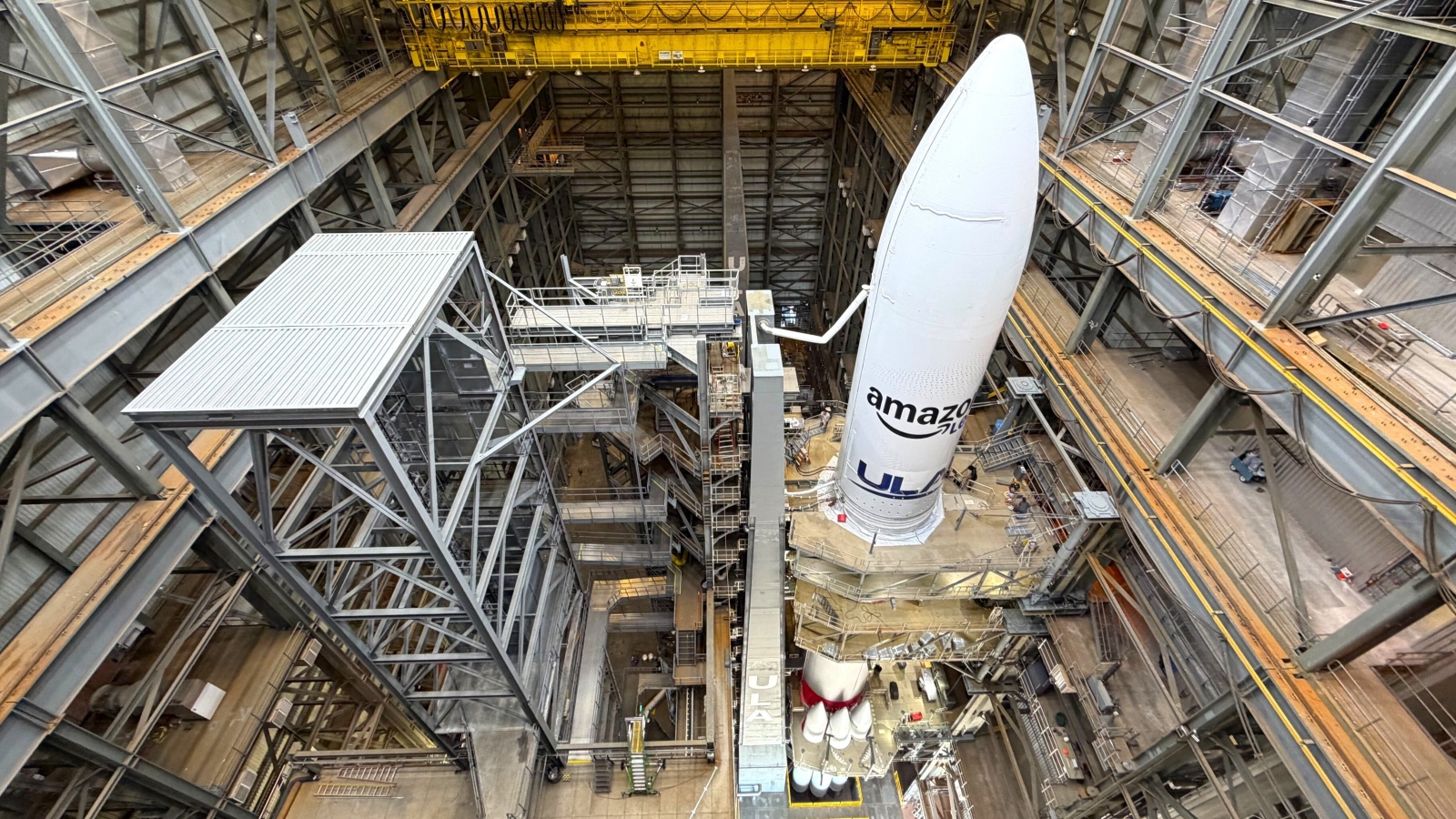
Image: Amazon — 40 Leo satellites stacked atop a Vulcan rocket inside Amazon's dedicated vertical integration facility (official image). The LV-01 mission carries the largest batch of Leo satellites yet.
TL;DR: Amazon Leo satellite internet India explained in one line: Amazon's satellite broadband network launches its biggest batch yet — 40 satellites on a Vulcan rocket on Saturday, 14 November 2026 — but there is still no India launch date, price or licence, because the company must file a fresh application under India's new telecom rules.
Key Highlights
- LV-01 launches Saturday, 14 November 2026 from Cape Canaveral, carrying 40 Leo satellites — the largest single Leo batch yet — on ULA's Vulcan rocket, which returns to flight after a nine-month pause.
- Amazon Leo is the renamed Project Kuiper: a low Earth orbit broadband constellation of 3,232 first-generation satellites at 590–630 km, with about 400 in orbit and 1,000 built.
- Three terminals: Leo Nano (up to 100 Mbps), Leo Pro (up to 400 Mbps) and Leo Ultra (up to 1 Gbps) — but Amazon has still not published consumer prices.
- India is a stated priority market, but not a launch market yet: Amazon's satellite arm applied for a GMPCS authorisation about two years ago; the telecom department cancelled the pending application under the new Telecom Act regime, so a fresh filing is needed first.
- The clock is ticking in the US too: Amazon missed the FCC's July 2026 halfway milestone of 1,616 satellites in orbit and got a waiver that costs it spectrum priority on later satellites.
Amazon Leo satellite internet India explained: what happened?
On 9 November 2026, Amazon announced that its first Vulcan mission, Leo Vulcan 1 (LV-01), is targeting liftoff on Saturday, 14 November 2026 at 12:32:30 p.m. EST (11:02 p.m. IST) from Space Launch Complex 41 at Cape Canaveral Space Force Station in Florida. It will carry 40 Leo satellites to low Earth orbit — the largest batch the programme has ever flown at once, and the first of 38 launches Amazon has contracted with United Launch Alliance (ULA).
The mission matters for two reasons. First, it is Vulcan's return to flight: the rocket has not flown since February 2026, and LV-01 is also the first Vulcan to fly a shorter, optimised Centaur V upper stage and the first to fly in the powerful six-booster configuration. Second, it is the moment Amazon's constellation programme shifts from trickle to sprint. Amazon completed its 1,000th satellite in early September 2026 and says it has hundreds of flight-ready satellites waiting; LV-02 is already being prepared in a second integration facility and is expected to launch within weeks of LV-01. Amazon says Vulcan will launch more than 1,500 of its first-generation satellites — close to half the constellation — making it the programme's primary workhorse over the next several years.
Amazon has not published a launch time for LV-01 in its announcement, and launch dates can move. The next Arianespace mission, Leo Europe 4 (LE-04), is targeting no earlier than 23 November from Kourou in French Guiana, and Amazon says it has more than 100 missions ahead, with an initial service rollout later in 2026.
What is Amazon Leo? How the constellation works
Amazon Leo is Amazon's satellite broadband network, developed for six years under the name Project Kuiper before Amazon renamed it on 13 November 2025. Like Starlink, it replaces a few big geostationary satellites parked 35,786 km up with thousands of small satellites a few hundred kilometres above Earth. The shorter distance cuts the round-trip delay that makes video calls and gaming awkward over older satellite internet — the trade-off is that each satellite is overhead for only a few minutes, so continuous coverage needs a very large fleet.
The system has three parts: the satellites, a network of ground gateway antennas that connect them to the internet, and the flat customer antennas — terminals — that homes and businesses install. Amazon's first-generation constellation is licensed by the US Federal Communications Commission (FCC) for 3,232 satellites in three shells at 590, 610 and 630 km. Deployment of production satellites began in April 2025, and about 396 were in orbit by early July 2026 across 14 missions. A successful LV-01 would take the total to about 436.
Amazon sells the service through three terminals, with speeds quoted as the company's stated maxima from limited preliminary testing — not speeds measured on a mature consumer network:
| Terminal | Who it is for | Stated maximum download speed |
|---|---|---|
| Leo Nano | Homes, small sites | Up to 100 Mbps |
| Leo Pro | Homes and small businesses | Up to 400 Mbps |
| Leo Ultra | Enterprises, governments | Up to 1 Gbps (uploads up to 400 Mbps) |
Coverage starts where the satellites are densest — the mid-latitude bands of the northern and southern hemispheres, not the equator — and expands toward the equator as more satellites go up. Amazon runs an enterprise preview for selected business customers, with partners including AT&T, Verizon, Vodafone, JetBlue, Delta and NASA, and says limited commercial service will open later in 2026. No consumer prices have been published.

An earlier Amazon Leo launch (then called Project Kuiper) lifting off from Cape Canaveral. Image: Wikimedia Commons / U.S. Space Force photo by Gwen, public domain
Amazon Leo vs Starlink: where the race stands
On paper Leo is the strongest challenger to Starlink, but the two networks are at very different stages. Starlink has been operating since 2019 and is live in about 160 countries; Leo has not started commercial service anywhere yet. The gap is launch cadence, not factory output: Amazon builds satellites faster than rockets have been available to carry them, with Vulcan and Blue Origin's New Glenn both grounded for most of 2026.
| Amazon Leo | Starlink | Eutelsat OneWeb | |
|---|---|---|---|
| Satellites in orbit (mid-2026) | About 396 | About 10,400 | About 648 |
| Planned first generation | 3,232 (FCC-licensed) | Up to 42,000 (15,000 cleared) | First generation complete since 2023 |
| Service status | Enterprise preview; limited commercial service targeted late 2026 | Live in about 160 countries, 10 million+ subscribers | Enterprise connectivity |
| Consumer price | Not published | Published, varies by country | Enterprise pricing |
Leo also carries a regulatory penalty. The FCC licence required half the first-generation constellation — 1,616 satellites — in orbit by 30 July 2026. Amazon had launched about 331 by that date and petitioned for relief; the FCC granted a waiver in June 2026 but attached a cost, reducing the spectrum priority of satellites launched after the deadline until Amazon reaches 1,616 satellites or 30 October 2027 arrives, whichever comes first. The full 3,232 must be in orbit by 30 July 2029. That is why LV-01 and the 37 Vulcan missions behind it matter so much: every launch now is about closing a gap the regulator is counting.
Why it matters for India readers
India is the largest market where satellite broadband is still unclaimed, and Amazon has said publicly that it sees the country as a key market. Chris Hofer, Amazon Leo's head of international spectrum management and strategy, told the IAFI Space Policy Conference in New Delhi in July 2026 that the network had around 400 satellites in orbit and that India was a promising market because of its digital focus — but that the company had announced no India launch date, process or subscription plans, and that entry remains subject to regulatory and security clearances. An inter-ministerial committee of home affairs, defence and other officials met on the question on 27 May 2026.
The licence position is the hard part. India runs satellite broadband through the GMPCS authorisation framework. The telecom department's January 2026 update listed authorisations for OneWeb India Communications, Jio Satellite Communications and Starlink Satellite Communication, while Amazon's application was still under examination. Then, according to Mint reporting on 9 September 2026, the department cancelled Amazon Leo's pending application under the new Telecom Act 2023 authorisation regime — so the company must file a fresh request before it can offer satellite broadband in India. The same reporting says Amazon has been scouting local partners, including Tata's Nelco, and that its initial India offer would be fixed broadband to homes.
For Indian readers the practical consequence is simple: do not expect a Leo dish on sale in India this year. Even after the licence question is resolved, Amazon would still need spectrum, security clearance and local gateways, and its first service latitudes are the mid-northern and mid-southern bands — northern India sits inside the northern band, but the equator-ward expansion comes later. Starlink, meanwhile, holds a licence but its own commercial launch has not happened either, with Indian press reporting in June 2026 that final approvals were effectively frozen over security concerns — a situation that is still moving and should be re-checked before anyone plans around it.
Should you care?
✅ Worth watching, not worth waiting for. If you live beyond reliable fibre or 4G/5G, Leo is the second real satellite option coming — but it has no India date, no price and no licence yet. Follow the LV-01 launch on Saturday and the DoT's authorisation list, not the hype; the first honest signal of an India launch will be a fresh GMPCS filing, not a product announcement.
FAQs
What is Amazon Leo?
Amazon Leo is Amazon's low Earth orbit satellite internet network, previously called Project Kuiper. It uses thousands of satellites at 590–630 km, plus ground gateways and customer antennas, to beam broadband to homes, businesses, governments, airlines and mobile carriers. Its first-generation constellation is licensed for 3,232 satellites.
When will Amazon Leo launch in India?
There is no announced date. Amazon says India is a key market, but its GMPCS application was cancelled under the new Telecom Act regime in September 2026 and it must file a fresh request; spectrum, security clearance and local gateways would still follow. No price or subscription plan for India has been announced either.
How much will Amazon Leo cost in India?
Amazon has not published consumer prices anywhere yet — not for the Nano, Pro or Ultra terminals, and not for monthly plans. The only figures available are the terminals' stated maximum speeds (100 Mbps, 400 Mbps and 1 Gbps). Treat any price quoted online as unconfirmed until Amazon announces it.
Is Amazon Leo better than Starlink?
Not yet, for most people. Starlink is live in about 160 countries with over 10,000 satellites and 10 million subscribers; Leo has about 400 satellites in orbit and no commercial service. Leo's claimed advantages are its enterprise and AWS links — the Ultra terminal connects directly into Amazon's cloud — and potentially faster uplinks, but those claims rest on limited preliminary testing, not a mature network.
Takeaway
LV-01 is the launch where Amazon Leo stops being a factory story and becomes a cadence story: 40 satellites on a returning Vulcan, 37 more Vulcan flights behind it, and a regulator counting down to 2029. For India, the interesting number is not 40 but zero — zero licences, zero prices, zero dates — until a fresh GMPCS filing appears. Watch Saturday's launch, then watch the DoT.
If you want the launch itself, read our ULA Vulcan rocket return to flight on 14 November post — it covers the rocket, the nine-month grounding and the 40-satellite payload in detail.
Sources
- Amazon — Amazon Leo to launch 40 satellites on its first Vulcan mission (9 November 2026) — LV-01 date, 40 satellites, 38 ULA launches, 1,500+ Vulcan satellites, 1,000th satellite, LV-02, LE-04, service rollout.
- Financial Express — 'India is a great candidate': Amazon Leo signals strong interest in expanding satellite broadband push (23 July 2026) — India as key market, Chris Hofer remarks, no India date or plans, inter-ministerial committee, terminals.
- Gadgets Now — Starlink vs Amazon Leo vs OneWeb: Why the 2026 race has 3 scoreboards — satellite counts, Starlink scale, FCC waiver and spectrum penalty, India approval freeze context.
- Inside Deep Tech — Amazon Leo: A Full Guide to Satellites, Launches and Service — rename date, 3,232 satellites, FCC deadlines, terminals, enterprise preview.
- VentureAtlas — Amazon Leo company profile (citing Mint, 9 September 2026) — DoT cancellation of pending GMPCS application, fresh filing required, Nelco partner scouting.
- Related TechByCountry reading: China's Guowang constellation passes 240 satellites; AST SpaceMobile's direct-to-phone satellite service takes a different route to the same sky.
Comments
Post a Comment