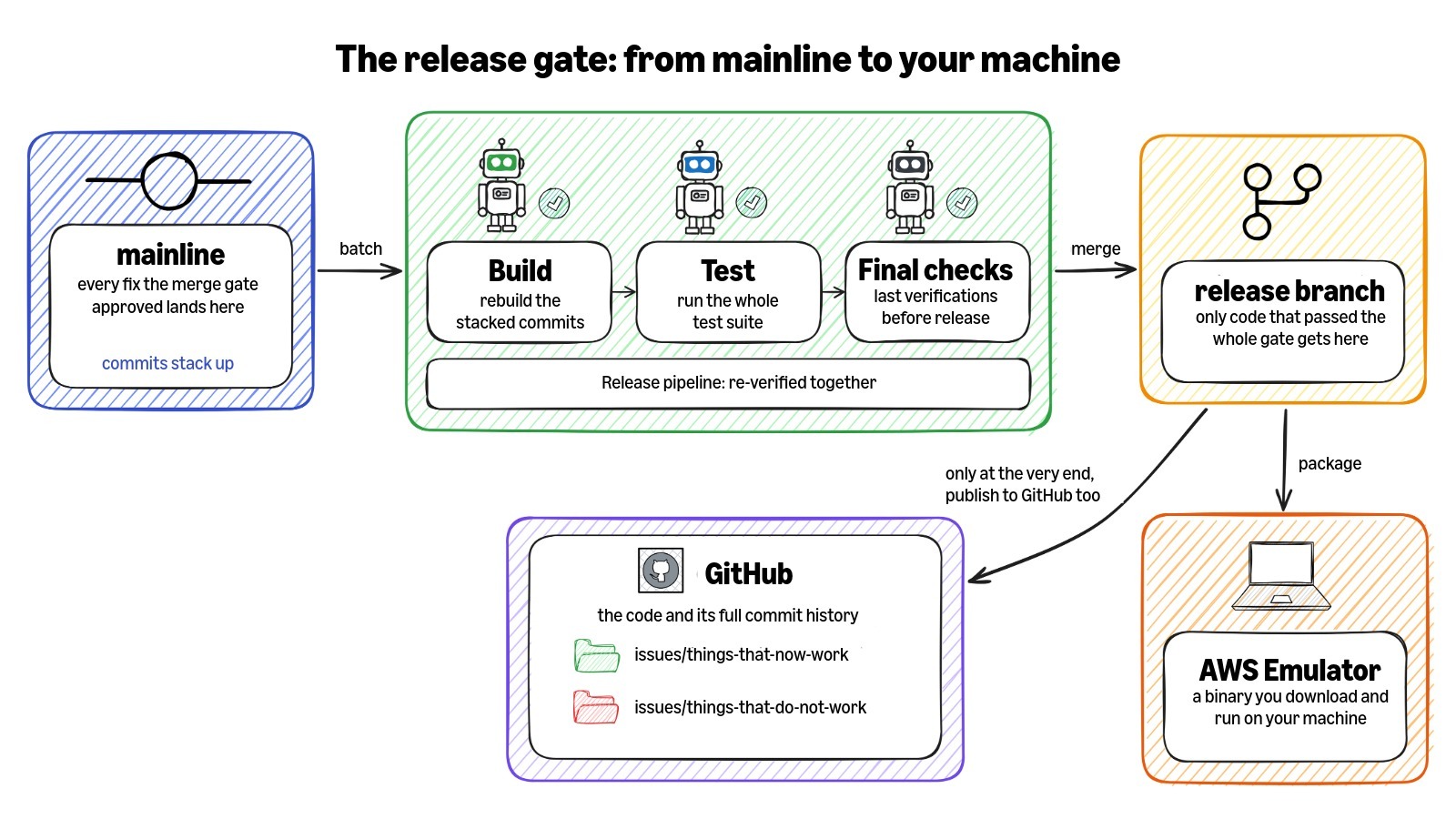
Image: Amazon — diagram of the three AI agent teams that build AWS Emulator, working through a shared code repository (official visual).
TL;DR: AWS Emulator built by AI agents explained: Amazon has released a free local copy of AWS that runs on your laptop — and not one line of its code was written or reviewed by a human. Autonomous agents built it from AWS's own API models, and three agent teams keep improving it every day. It is a testing tool, not a replacement for real AWS.
📌 Key Highlights
- AWS Emulator, released on 11 November 2026, runs more than 200 AWS services locally on Linux, macOS and Windows — no AWS account needed and no additional fee.
- Every line of code was written by autonomous AI agents. Amazon's engineers wrote none of it and reviewed none of it, according to senior principal engineer Matthew Goldberg.
- It began as a weekend experiment: the Kiro coding agent produced a working Amazon SQS clone in 15 minutes, then built the rest of AWS over the weekend.
- Three agent teams build it — test writers, issue finders and fixers — behind a merge gate that checks compiling, coding standards, security and fidelity, with thousands of issues fixed every day.
- The catch: it does not enforce IAM policies, simulate throttling or outages, or sandbox code — and operations it has not implemented fail with HTTP 501 instead of faking success.
What is AWS Emulator?
AWS Emulator is a local emulator for Amazon Web Services that you run on your own machine. The AWS Command Line Interface, the AWS SDKs and your coding agents talk to it over a local HTTPS endpoint using the same AWS APIs they would use in the cloud — from your laptop, with no connection to AWS needed for the test itself.
Setup is deliberately boring. You install it, start it, and it generates its own credentials, a config file and a certificate. You set environment variables such as AWS_ENDPOINT_URL so the SDK talks to your laptop instead of AWS, and your application code stays unchanged. A unit test that creates a DynamoDB table, writes an item and reads it back is the same test — it just runs locally, without a deployment.
It is implemented in Rust, so it stays light on CPU and memory. It supports the APIs of AWS services that have an API model in the public AWS API models repository — 438 API models covering more than 200 services at launch — and because it is built from those same models, your requests and the errors you get back have the same shape as on AWS. There is no additional service fee: you pay only for AWS resources when you deploy on AWS. The source is published on GitHub under a CC0 public-domain dedication.
AWS Emulator built by AI agents: how the three agent teams work
The headline is the part that sounds impossible, and Amazon is blunt about it. "The emulator was written entirely by autonomous agents," Goldberg wrote. "Our team hasn't written or reviewed any of the code." The idea came from Anthropic researchers demonstrating earlier in 2026 that AI agents could autonomously build a C compiler: if agents can build a compiler from a spec and a reference implementation, they could build AWS the same way — the public API models are the spec, and the real AWS cloud is the reference.
He gave the Kiro coding agent the simplest prompt he could think of: write tests based on the AWS CLI, iterate on those tests until they pass against real AWS, then build an in-memory implementation those same tests pass against. Kiro came back after 15 minutes with a passable first version of Amazon SQS. Goldberg refined the prompt, had Kiro build the rest of AWS over the weekend — and it did. His team started using it to test their software that Monday.
Turning a weekend experiment into something Amazon would ship took guardrails. The work is split across three teams of agents, each with a bounded job. Test writers devise real-world scenarios from the public API models and verify each one against real AWS before saving it as a fidelity test — there are tens of thousands of them. Issue finders replay those tests against the emulator and file what fails into a "things-that-do-not-work" folder. Fixers take one issue each and send the fix through a merge gate that blocks anything that does not compile, fails coding standards, fails a security review or regresses fidelity. Goldberg says thousands of issues are fixed every day as hundreds of agents work concurrently — and "without this merge gate, we wouldn't trust what our agents are building."
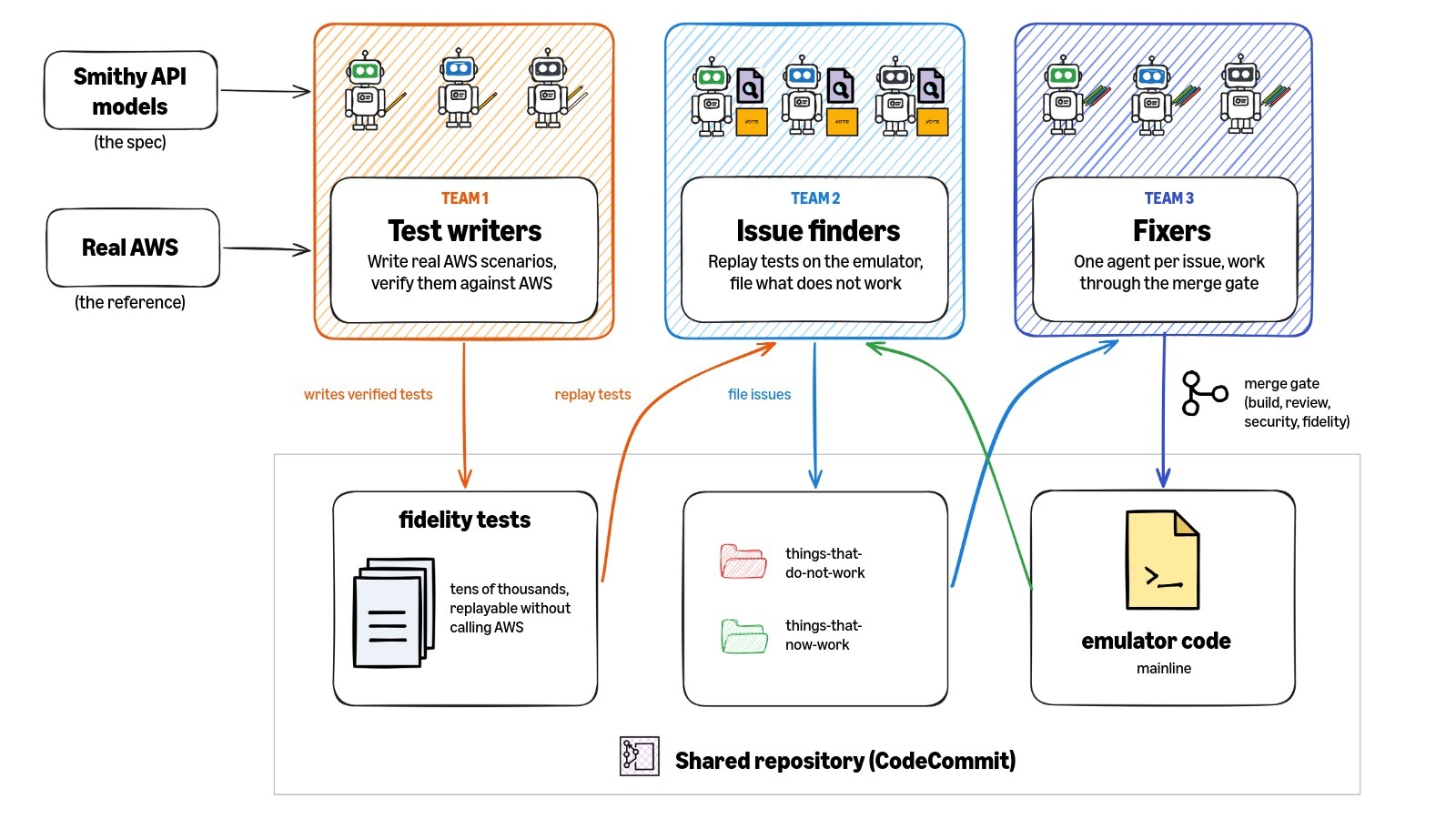
Image: Amazon — the agent workflow behind AWS Emulator: tests verified against real AWS, issues found by replaying them, fixes merged through a gate (official visual).
| AWS Emulator at a glance | Details |
|---|---|
| Released | 11 November 2026 |
| What it is | Local emulator of AWS services, running on your machine |
| Coverage | 438 API models, more than 200 AWS services |
| Built with | Rust; 100% of code written by autonomous AI agents |
| Runs on | Linux (RPM/Debian packages), macOS and Windows (Docker), embedded mode for Rust tests |
| Cost | No additional service fee; pay only for real AWS resources |
| Licence | CC0 public-domain dedication; source on GitHub, no pull requests accepted |
| How it checks itself | Tens of thousands of fidelity tests, each verified against real AWS |
What it can and cannot do
An emulator is only useful if a test that passes against it would also pass against AWS, so Amazon measures that directly. A fidelity test is a short workflow checked against real AWS: to pass, the emulator must match the response to every call, including its status code, body and exact error code and message. If the emulator does not implement an operation yet, it returns HTTP 501 (Not Implemented), so your tests fail right away instead of passing on a lie.
The limits matter as much as the headline. It does not evaluate IAM or resource-based policies the way AWS does, so a request AWS denies could succeed locally. It does not simulate throttling or outages, snapshot and restore, or per-Region availability. It does not sandbox the code it executes. Each instance acts as a single account in a single Region, keeps resources in memory and deletes them when stopped. And its fidelity is incomplete: AWS's own measurements show the emulator does not yet reproduce every AWS operation accurately. The supported use is building and testing; production workloads and application security tests are out of scope. Validate against real AWS before you deploy.
Why it matters for India readers
India has one of the world's largest AWS developer communities, and this lands directly on their daily work. Testing against real AWS costs money and time, and for students, startups and small teams the bill is a real constraint. A free local stand-in that runs the same APIs removes that friction — and it is built for the way coding agents now work, letting an agent create a resource, inspect the result and revise its code without waiting on a Region.
It also arrives in a big week for developer tooling: the same days brought the Node.js November security releases and Microsoft's .NET 11 release with C# 15 union types. And it is the clearest sign yet that AI agents have moved from demos to production engineering — the same week DeepMind's AlphaGenome 2 put AI to work on disease genetics. As Amazon's Swaminathan Sivasubramanian put it, the engineer's job is shifting: decide what should be built, then create the specifications, tests and merge gates that determine correctness while agents write and check the code.
Should you care?
✅ Verdict: Yes, if you build on AWS — install it and try your existing test suite against it today. It is free, it runs locally, and a passing local test is far cheaper than a deploy-and-wait cycle. But treat it as a fast first pass, not proof: check the per-service fidelity scores, remember it ignores IAM, and always validate against real AWS before production.
FAQs
What is AWS Emulator?
AWS Emulator is a free local emulator of AWS services, released on 11 November 2026. It runs on your own machine and lets the AWS CLI, SDKs and coding agents use the same AWS APIs they would use in the cloud, over a local HTTPS endpoint — without an AWS account or any additional service fee.
How does AWS Emulator work?
You install it, start it, and it generates its own credentials, config file and certificate. You set environment variables such as AWS_ENDPOINT_URL so your tools talk to your laptop instead of AWS, and your application code stays unchanged. It is written in Rust and runs on Linux, macOS and Windows.
Is AWS Emulator really written entirely by AI?
Yes, according to Amazon: thousands of autonomous agents wrote every line of code, and the team neither wrote nor reviewed any of it. Humans built the scaffolding instead — the specifications, the fidelity tests, the merge gates and the release pipeline.
Can AWS Emulator replace real AWS for testing?
No. It does not evaluate IAM or resource-based policies the way AWS does, does not simulate throttling or outages, does not sandbox executed code, and acts as a single account in a single Region with in-memory resources. Validate against real AWS before deploying to production.
Takeaway
AWS Emulator is two stories in one: a genuinely useful free tool that puts a local copy of AWS on your laptop, and the first major product Amazon admits no human wrote. The guardrails — fidelity tests, merge gates, adversarial security review — are the real product here. If they hold, this is what software engineering starts to look like.
Before trusting a local pass, check the per-service fidelity scores in the public repository — and run your own test suite against it to see where it stands today.
Sources
- AWS — Test your applications against AWS locally with AWS Emulator
- About Amazon — AWS Emulator: a local emulator built 100% by autonomous AI agents
- All Things Distributed — AWS Emulator and the engineer's job when agents write the code
- Unite.AI — AWS Releases Local Emulator Written Entirely by Autonomous AI Agents
- InfoWorld — AWS unveils local emulator service to help enterprises accelerate app development and testing
Comments
Post a Comment