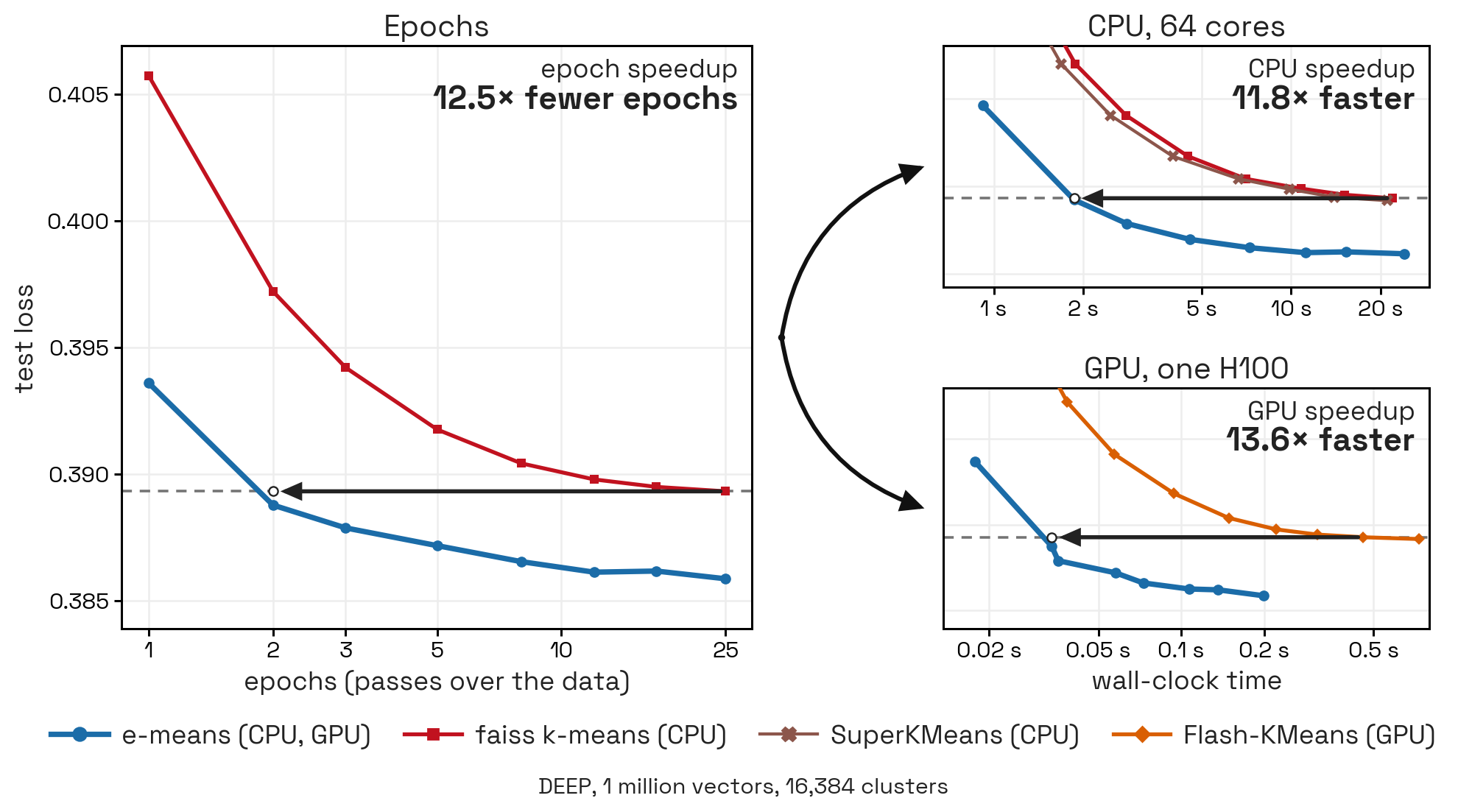
Image: Meta FAIR (e-means project) — e-means vs Lloyd's k-means, in epochs, CPU time and GPU time (official project figure).
TL;DR: e-means algorithm k-means explained in one line: Meta FAIR's e-means replaces Lloyd's full-dataset passes with mini-batch exponential moving average updates, and the authors report it matches Lloyd's 25-epoch loss in about 2 epochs — 10–45× faster on GPU. The code is not yet in FAISS, and independent checks are still pending, so treat the headline as a strong claim, not a settled benchmark.
Key Highlights
- Meta FAIR researchers published e-means on arXiv on 6 November 2026 — a drop-in replacement for Lloyd's k-means clustering algorithm.
- Instead of re-reading the whole dataset every iteration, e-means updates centroids from small mini-batches with an exponential moving average, so old assignments are gradually forgotten.
- Authors' results: it beats the loss Lloyd's algorithm reaches in 25 epochs after just 1.4–2.6 epochs, with 10–45× less GPU wall-clock time than Flash-KMeans and 8–15× less CPU time than Faiss.
- At the largest scale tested, e-means split 10 billion image embeddings into 16 million clusters in 2.5 epochs.
- Honest caveat: all speed figures are the authors' own, the code is not yet in the public FAISS release, and one independent re-implementation measured only 1.5× on small data.
e-means algorithm k-means explained: what happened?
On 6 November 2026, researchers at Meta's Fundamental AI Research lab (FAIR) posted a paper titled "e-means: outperforming k-means (in one-tenth the epochs)" on arXiv. The authors — Swann Bessa, Pierre-Emmanuel Mazaré, Gergely Szilvasy, Hugo Touvron, David Picard, Matthijs Douze and Hervé Jégou — set out to modernise one of machine learning's oldest workhorses: k-means clustering, the algorithm that groups data points around a set of centroids and underpins everything from image search to product recommendations.
The paper landed on Hacker News on 9 November 2026, where it drew hundreds of upvotes and a long technical discussion, and the team published a detailed project page explaining the method in plain terms. The claim that caught attention is simple: the same clustering quality Lloyd's algorithm reaches after 25 full passes over the data, e-means reaches in about two. For teams that build vector-search indexes — the retrieval layer behind most AI search and recommendation features — that would turn a slow offline step into a quick one.
How e-means works, in plain English
Lloyd's algorithm, the standard way k-means has been run for decades, works in full passes: assign every point to its nearest centroid, recompute every centroid as the exact mean of its points, repeat 20–50 times. Each pass costs a full read of the dataset, and the loss only ever goes down — which also means the algorithm can get stuck in a bad arrangement of centroids and never climb out.
e-means changes the update rule. It works on small mini-batches and keeps, for each cluster, a running sum and count that are updated as an exponential moving average: new batch data counts fully, older assignments fade away at a rate set by a step size. The centroid is always the ratio of those two running totals, so it tracks recent assignments instead of the whole history. The same trick is used to train the codebooks inside VQ-VAEs, the tokenisers behind many generative models — the FAIR team found it works just as well on static datasets, provided the other pieces are in place.
Those other pieces are what make the method more than a one-line change. Two fitted scaling laws automatically pick the batch size and step size from the problem's size, so e-means needs no hyperparameter tuning where Lloyd's needs none either — a deliberate design choice. Dead clusters, centroids that end up with no points assigned, are revived by splitting a large cluster instead of sampling a random point. A cosine schedule anneals the step size, and a finalisation stage ends each run on each cluster's exact last-epoch mean. The team also ships specialised GPU kernels that fuse the nearest-centroid assignment, turning the epoch savings into matching wall-clock savings.
| Measure | Lloyd's k-means | e-means (authors' results) |
|---|---|---|
| Epochs to reach Lloyd's 25-epoch test loss | 25 epochs | 1.4–2.6 epochs (1.2–3 on the project page) |
| GPU wall-clock time at equal loss | Baseline (Flash-KMeans) | 10–45× faster |
| CPU wall-clock time at equal loss | Baseline (Faiss) | 8–15× faster |
| Largest test: 10B embeddings, 16M clusters | 25 epochs for the reference loss | 2.5 epochs |
| Hyperparameter tuning | None needed | None needed — scaling laws set batch and step size |
| Escaping bad local minima (toy tests) | Stuck in 15.5–46% of random starts | Stuck in 0–4% of random starts |
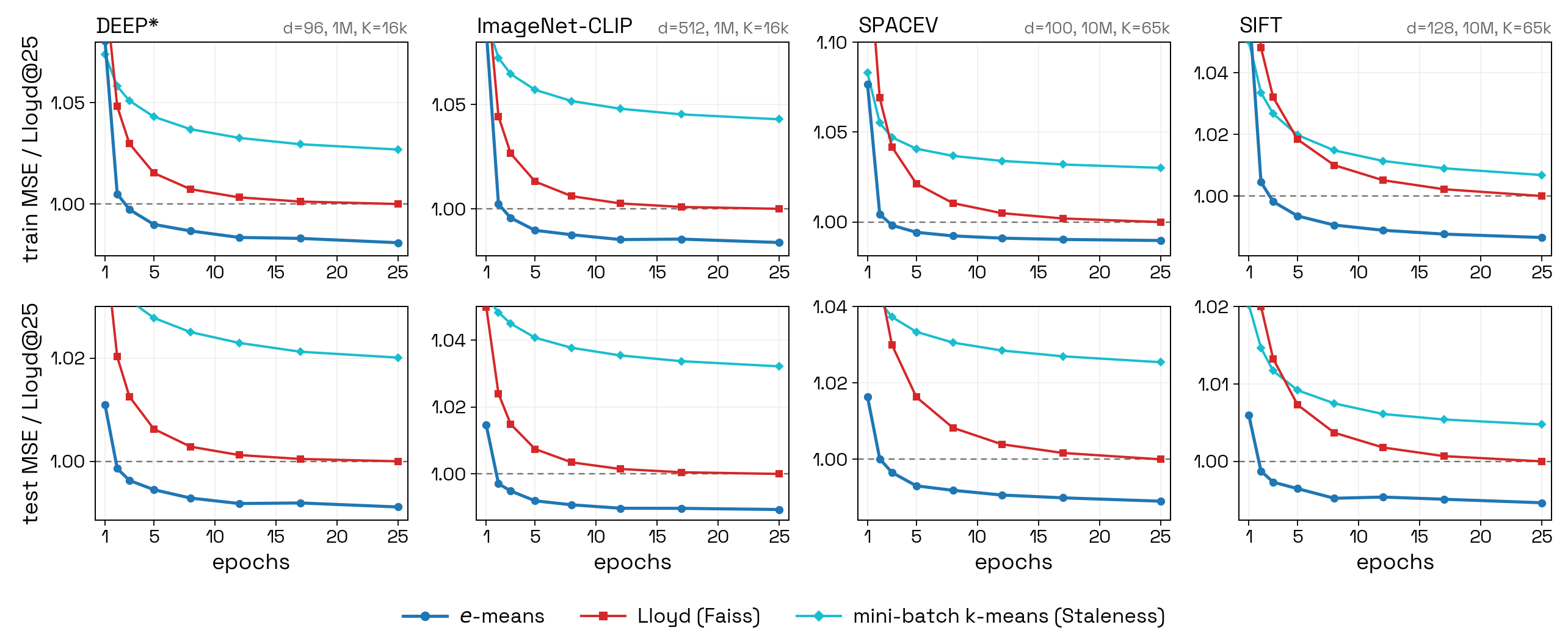
Image: Meta FAIR (e-means project) — convergence curves of e-means vs Lloyd at 25 iterations (official project figure).
Why it matters for India readers
k-means sits inside tools Indian developers already use daily. Faiss, Meta's open-source vector-search library, is the default way Indian startups and IT teams build retrieval for AI search, chatbots and recommendation features — and k-means is the step that partitions those vector indexes before a single query is answered. When that step takes hours on a large catalogue, index rebuilds get scheduled overnight and stale results linger; a 10× faster clustering step means fresher indexes, cheaper GPU bills and faster iteration on the retrieval layer itself.
The same logic applies to data teams clustering embeddings for deduplication, customer segmentation and content curation. None of this needs new hardware: e-means is a software change to an existing step, and the authors say it will ship with FAISS 1.16.0. For students and researchers, the paper is also unusually readable — the project page prints the exact update rule and the fitted scaling-law constants, so the method can be followed and re-implemented without guessing.
Should you care?
Verdict: ✅ Yes, if you build vector search, recommendation or embedding pipelines — watch this closely, and try it when the FAISS release lands. The method is simple, the paper is unusually transparent, and the upside is a genuinely faster index build. ⏳ Wait, if you are deciding a production migration today — the speed figures are the authors' own, the code path the project page links to currently returns a 404, and one independent re-implementation on small synthetic data measured only 1.5× with slightly worse loss. Treat "10× faster" as a regime claim for large-scale embedding workloads, not a guarantee for every dataset.
Availability and alternatives
e-means is a research result, not a product you can download today. The paper is on arXiv (arXiv:2611.09501) and the project page is live at e-means.github.io, with the method, scaling laws and results laid out in full. The authors say the implementation will ship with FAISS 1.16.0 under an MIT licence, but as of 9–10 November 2026 the linked code path in the Faiss repository returns a 404 and the latest pip release (faiss-cpu 1.15.1) does not include the module — so check the FAISS releases page before planning around it.
The nearest alternatives are the tools e-means was measured against: Faiss's own k-means, the Flash-KMeans implementation, and scikit-learn's k-means for smaller workloads. A related recent variant worth knowing about is SuperKMeans, another k-means accelerator for vector embeddings that reports up to 7× faster clustering on CPUs. Our earlier Triangular Log-Det PDHG explainer covers a different new optimisation algorithm from the same month, and our WorldParticle explainer shows how the same research wave is reshaping simulation — both are the kind of methods-first papers this slot tracks.
FAQs
What is e-means?
e-means is a new clustering algorithm from Meta FAIR that replaces Lloyd's k-means. It updates cluster centroids from small mini-batches using an exponential moving average, instead of recomputing them from the full dataset every iteration, and it automatically picks its batch size and step size from fitted scaling laws.
How is e-means different from k-means?
Standard k-means (Lloyd's algorithm) makes full passes over the data and recomputes each centroid as the exact mean of its assigned points. e-means works on mini-batches, lets older assignments fade away through a moving average, revives dead clusters by splitting large ones, and finishes with a finalisation step — which the authors show also helps it escape bad local minima that trap Lloyd's algorithm.
Is e-means really 10 times faster than k-means?
On the authors' own tests, yes — in the large-scale embedding regime: 10–45× less GPU wall-clock time than Flash-KMeans and 8–15× less CPU time than Faiss, at equal or better loss. But those are self-reported figures with no independent benchmark yet published, and one independent re-implementation on small synthetic data measured only 1.5×. The honest answer is: much faster on large embedding workloads, unproven elsewhere.
How do I use e-means?
Not yet through a stable release: the authors say it will ship with FAISS 1.16.0 as faiss.contrib.e_means, but that code path currently returns a 404 and is absent from faiss-cpu 1.15.1. Until the release lands, the paper and project page give the full update rule and scaling-law constants for anyone who wants to re-implement it.
Takeaway
e-means is the rare algorithms paper that is both simple and immediately useful: one changed update rule, plus scaling laws, dead-cluster revival and a finalisation step, and k-means — a 70-year-old workhorse — runs an order of magnitude faster on the workloads that matter most. The caveats are real, but the method is public and the upside is large.
If you maintain a Faiss index, read the project page and watch for the FAISS 1.16.0 release notes — that is when this stops being a paper and becomes a one-line import.
Sources
- arXiv: e-means: outperforming k-means (in one-tenth the epochs) — Bessa et al., FAIR at Meta
- e-means project page — Meta FAIR (method, scaling laws, results and figures)
- Nakoda AI News: Meta Researchers Release e-means, a Faster Replacement for k-means Clustering in FAISS
- Dev.to: 10x faster k-means? I re-ran it and got 1.5x (independent re-implementation check)
Comments
Post a Comment