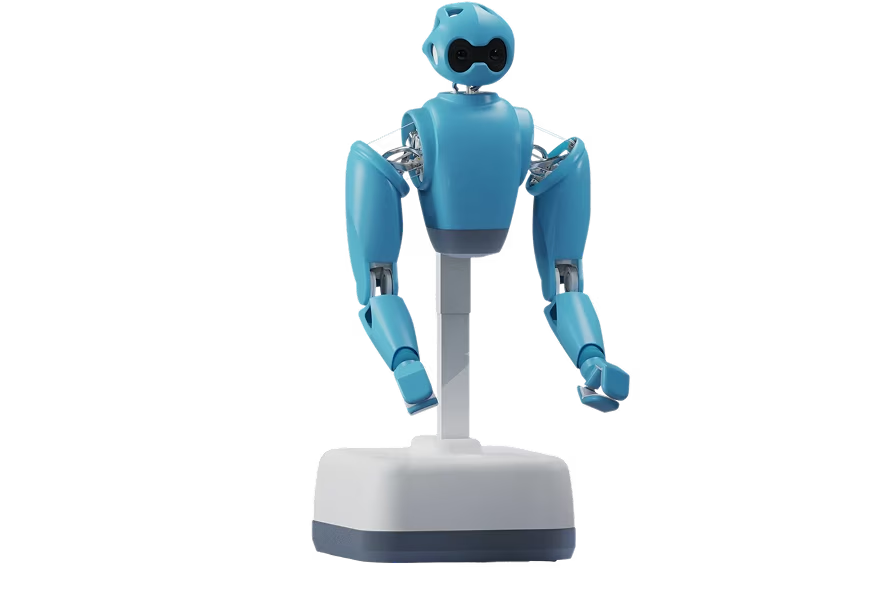
Image: Embodied AI — AIR (AIR01), the Swiss company's wheeled humanoid robot (official product image).
📌 KEY HIGHLIGHTS
- Unveiled today: AIR was revealed on 6 November 2026 at Humanoid Europe 2026 in Munich, built in just 9 months from research to industrial humanoid.
- Learns by watching: AIR starts every job under human control, records every run, and typically takes over the task itself within about a month — and what one robot learns, the next can use.
- Safety by design: tendon-driven arms, motors housed in the torso, and wheels instead of legs. Designed under ISO/TS 15066:2016, with CE marking planned for 2027.
- Already proven in factories: the company's AI stack runs in paid factory deployments, hitting 98% reliability on a cable-handling test against a 90% target, according to the company.
- Not for sale yet: no price or sale date announced, and no India launch timeline. Testing with global manufacturers is under way now.
What happened?
Embodied AI, a Swiss robotics company and EPFL spin-out based in Lausanne, unveiled AIR at Humanoid Europe 2026 in Munich on 6 November, at 16:00 CET. The company says it went from research to an industrial humanoid in nine months, has signed contracts with major manufacturers globally, and is now testing AIR with them while starting plans for scaled production.
The pitch is aimed at a real gap. Deloitte and The Manufacturing Institute estimate as many as 1.9 million US manufacturing jobs could go unfilled by 2033, and the Manufacturing Leadership Council found 22% of manufacturers plan to use physical AI, such as humanoid robots, within two years — more than double today's 9%. But Deloitte also found more than 80% of factory task hours are expected to stay human-driven. AIR is built for that middle ground: the repetitive, high-dexterity manual tasks that change too often for conventional robots, so the people already on the line can focus on work that needs their skill.
Most humanoids today are still demonstrations, and most industrial robots are built for heavy-duty work behind cages, away from the people who know the job best. AIR is designed to go onto the factory floor as it is, next to the team already there.
How the Embodied AI AIR humanoid robot learns
AIR does not arrive knowing the job. Every task starts under the control of a human operator, so the robot is productive from its first shift. Every run is recorded, and Embodied AI's own AI stack learns from those demonstrations until AIR can do the task itself — typically within about a month. The operator then stays on hand to cover anything the robot has not seen before, and skills learned by one robot can be transferred to others.
That learning-on-the-job approach is what separates AIR from a pre-programmed machine: the robot is trained on real manufacturing data, on site, rather than only in simulation. It is the same idea behind the latest AI decision models for agents — software that judges and chooses, rather than just generating text — which is why Kakao's new Kanana-2-v-decide AI decision model, also unveiled this week, is worth reading alongside this story.
The company's AI stack is already proven in paid factory deployments with its separate two-arm industrial cell. When a leading consumer electronics manufacturer tested five funded startups on a cable-handling task, Embodied AI says it met every target, reaching 98% reliability against a 90% goal — while the four other startups failed to meet the requirements. Those figures come from the company itself, so treat them as its own test result rather than an independent benchmark.
Built safe, not caged
Safety is the core of AIR's design, and it comes from the hardware, not from software holding the robot back. AIR uses a tendon-driven architecture: the motors, gearboxes and electronics sit in its torso, and its arms are light, moved by tendons, so they carry almost no mass and give way on contact. It runs on wheels rather than legs, because factory floors are flat and wheels are more stable. AIR is designed under ISO/TS 15066:2016, the technical specification for collaborative industrial robot safety, with CE marking planned for 2027.
Co-founder and CEO Francesco Stella put the stakes plainly: "Hallucination of AI models is acceptable in the digital space because humans review, reject, or correct the output before acting on it. In robotics, however, incorrect actions have immediate and irreversible physical consequences. When AI is used to taking physical actions, errors can cause severe damage or endanger human lives. Safety and reliability are non-negotiable requirements of physical AI to enter the real world at scale."
The arm design grew out of Stella's doctoral research at EPFL, the Swiss Federal Institute of Technology in Lausanne; the 28-year-old previously researched at MIT's Computer Science and Artificial Intelligence Laboratory. He co-founded Embodied AI with chief technology officer Kai Junge and chief operating officer Max Polzin, both robotics PhDs with backgrounds at Cambridge, ETH Zurich and EPFL. The company is backed by Faber, which led its first funding round, along with TechShop, Look AI Ventures, Plug and Play and Vento. That caution about AI acting on wrong guesses is shared across the industry — researchers at POSTECH recently showed a verification trick that stops AI agents acting on wrong guesses, a useful companion read.
| AIR at a glance | Detail |
|---|---|
| Developer | Embodied AI — Swiss robotics company, EPFL spin-out, based in Lausanne |
| Unveiled | 6 November 2026, Humanoid Europe 2026, Munich (16:00 CET) |
| Model | AIR (listed as AIR01 on the company site) |
| Built in | 9 months, research to industrial humanoid |
| Movement | Wheels, not legs — built for flat factory floors |
| Arms | Tendon-driven, lightweight; motors, gearboxes and electronics in the torso |
| Learning | Imitation learning from human operators; typically autonomous in about a month |
| Safety | Designed under ISO/TS 15066:2016; CE marking planned for 2027 |
| Proven result | 98% reliability on a cable-handling test vs a 90% target (company data) |
| Price / availability | Not announced; testing with global manufacturers now |

Image: Embodied AI — AIR at work in a manufacturing setting (official image from embodiedai.ch).
Why it matters for India readers
No India deployment, price or timeline has been announced for AIR, so Indian factories will not see this robot soon. But the story still matters here. India's factories face the same skilled-worker shortages the robot is built for, and manufacturing sits at the centre of India's growth plans — the same automation wave that brought software AI into offices is now reaching the factory floor as physical AI.
The design choice is the part to watch: instead of caged robots that need factories rebuilt around them, AIR is meant to slot into existing lines beside existing workers. If that approach works at scale — and the 2027 CE marking will be the first real test of it — it changes who can automate, including the mid-size manufacturers that dominate India's industrial base. For now, though, AIR is a European pilot-stage product, and its relevance to India is as a signal of where factory automation is heading, not as something to buy.
Should you care?
FAQs
What is Embodied AI AIR?
AIR is a wheeled humanoid robot from Swiss startup Embodied AI, unveiled on 6 November 2026 at Humanoid Europe in Munich. It is built for repetitive, high-dexterity factory tasks that change too often for conventional robots, and it is designed to work safely alongside human factory teams rather than behind cages.
How does AIR learn factory tasks?
Through imitation learning. A human operator controls AIR at first, every run is recorded, and the company's AI stack learns from those demonstrations until the robot can do the task itself — typically within about a month. The operator stays available for unfamiliar situations, and skills learned by one robot can be transferred to others.
Is AIR safe to work alongside people?
That is the design goal. Its tendon-driven arms are lightweight and give way on contact, the heavy motors sit in its torso, and it moves on wheels for stability. It is designed under the collaborative-robot safety specification ISO/TS 15066:2016, with CE marking planned for 2027 — but that marking has not been granted yet, so independent safety certification is still to come.
When will AIR be available, and how much does it cost?
Neither has been announced. AIR is currently being tested with global manufacturers, CE marking is planned for 2027, and the company is starting plans for scaled production. There is no India launch date or price either — the company has disclosed no figures at all so far.
Takeaway: AIR is the factory robot built around a simple idea — let the machine learn the job from the worker, safely, on the real factory floor. Nine months from research to reveal and already in manufacturer testing, it is further along than most humanoid demos. The proof comes in 2027, when CE marking decides whether it can be sold at scale.
For the other big robotics bet this week, read our Axon–Skydio $1.2 billion investment explainer — and if you run a production line, the date to watch is 2027, when AIR's CE marking should show whether this robot is ready to sell.
Sources
- Business Wire — Embodied AI Unveils AIR, a Physically Safe Humanoid Robot That Learns on the Job (6 November 2026, company announcement)
- The AI Insider — Switzerland's Embodied AI Unveils Humanoid Robot Designed to Learn Factory Tasks From Workers (6 November 2026)
- Embodied AI — official website (AIR01 product page)
- Deloitte / The Manufacturing Institute — US manufacturing could need new employees by 2033 (2024 Manufacturing Talent Study)
Comments
Post a Comment