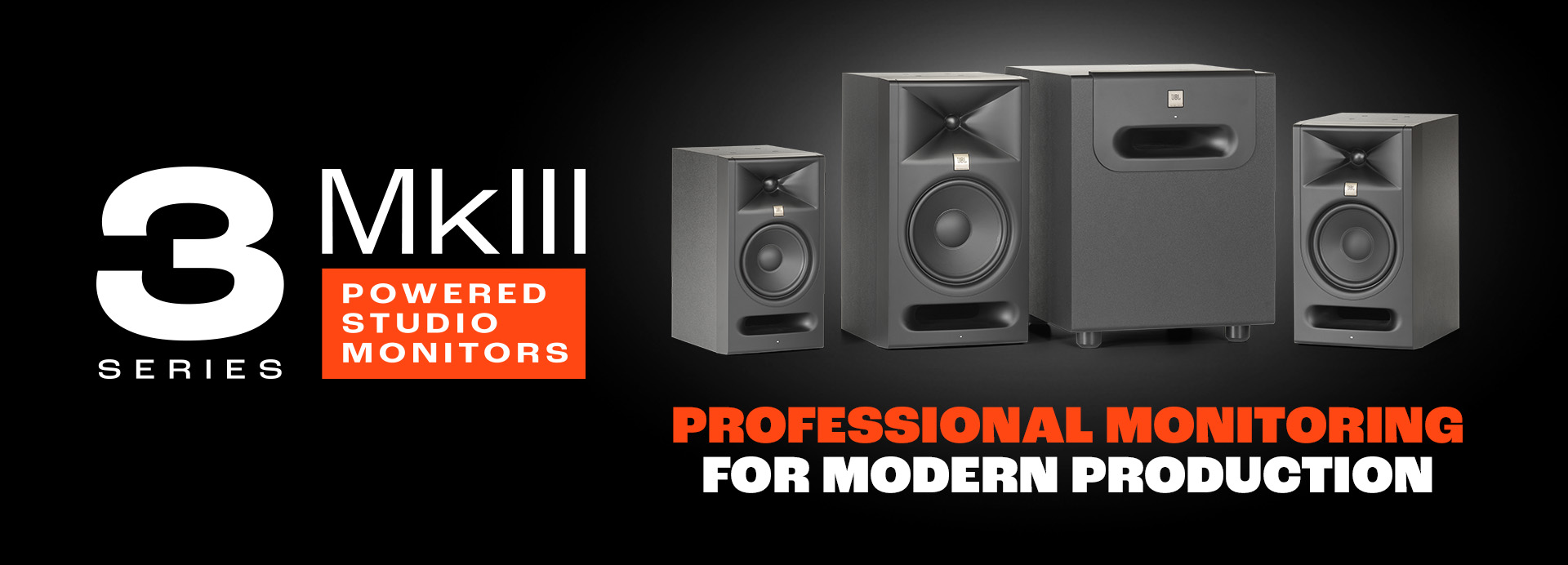
Image: JBL Professional — 3 Series MkIII family (official product image)
TL;DR: JBL 3 Series MkIII studio monitors explained in one line: HARMAN has rebuilt its popular 3 Series from the drivers up — three new powered monitors (305P, 306P, 308P MkIII) plus the 310S MkIII subwoofer, with new Class D amps and 81 room-EQ combinations. The range went on sale across Asia-Pacific, Europe, the Middle East and Africa on 3 November 2026, starting at $199 (roughly ₹17,600). India prices have not been announced yet.
📌 Key Highlights
- Four new models: JBL 305P MkIII (5-inch), 306P MkIII (6.5-inch) and 308P MkIII (8-inch) powered studio monitors, plus the 310S MkIII 10-inch powered subwoofer.
- Biggest redesign yet: HARMAN calls it the most extensive redesign of the 3 Series platform to date — new drivers, a new waveguide, front-firing ports and new Class D amplification.
- Room tuning without software: four one-touch room controls give 81 corrective EQ combinations, so you can adapt the monitors to your desk or room with no calibration app.
- Prices (US street): $199 (305P), $249 (306P), $299 (308P) and $499 (310S) — India prices are not announced yet.
- Availability: on sale in Asia-Pacific, Europe, the Middle East and Africa since 3 November 2026; North America follows on 7 January 2027.
What happened?
HARMAN Professional Solutions announced the JBL Professional 3 Series MkIII family on 3 November 2026, after previewing the range at its HARMAN ExPLORE event in Tokyo in October. The 3 Series has long been the default first serious monitor for home studios, YouTubers and podcasters, and this is the first full rebuild of the platform — not a minor refresh. Every model gets redesigned high- and low-frequency drivers, an updated JBL Image Control Waveguide, new Class D amplification and a front-firing Slipstream bass port.
The timing is no accident. The MkIII is aimed squarely at how audio is made today: music and video production, podcasting, editing and content creation, in rooms that are usually bedrooms and home offices rather than treated studios. That is why the headline feature is not raw power but room adaptation — the monitors are built to sound right in awkward spaces.
JBL 3 Series MkIII studio monitors explained: the four models at a glance
All four models are powered (each has its own amplifier built in), so you connect them straight to an audio interface, mixer or playback device — no separate amp needed. JBL's own spec table tells the story:
| Model | Size | Bass extension | Peak SPL | Amplifier | US street price* |
|---|---|---|---|---|---|
| 305P MkIII | 5-inch two-way | 45 Hz | 109 dB | 86 W Class D | $199 (roughly ₹17,600) |
| 306P MkIII | 6.5-inch two-way | 43 Hz | 112 dB | 110 W Class D | $249 (roughly ₹22,000) |
| 308P MkIII | 8-inch two-way | 41 Hz | 113 dB | 110 W Class D | $299 (roughly ₹26,500) |
| 310S MkIII | 10-inch subwoofer | 26 Hz | 116 dB | 300 W Class D | $499 (roughly ₹44,200) |
*US street prices reported by retailers (Full Compass, via OHHIFI and StereoNET). HARMAN has not published official list prices, and India prices have not been announced. Rupee figures are rough conversions of the US prices, not Indian prices.
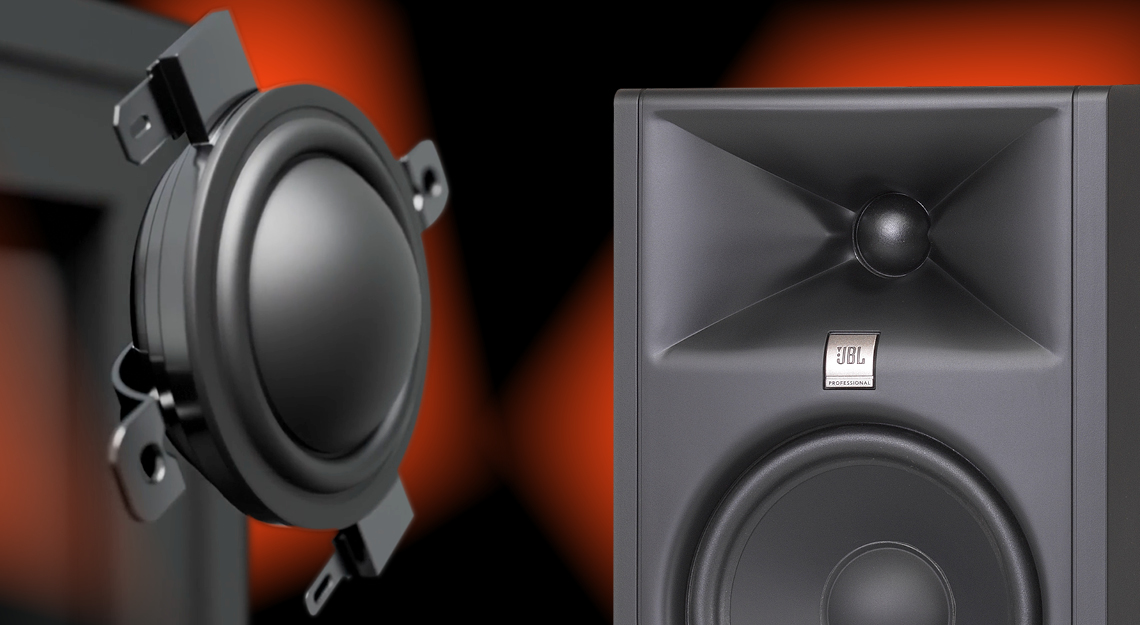
Image: JBL Professional — the MkIII's redesigned low-frequency driver and Image Control Waveguide (official product image)
What's actually new inside the MkIII range
New drivers and waveguide. The high-frequency driver is redesigned and works with an updated Image Control Waveguide, which JBL says gives a wider, more consistent listening area and steadier stereo imaging — so the mix sounds the same when you lean left or right at your desk. The low-frequency drivers use stiffer cone materials, upgraded magnet assemblies and aluminium shorting rings to handle more power with less distortion.
Front-firing port. The Slipstream bass port now fires from the front instead of the rear. That matters in real rooms: rear-ported monitors need space behind them, and most desks sit against a wall. A front port makes bass response more predictable when the speaker is pushed close to a wall or into a corner.
Class D amplification. Every model gets a new Class D amp — 86 W in the 305P, 110 W in the 306P and 308P, and 300 W in the subwoofer. JBL promises more output, more headroom and lower system noise than the outgoing MkII models.
81 room-EQ combinations, no software. Each full-range monitor has four one-touch room controls covering speaker placement, wall distance and high- and low-frequency adjustment — 81 combinations in total. There is no calibration microphone and no app to install, which keeps the setup simple for creators who just want to plug in and work.
Built to scale. Balanced Neutrik combo inputs and switchable +4 dBu/−10 dBV input sensitivity make the monitors easy to connect to interfaces, mixers and playback gear. Integrated M4 mounting points on every full-range monitor let you wall-, ceiling- or arm-mount them and grow from stereo to 2.1, surround or immersive setups. The 310S subwoofer extends response down to 26 Hz and adds selectable crossover settings plus an external bass-management bypass.
Price, availability and the India picture
The range has been on sale in Asia-Pacific, Europe, the Middle East and Africa since 3 November 2026, with North American availability starting on 7 January 2027. Asia-Pacific is explicitly in the first wave, which is good news for Indian buyers — but JBL has not announced India prices or named Indian dealers for the MkIII yet, and Indian retailers had no listings at the time of writing.
Until local pricing appears, the US street prices are the best guide: $199 for the 305P MkIII, $249 for the 306P, $299 for the 308P and $499 for the 310S subwoofer — roughly ₹17,600, ₹22,000, ₹26,500 and ₹44,200 respectively at current rates. Indian prices, when they come, will be higher once import duties and taxes are added, so treat those conversions as a floor, not a quote. The outgoing MkII models are still in stock at retailers, which usually means discounts on the older range in the coming weeks.
One honest caveat: no independent measurements or listening tests of the MkIII exist yet. Everything so far is JBL's own specification and the first reports from the launch — the case for upgrading rests on paper, not on a reviewer's test bench.
Should you care?
✅ Yes, if you mix, edit or produce audio — and your room is a normal room, not a treated studio. The front port and the 81 room-EQ combinations solve the exact problems home creators face, and the 305P MkIII at $199 is the value pick for a desk setup. The 306P is the sweet spot if your room is bigger; the 308P is for low-frequency-critical work.
⏳ Wait, if you already own the MkII — the upgrade case is the room controls and the front port, not output. Audition the MkIII against your current monitors first, and watch for independent measurements before deciding. And if you only listen to music rather than produce it, these are studio tools — regular speakers or headphones will serve you better for the money.
⏳ India buyers should wait for local pricing — importing a pair from the US or Europe means paying shipping and customs on heavy speakers, and warranty support is far simpler through an authorised Indian dealer once stock lands.
FAQs
When will the JBL 3 Series MkIII be available in India?
JBL has not announced an India launch date or India prices. The range went on sale across Asia-Pacific from 3 November 2026, so Indian availability through authorised dealers is expected to follow — check JBL Professional India or an authorised dealer for the first local listings.
How much does the JBL 305P MkIII cost?
The 305P MkIII costs $199 at US street prices (roughly ₹17,600), with a $249 list price. There is no official India price yet; expect the Indian price to be higher once duties and taxes are added.
What is the difference between the 305P, 306P and 308P MkIII?
Driver size and output. The 305P is a 5-inch monitor (45 Hz, 109 dB, 86 W) for compact desks; the 306P is 6.5-inch (43 Hz, 112 dB, 110 W) for project studios; the 308P is 8-inch (41 Hz, 113 dB, 110 W) for larger rooms and bass-heavy work. All three share the new drivers, waveguide, Class D amps and 81 room-EQ combinations.
Should I upgrade from the 3 Series MkII?
Only after an audition. The MkIII's real gains are the front-firing port and the room controls, not raw output, and no independent measurements exist yet to confirm the improvement. The MkII is still in stock and may see discounts, which makes it a bargain if your room already works with rear-ported monitors.
What does the 310S MkIII subwoofer add?
A 10-inch driver, 300 W of Class D power and bass extension down to 26 Hz, with selectable crossover settings and an external bass-management bypass. It is designed for stereo, 2.1, surround and immersive setups, and it pairs with any of the three MkIII monitors.
Takeaway: The JBL 3 Series MkIII is the first full rebuild of the most popular beginner studio monitor line — new drivers, a front port that suits real desks, and 81 room-EQ combinations that need no software. The 305P MkIII at $199 is the one to watch; Indian buyers should wait for local pricing before buying.
If you are setting up a home studio, the next step is to measure your room and check the official JBL Professional page for the model that fits your desk — and keep an eye out for the India price announcement before ordering.
Related reading: OnePlus Buds Pro 4's Dynaudio-tuned dual drivers show how far flagship earbuds have come on sound quality, while Amazon's new Echo Show 16 smart display is the other end of the home-audio spectrum. For open-ear listening, see Samsung's Galaxy Buds On open-ear earbuds.
Sources
- JBL Professional — JBL Professional Introduces 3 Series MkIII Powered Studio Monitors and Subwoofer (official announcement, 3 November 2026)
- JBL Professional — 3 Series MkIII product family page
- Gadgets360 — JBL 3 Series MkIII Studio Monitors Launched Alongside 310S MkIII Subwoofer (6 November 2026)
- StereoNET — JBL Rebuilds Its Affordable 3 Series Studio Monitors for MkIII (4 November 2026)
- OHHIFI — JBL 3 Series MkIII Debuts: New Drivers, Front Ports and a Four-Knob Room EQ (street prices, MkII comparison)
- MySmartPrice — JBL's 3 Series Studio Monitors Get A Ground-Up Refresh With The MkIII Range (India price status)
Comments
Post a Comment