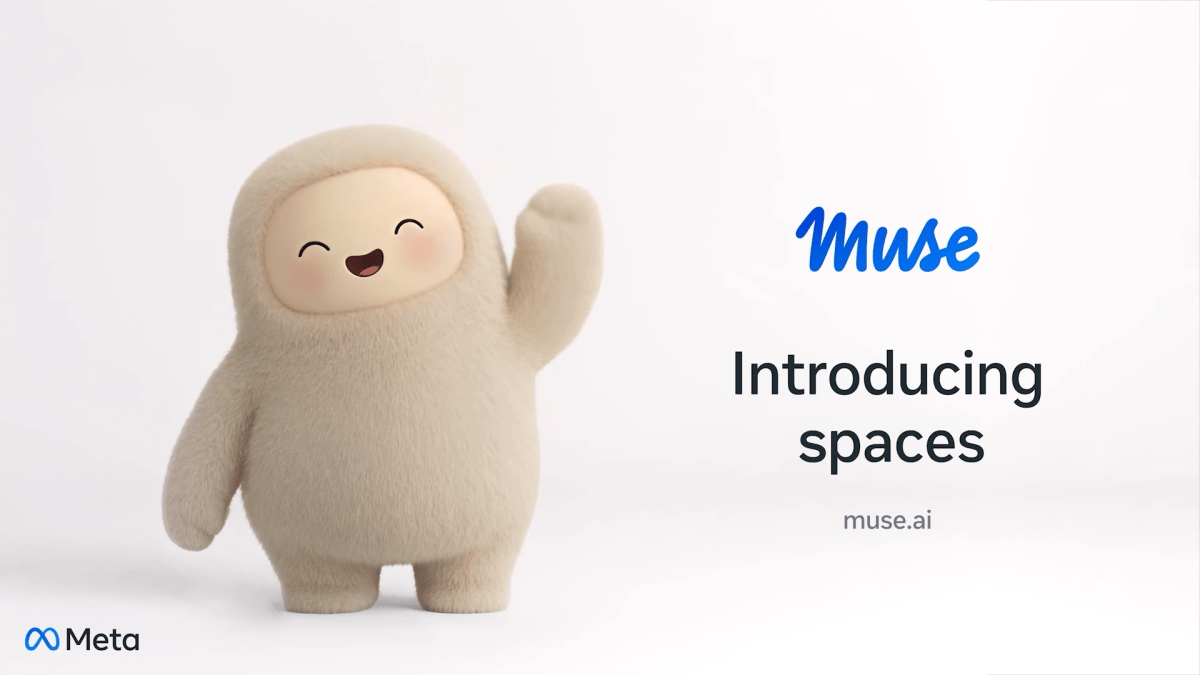
Image: Meta Newsroom — the official visual for Spaces in the Muse app (official product image).
TL;DR — Meta Muse Spaces explained in one line: on 6 November 2026, Meta let Muse users build custom mini-apps — trackers, planners and dashboards — just by describing the idea in chat. The same day, smarter models with Active Memory and Active Focus reached Muse and Meta AI, so the assistant remembers what matters and keeps working through setbacks. Spaces are live wherever Muse is available; India still has no launch date for the Muse app itself.
📌 KEY HIGHLIGHTS
- Spaces launched 6 November 2026: describe an idea in chat and Muse builds a custom experience — a gift tracker, wedding planner, trip planner, school dashboard and more.
- Spaces live where you want them: pin them to the sidebar or main tabs, hide the ones you don't need, or schedule when they appear — a weekday planner up front, weekend plans on Saturday.
- They stay up to date on their own: connect the apps you use and your spaces refresh in the background — new concert dates, price changes, savings progress — without you having to ask.
- Smarter models underneath: specialized models trained using Muse Wonder now power Muse and Meta AI. Active Memory means Muse forgets critical information 2.4 times less often; Active Focus means a 67% improvement in finishing everyday tasks that hit unexpected problems, according to Meta's own evaluations.
- Sharing isn't live yet: Meta says it is exploring ways to let people share spaces with others — for now, every space is personal.
- India: the standalone Muse app has no announced India launch date, but the improved models also reach Meta AI, which is available in India inside WhatsApp, Instagram and Facebook.
What happened?
Meta had a busy week for Muse, its personal AI agent. On 5 November, it rolled out real-time voice conversations and expressive avatars in the Muse app in the United States. On 6 November, two more things landed at once: Spaces, a new way to build custom screens inside Muse, and a model upgrade that brings two headline capabilities from Meta's frontier Muse Wonder model — Active Memory and Active Focus — to everyone who uses Muse and Meta AI.
Muse Wonder itself launched in October 2026 as Meta's most capable model family for personal and professional agent work. The full Wonder models stay reserved for harder tasks and paying subscribers; what arrived on 6 November is different — specialized versions of Meta's existing models, trained using Wonder, that bring some of its behaviour to the everyday assistant millions of people already use. Meta announced the model upgrade in a Meta AI Research blog post, and Spaces in a Meta Newsroom post the same day.
What are Meta Muse Spaces?
A space is a custom experience you create inside Muse by describing your idea. Instead of re-explaining a project every time you open a chat, you describe it once — "build me a wedding planner" or "track my job applications" — and Muse builds a dedicated screen for it. The first version is only a starting point: you keep refining it by asking Muse to add what's missing, change the look, or adjust how it works.
Meta lists nine examples of what people can build, and they show the range — practical, creative and work-related:
| Space | What it does |
|---|---|
| Shopping hub | Gift ideas, wishlists from Instagram saves, Marketplace listings and buyer messages in one view |
| School dashboard | Finds events relevant to your kids in school emails and adds them to your calendar |
| Wedding planner | RSVP list, vendor invoices and to-dos |
| Order tracker | New orders, customer messages and what needs to ship today for a small business |
| Trip planner | Flights, hotel, reservations and a day-by-day itinerary |
| And more | Music tracker, trivia game, podcast studio and a client hub for freelance work |
The useful part is what happens after the space is built. Connect the apps you use, and Meta says your spaces keep themselves up to date in the background — new concert dates, price changes or savings progress show up without you asking. Inside a space you can check things off, add notes and make edits, and everything is still there when you return. Meta has not published a full list of the apps that can be connected, and it has not said how often spaces refresh, so treat the background updates as a promise to test rather than a guarantee.
Spaces are not standalone apps you can download or publish to an app store — they live inside Muse. And one limit matters for teams: sharing is not available yet. Meta says it is exploring ways for people to share spaces to build a more collaborative experience, but no date has been given.
Active Memory and Active Focus: the smarter models underneath
Spaces are the visible change; the model upgrade is the deeper one. Meta trained specialized versions of its models using Muse Wonder, and two Wonder capabilities now reach Muse and Meta AI users.
Active Memory is the assistant remembering what matters across conversations. Meta says the models were trained to recognise what type of information is temporary versus permanent, to reason across time, and to tell what is still relevant from what has gone stale. The headline number: in Muse, the improved models show a 2.4 times reduction in forgetting critical information needed to help you reach your goals. In plain terms, you should have to repeat yourself less — a preference, a deadline or a decision from last week resurfaces when it becomes relevant again.
Image: Meta AI Research — the official visual for Muse's models (official image).
Active Focus is persistence. Meta trained the models on a variety of real-world bottlenecks, so when a task hits an unexpected problem they try harder, recover, or find an alternative instead of stopping. Meta reports a 67% improvement in completing everyday Muse tasks where unexpected issues arise. The models also learned to be better multi-taskers — knowing when to push on your goals independently and when to collaborate live with you — and to adapt when you steer or clarify mid-task without getting confused.
In Meta AI, the same improvements are meant to make it a better thinking partner: breaking complex problems into clear steps, asking sharper follow-up questions, and keeping up when you change direction mid-conversation. One honest caveat: both the 2.4 times and 67% figures come from Meta's own evaluations, and no independent testing has been published — so treat them as Meta's claims about its models, not as verified results. The pattern is familiar across the industry: OpenAI's always-on Dots agents and Anthropic's proactive agents make similar persistence promises, and the real test in every case is weeks of everyday use.
What it means for readers in India
The honest answer is: the Muse app itself is not here yet. Meta says spaces are available everywhere Muse is available, and Muse currently covers the United States, Canada, Japan, Singapore and Mexico — Meta has not announced a launch date for India. So Indian readers cannot build a Space today, and should not assume otherwise from the global announcement.
What does reach India is the model upgrade. Meta AI — the assistant built into WhatsApp, Instagram, Facebook and Messenger — is available in India, and the specialized models are rolling out to Meta AI as well as to Muse. That means the Active Memory and Active Focus improvements should show up in the Meta AI many Indian readers already use: a multi-step question that spans two conversations, a plan that survives a change of direction, a follow-up that remembers the context. If you use Meta AI, that is where you will feel this update first.
There is also a strategic angle worth noting. Meta is folding its frontier model work into everyday products rather than keeping it behind a developer API — the same week it acquired the AI coding startup Conductor to strengthen its agent tooling. The race among the big labs is no longer just about benchmark scores — recent agent benchmarks show even the best models completing only a small fraction of long tasks — it is about which assistant actually remembers, persists and finishes the job. Spaces are Meta's bet that the answer is a persistent, personal workspace, not another chat thread.
Should you care?
✅ Yes, if you already use Meta AI or have Muse access. Active Memory fixes the most annoying thing about AI assistants — repeating yourself — and Spaces turn one-off chats into reusable tools. Try a Space for the one tracker you keep rebuilding: a gift list, a trip plan, a job search board.
⏳ Wait, if you are in India and only want Spaces. The Muse app has no India date yet, so there is nothing to install. Use the improved Meta AI inside WhatsApp or Instagram instead, and watch for a Muse India announcement before paying anyone for "early access" — Meta has announced no such programme.
FAQs
What are Meta Muse Spaces?
Spaces are custom experiences you create inside Meta's Muse app by describing an idea in chat — for example, a gift tracker, a wedding planner or a trip planner. Muse builds the space, you refine it by asking for changes, and it stays in your sidebar or tabs, updating itself from your connected apps.
What is Active Memory in Meta Muse?
Active Memory is Muse's ability to remember what matters across conversations and bring back relevant details when they matter again. Meta says its improved models forget critical information 2.4 times less often, based on its own evaluations, by distinguishing permanent information from temporary notes and reasoning across time.
Is Meta Muse available in India?
Not yet. The standalone Muse app is currently available in the United States, Canada, Japan, Singapore and Mexico, and Meta has not announced an India launch date. However, the improved models also roll out to Meta AI, which is available in India inside WhatsApp, Instagram, Facebook and Messenger.
Can you share a Space with someone else?
Not at launch. Meta says spaces are personal from the start and it is exploring ways to let people share them for a more collaborative experience, but no date has been given.
Takeaway: Meta's 6 November update gives Muse a memory and a workspace — Spaces turn a described idea into a reusable mini-app, and Active Memory and Active Focus make the assistant remember more and give up less. Indian readers get the smarter models inside Meta AI now; the Muse app itself is still waiting on an India date.
If you already chat with Meta AI inside WhatsApp or Instagram, give it a multi-step job that spans two conversations and see whether it picks up the thread — that is Active Memory in action.
Sources
- Meta Newsroom — Design the Muse App, Just for You (6 November 2026)
- Meta AI Research — Bringing Specialized Models to Muse and Meta AI (6 November 2026)
- Digital Trends — Meta now lets you build your own mini-app experiences called spaces in the Muse app
- ShiftDelete — Meta Muse Models Bring Active Memory to All Meta AI Users
- Meta Newsroom — Give Your Muse a Voice (5 November 2026)
Comments
Post a Comment