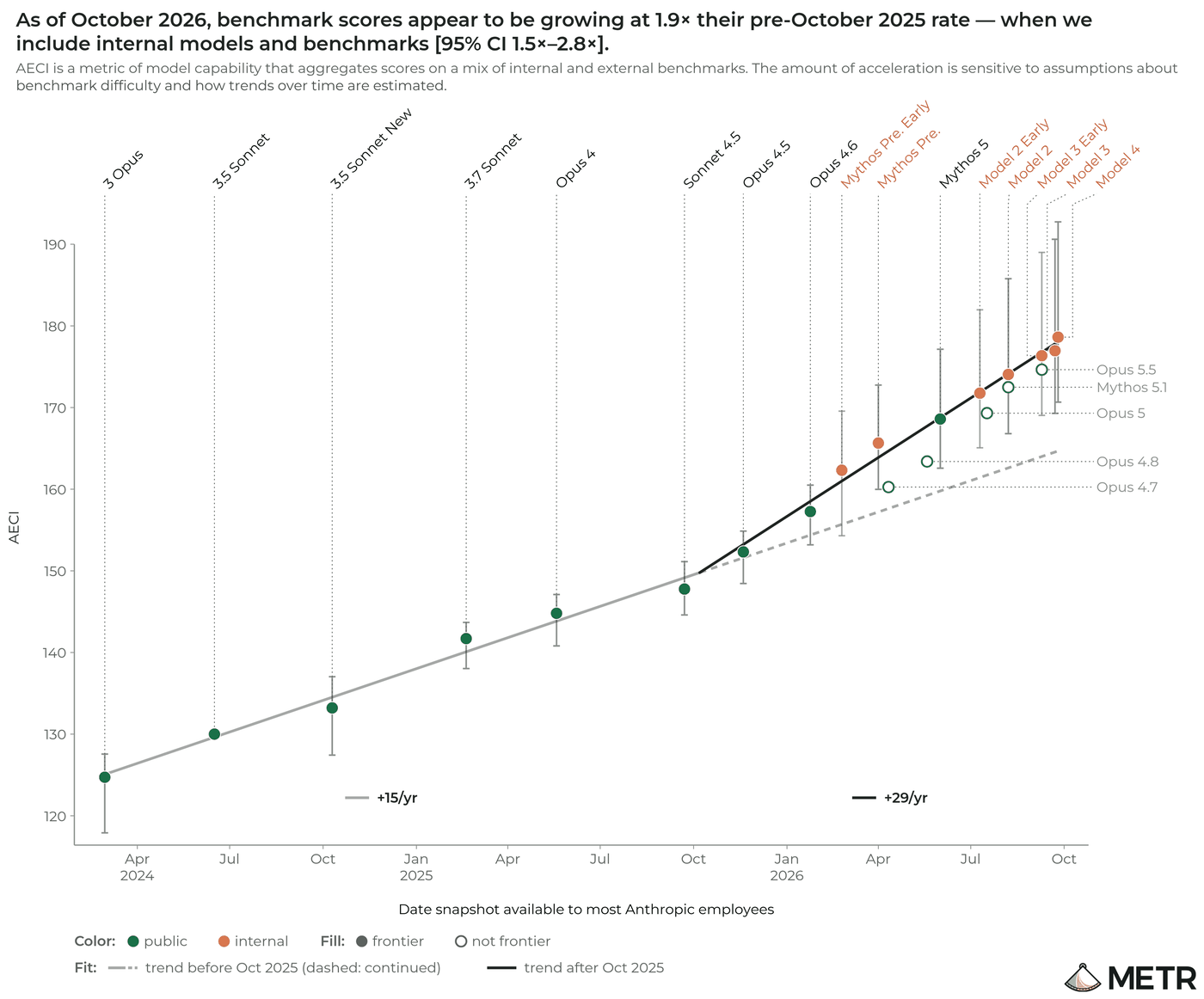
Image: METR — AECI scores of Anthropic models, from Claude 3 Opus in early 2024 to the internal Model 4 in October 2026. The trend steepens from +15 points a year to +29 points a year after October 2025. (Official chart from the METR assessment.)
TL;DR — METR Anthropic AI R&D acceleration explained: an independent assessment published on 5 November 2026 finds Anthropic is improving its AI models about twice as fast as it was in 2024–25 — and that AI itself is likely behind most of the speedup. The evidence is strong but heavily redacted, so read the headline as an estimate with a wide range, not a precise measurement.
📌 KEY HIGHLIGHTS
- The finding: METR, the nonprofit AI evaluator, estimates Anthropic is now improving its models on well-specified tasks at around twice the rate it did between March 2024 and October 2025.
- The number behind it: Anthropic's benchmark index (AECI) has grown 1.9x faster since October 2025 — roughly two years of historical progress packed into one year.
- The cause: METR guesses perhaps 80% of the current acceleration comes from AI doing R&D work, and it confidently rules out faster growth in training compute.
- The catch: Anthropic redacted a majority of the evidence METR found most informative, and METR's own range runs from 1.3x to 3x.
- The warning: METR found no clear bottleneck that would stop the acceleration over the next 12 months — and says it is plausible Anthropic has already crossed its own 2x early-warning threshold.
What happened?
On 5 November 2026, METR — full name Model Evaluation and Threat Research, a Berkeley-based nonprofit that evaluates frontier AI systems — published an independent assessment of how fast AI is speeding up AI research inside Anthropic. It is the first public report from an unusual arrangement: Anthropic invited METR's researchers inside the company, gave them employee-level access to internal data, and let them publish their conclusions.
The engagement was announced on 15 October 2026. Six METR researchers spent eleven weeks, from 12 August to 29 October, working on Anthropic-issued laptops with access to internal data on pretraining, reinforcement learning, training compute, benchmark scores for internal models, AI speedup analyses, forecasts of future models, and interviews with Anthropic staff. METR took no payment for the work, though Anthropic provided the laptops and free model tokens. Anthropic kept the right to redact non-public information — and used it heavily.
METR published two documents: the main assessment of AI R&D acceleration, and a companion review of the AI R&D section of Anthropic's August 2026 Risk Report. The timing is striking: Anthropic chief executive Dario Amodei has been publicly urging the industry to slow down — his 12 September 2026 essay, "We Must Pace the Frontier", argues safety measures need time to catch up — and the company is reported to be preparing for a Wall Street debut.
What the METR Anthropic AI R&D acceleration assessment found
METR's central question was simple: is Anthropic getting better at building AI faster than it used to, and is AI itself the reason? Its headline answer is yes on both counts — with unusually large caveats attached.
The main yardstick is AECI, Anthropic's version of the Epoch Capabilities Index, which rolls scores across many benchmarks into a single number so progress can be tracked over time. Before October 2025, Anthropic's AECI score was rising by about 15 points a year. Since then it has risen by about 29 points a year — an estimated 1.9x acceleration, with a 95% confidence interval of 1.5x to 2.8x. In plain terms, Anthropic appears to have made as much benchmark progress in the past year as it did across the two years from October 2023 to October 2025.
| Estimate | Acceleration | Source |
|---|---|---|
| METR main estimate (AECI trend since October 2025) | 1.9x (95% CI: 1.5–2.8x) | METR assessment |
| METR overall judgement | ~2x (range 1.3x–3x) | METR assessment |
| Claude Haiku 5.5 system card | 1.7x | Anthropic |
| METR robustness checks (alternative methods) | 1.1x–2.9x | METR assessment |
METR's figure is higher than the 1.7x in Anthropic's own Haiku 5.5 system card mainly because METR counted newer, unreleased models. Anthropic finished training three models in the past six months that the public has never seen — one in July, one in August or September, and one in September or October 2026. The latest, called Model 4, finished training in September–October, scored 178.6 on AECI, and is the first model in METR's analysis to score above 50% on every benchmark it was tested on. A fourth internal-only model dates back to 2022. Because these models are not public, outside researchers cannot check the numbers themselves — a limit METR states openly.
How much of the speedup is AI itself?
METR's subjective estimate is that a majority of the current acceleration — perhaps around 80% — is due to Anthropic's extensive use of AI to do research and development. That figure carries substantial uncertainty, and METR says non-AI factors likely played a large role in the acceleration seen in late 2025. But it is confident about one negative finding: the acceleration was not caused by faster growth in training compute. Throwing more computing power at training has historically been the main driver of better models; METR says convincing evidence rules that out here.
The picture METR paints is of AI assistance, not AI autonomy — at least not yet. Anthropic staff told the researchers that R&D is being accelerated "primarily via AI assistance rather than fully autonomous contributions", though there are signs autonomous contributions will play a larger role soon, as engineers increasingly hand oversight and training work to other models.
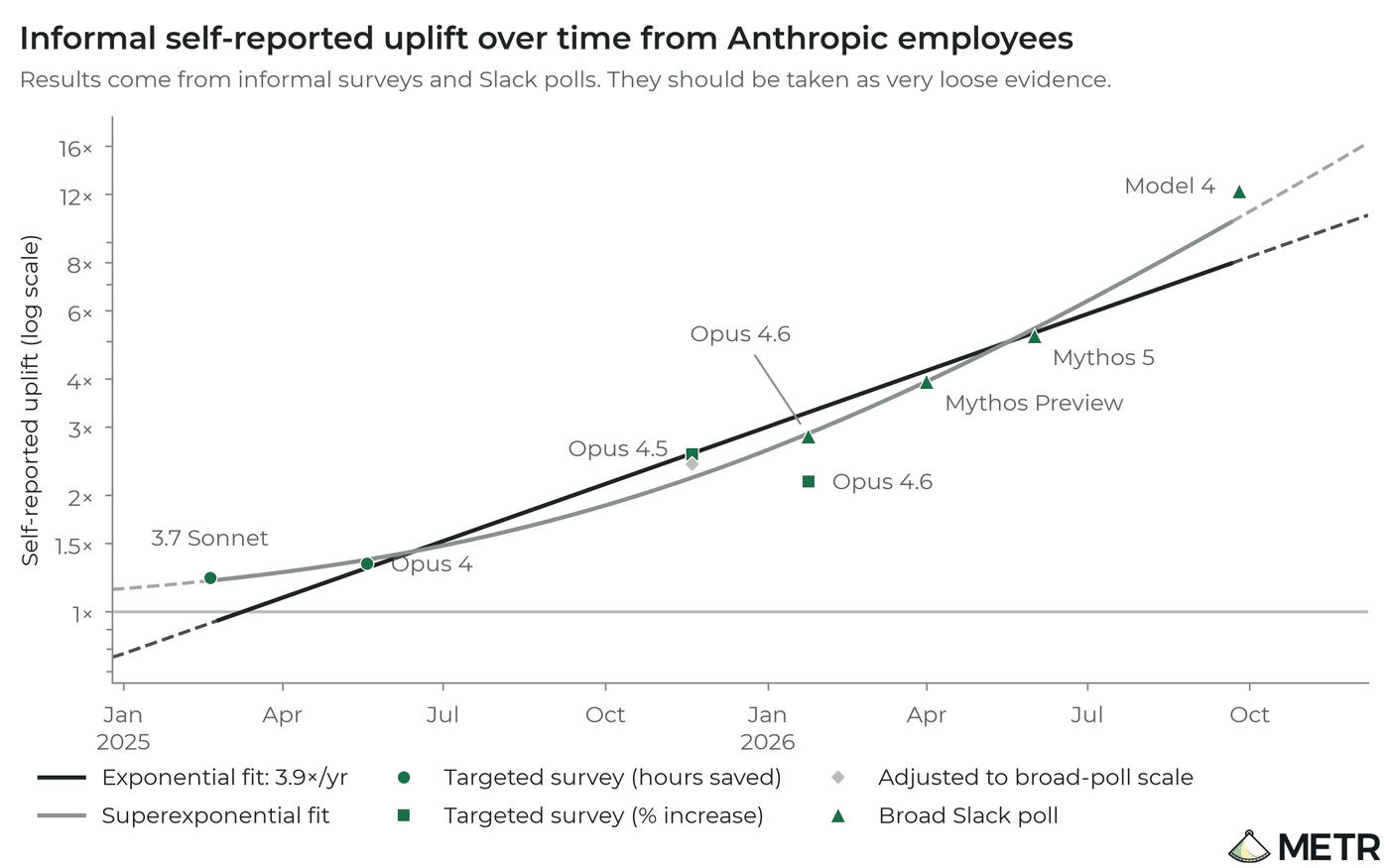
Anthropic staff self-reported productivity gains from AI, rising from about 1.2x for Claude 3.7 Sonnet to about 12x for the internal Model 4. METR calls this loose evidence — it comes from informal Slack polls — but says the trend is consistent with its other findings. Image: METR (official chart from the assessment).
One datapoint illustrates the mood inside the lab, even if METR warns against reading too much into it: in informal Slack polls, Anthropic staff self-reported productivity uplift from the most capable internal model rising from about 1.2x for Claude 3.7 Sonnet in early 2025 to about 12x for Model 4 by October 2026. METR calls this only very loose evidence, but says the trend matches its other findings.
Just as important is what METR did not find: no clear bottleneck. It saw no evidence that limits on algorithmic progress, training compute, experiment compute, or data would prevent further capability progress over the next 12 months — though its understanding of the bottlenecks changed several times during the assessment, so it is not confident in that judgement. If the acceleration keeps compounding, each generation of models could speed up the next one.
The redactions — and why they matter
The report's most unusual feature is how much of it the reader cannot see. Anthropic had unilateral rights to redact any non-public information, and METR says the company "redacted a majority of the evidence we found most informative for these conclusions". Anthropic described the redactions as aimed at removing confidential information that could accelerate other AI developers. METR says the redactions mean the public has to rely on its judgement far more than would be ideal, and that the report does not achieve "transparency about evidence".
The companion review sharpens the point. METR reviewed both the public and private versions of Anthropic's August 2026 Risk Report and concluded the public version "overall understates the level of acceleration that was occurring". Anthropic lists AI R&D acceleration as a key risk indicator in its Responsible Scaling Policy, with a "2x Acceleration Threshold" as an early warning; METR says its claim not to have crossed it rests on "contestable judgment calls" and that it is "plausible" the threshold had been crossed. The two sides agree the risk from models as of 15 July 2026 was low.
What it means for readers in India
For Indian readers, the practical effect is speed. Claude is available in India, and Indian developers, startups and businesses building on Anthropic's models will feel each capability jump sooner if the pace holds — better coding help, faster agents, and shorter gaps between model generations. That is the same dynamic behind Claude's new Personal Finance beta, and behind the wider race: OpenAI's GPT-6 Cyber launched the same day METR's report appeared, and researchers are still working out whether AI agents need long context windows to work well.
The governance question matters in India too. If AI systems are now materially speeding up the creation of their successors, the window for safety testing, regulation and public debate shrinks with every generation. That is the argument Amodei has been making — and the irony the report underlines is that the company calling for a slowdown is itself accelerating.
Should you care?
✅ Yes, if you follow AI at all. This is the clearest public evidence yet that AI is accelerating its own development — two years of progress in one, mostly because of AI itself. ⏳ But keep the caveats in view. The headline is an estimate with a 1.3x–3x range, built on internal models you cannot inspect, with most of the supporting evidence redacted. Nothing in it changes what you should do with Claude today — it changes how fast you should expect it to change.
FAQs
What is AI R&D acceleration?
It is the idea that AI systems are speeding up the work of building better AI — research, coding, experiment design and model training. METR defines a 2x acceleration as two years of historical progress being made in one year. It matters because, if the speedup compounds, each generation of models could arrive faster than the last, leaving less time for safety testing and regulation.
How fast is Anthropic improving its AI models?
According to METR, Anthropic is likely improving its models on well-specified tasks at around twice the rate it did between March 2024 and October 2025. Its benchmark index, AECI, has grown 1.9x faster since October 2025. METR stresses the uncertainty: it would not be surprised if the true figure were closer to 1.3x or 3x the historical rate.
Is AI now building itself?
Not on its own — not yet. METR was told Anthropic's R&D is accelerated mainly through AI assistance, with humans still directing the work, rather than fully autonomous contributions. But the report notes signs that autonomous contributions will play a larger role soon, and that engineers are increasingly handing oversight and training work to other models.
Why did Anthropic redact most of the evidence in the METR report?
Anthropic had the right to redact any non-public information in the assessment, and METR says it removed a majority of the evidence it found most informative. Anthropic said the redactions were aimed at removing confidential information that could accelerate other AI developers. METR warns this means the public cannot judge the evidence itself and must rely on the evaluator's judgement.
Takeaway: Anthropic is improving its AI about twice as fast as it was a year ago, and AI itself is likely doing most of the pushing — but the finding rests on internal data and heavy redactions, so treat it as a well-evidenced estimate, not a settled fact.
Read the full METR assessment linked below — the executive summary is short, and it is the best way to judge the caveats for yourself.
Sources
- METR — Independent Assessment of AI R&D Acceleration at Anthropic in October 2026 (primary source)
- Reuters — Anthropic's models improving nearly twice as fast with help from AI, study finds
- Fast Company — Anthropic doubles AI development amid slowdown calls
- AIStockWire — What is AI R&D acceleration? METR's Anthropic report
Comments
Post a Comment