OpenAI Daybreak Red Team Explained: AI Pen-Testing, Defense Factory Patches and What It Means for Security Teams
Image: OpenAI — Daybreak Red Team (official product image)
TL;DR: OpenAI Daybreak Red Team explained in one line: on 12 November 2026, OpenAI launched two AI security products — Daybreak Red Team, a team of AI agents that penetration-tests web applications, and Daybreak Defense Factory, which turns confirmed vulnerabilities into patches for engineers to review. Red Team is in early access behind a waitlist, Defense Factory ships through a Codex plugin, and OpenAI has announced no pricing for either.
Key Highlights
- Announced 12 November 2026 at OpenAI's "Cyber at the Frontier" keynote by president Greg Brockman.
- Daybreak Red Team sends a coordinated team of AI agents to test web apps, validate flaws and re-test patches — early access, with a waitlist now open.
- Daybreak Defense Factory uses agents built on GPT-6 Cyber to scan code and draft fixes; engineers review and test every patch before it merges.
- No pricing has been announced for either product.
- The launch follows GPT-6 Cyber's release the previous week — and landed on the same day nonprofits sued OpenAI and other labs to halt training of more capable models.
What happened?
OpenAI used its "Cyber at the Frontier" keynote on Thursday, 12 November 2026, to unveil two products under its Daybreak security platform. The pitch, in president Greg Brockman's words, is that "companies will be secure only to the extent of the frontier model that they use to defend themselves and how well they utilize that." In plain terms: attackers are already using AI to find flaws faster, so OpenAI wants defenders to have frontier AI on their side too.
Johannes Landgraf, OpenAI's head of cyber, told reporters the "defender's window" — the time defenders have to find and fix a weakness before attackers exploit it — is "under pressure" as capable models become widely available. "Attackers are able to move faster. I think we see that right now almost on a daily basis," he said. "Defenders also have to move faster at that."
The two products attack opposite ends of the same problem: one finds the holes, the other closes them.
OpenAI Daybreak Red Team explained: how the agent team works
Daybreak Red Team is a penetration-testing service run by AI agents rather than a single model. A coordinator agent plans the assessment, other agents investigate source code and application context to trace attack paths, and reviewer agents check the results before anything is reported. That structure matters because a lone model guessing at vulnerabilities produces noisy, unprioritised lists — the review step is what turns findings into something a security team can act on.
The service does three specific jobs. First, it tests web applications for exploitable flaws, using code and live app context rather than just scanning. Second, it validates reported vulnerabilities — findings from code scanners, bug-bounty submissions and disclosure reports can be checked against evidence, so teams can prioritise what is genuinely exploitable. Third, it checks that fixes hold: after a patch ships, Red Team re-tests whether the exploit is actually blocked, and repeats the assessment as the application changes.
Control is built in, not bolted on. Assessments run in isolated environments with Guardian review, operators set the scope — which apps and endpoints agents may reach — and can choose synthetic test data or read-only checks. Nancy Wang, who leads cyber-applied AI at OpenAI, described the service as delivering "superhuman pen-test at the scale of automated continuous scanning" — OpenAI's own framing, not an independently verified claim.
What Daybreak Defense Factory does
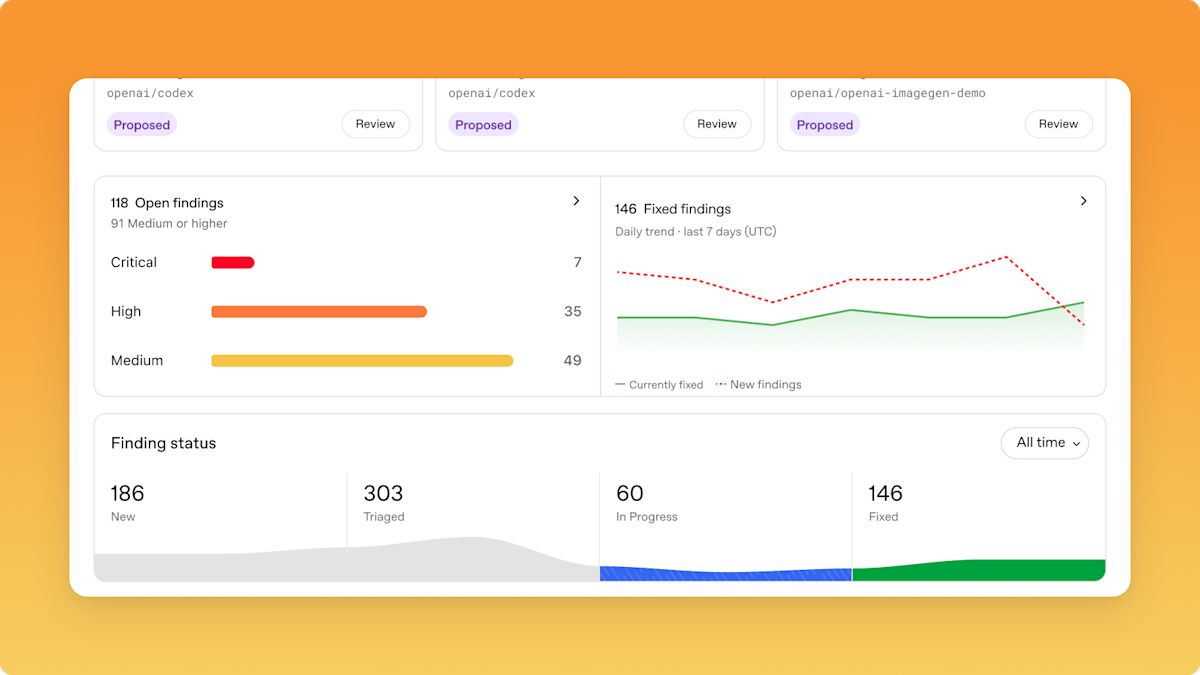
Image: OpenAI — Daybreak Defense Factory dashboard (official product image)
Defense Factory is the other half of the loop. Its agents — built on GPT-6 Cyber, OpenAI's security-specialised model — investigate vulnerabilities in a codebase and prepare patches, which engineers review and test before anything merges. It pulls in findings from a team's existing security tools as well as from Daybreak Red Team, so the output of the testing side flows directly into the fixing side.
It builds on Codex Security, OpenAI's earlier code-scanning agent, and works inside Codex: engineers can add context, examine the evidence behind a finding, tune a proposed patch and test the change while agents keep working in the background. Scans can run on new commits or on a recurring schedule, so the loop keeps going as code changes.
The idea is not new inside OpenAI — the company has been running this "defense factory" approach internally, and payments company Block reported using it to chain a simulated multi-stage attack in about two hours and produce a proposed patch in 18 minutes. Those are vendor-reported figures from Block's own environment, not independent benchmarks, and the 18 minutes covers a proposed patch, not a deployed fix.
Red Team vs Defense Factory at a glance
| Product | What it does | Availability |
|---|---|---|
| Daybreak Red Team | AI agents pen-test web apps, validate reported flaws, re-test patches | Early access, waitlist open |
| Daybreak Defense Factory | Agents on GPT-6 Cyber draft patches for engineer review in Codex | Via the Daybreak plugin in Codex |
| Daybreak (the platform) | Governed access to frontier cyber models for vetted defenders | Running since May 2026 |
Why it matters for Indian readers
India's security-talent shortage is the real audience for this launch. Most Indian startups and SaaS teams ship large amounts of code with small security teams — or none at all — and OpenAI explicitly designed both products to be "turnkey and easy to use" for organisations without red-team staff. A tool that tests an app continuously and drafts patches could close part of that gap, especially as AI-generated code increases the volume of code that needs securing.
But the limits matter as much as the promise. Neither product has announced pricing, and there is no India-specific availability or pricing detail — early access is a waitlist, not a launch in India. And the products do not remove the human: Clint Gibler, who leads cybersecurity research at OpenAI, said the goal is not to replace a conventional red team but to bridge the gap between what defenders can protect and the sheer amount of code AI now generates. Every patch still needs an engineer to review it before it merges. For Indian teams, the honest read is that this is a capability to watch and join the waitlist for — not a security solution to buy today.
The timing adds a wrinkle worth noting. On the same day, a coalition of nonprofits — including Public Citizen and the Heat Initiative — sued OpenAI, Anthropic, Google, Meta and SpaceX in a San Francisco court, asking a judge to halt development of AI models more capable than the companies' existing systems. The suit does not target Daybreak itself, but it is a reminder that the same frontier models OpenAI is selling as defense are the ones critics want restrained.
Should you care?
✅ Yes, if you build or run web applications. Continuous AI pen-testing plus AI-drafted patches is a genuine shift in how small teams can defend software — join the Red Team waitlist and watch how Defense Factory performs in Codex. ⏳ Wait, if you want a finished product. There is no pricing, no public performance data beyond vendor claims, and no India-specific rollout yet. Treat this as early access, not a purchase decision.
Price, availability and limits
OpenAI has announced no pricing for either product. Daybreak Red Team is launching in early access with select customers and a waitlist open now; Daybreak Defense Factory is available through the Daybreak plugin in Codex. Access to the underlying Daybreak cyber models remains governed — OpenAI vets defenders before granting access, and the models run with guardrails retuned for legitimate security work. One important distinction: Daybreak itself is not new. The programme began in May 2026 and split into Blue and Red tiers in August 2026; what launched on 12 November is the two named products on top of it. The blog has covered the surrounding story before — including Anthropic's self-hosted Claude Managed Agents private beta, which takes the opposite approach by letting companies run agents on their own servers.
FAQs
What is OpenAI Daybreak?
Daybreak is OpenAI's cybersecurity programme, introduced in May 2026, that gives vetted security teams governed access to frontier cyber models for legitimate defensive work. The 12 November launch adds two named products to it: Daybreak Red Team for testing and Daybreak Defense Factory for fixing.
How is Daybreak Red Team different from a normal penetration test?
A human pen-test is a point-in-time exercise by a small team. Red Team uses a coordinated team of AI agents that can test continuously, validate scanner and bug-bounty findings against evidence, and re-test patches as the app changes — but OpenAI says it is meant to extend human red teams, not replace them.
Is Daybreak Defense Factory available now?
It is available through the Daybreak plugin in Codex. Daybreak Red Team is in early access with select customers and a waitlist. Neither product has announced pricing, and no India-specific availability has been stated.
Does Daybreak replace human security teams?
No. Agents investigate and propose patches, but engineers must review and test every patch before it merges, and assessments run under operator-set scope controls with human review. OpenAI positions the tools as a way to scale scarce security expertise, not to remove it.
Takeaway
OpenAI's Daybreak launch turns AI from a security worry into a security tool — agents that test your apps and draft your patches. The idea is strong, the early-access reality is narrow, and the human still signs off on every fix.
If your team ships web apps, the practical next step is to check how often your code is actually tested — our breakdown of the ScreenConnect MSP attacks shows what happens when that testing lags, and MongoDB's critical 9.5 flaw is a reminder to patch what scanners already found.
Sources
OpenAI — Cyber at the Frontier (launch hub)
OpenAI — Daybreak Red Team
OpenAI — Daybreak Defense Factory
The Deep View — OpenAI sees a new enterprise frontier in cyber (12 Nov 2026)
The Register — OpenAI launches security products (12 Nov 2026)
Comments
Post a Comment