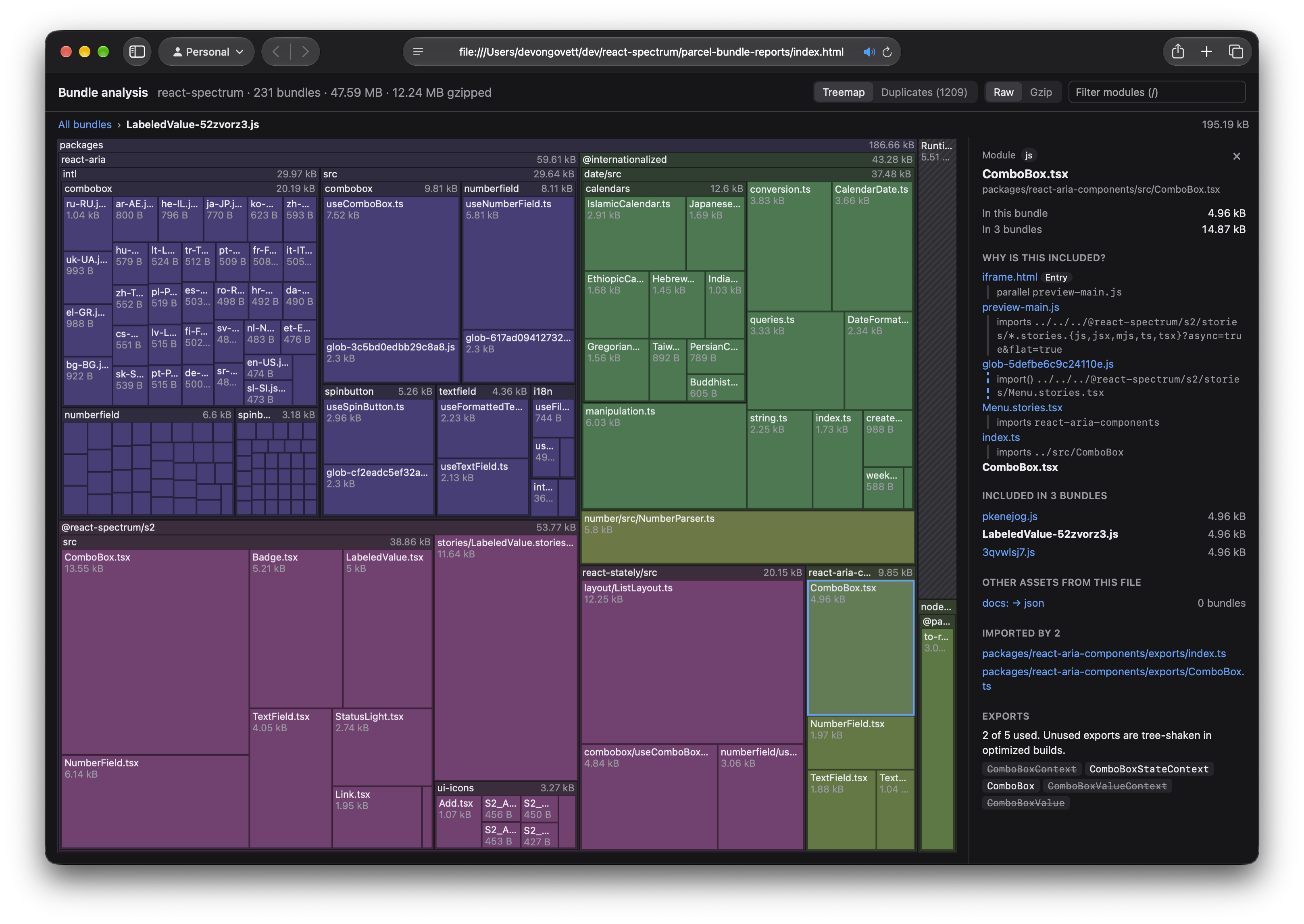
Image: Parcel — Parcel 3's built-in bundle analyzer (official announcement visual from the Parcel 3 alpha post, 4 November 2026).
TL;DR — Parcel 3 alpha Rust bundler explained in one line: Parcel's popular zero-config web bundler has been rewritten from the ground up in Rust, and the team says cold development builds run up to 100x faster than Parcel 2. The first alpha landed on 4 November 2026 as version 3.0.0-alpha.2 on npm, as a self-contained binary under 30 MB with no Node.js dependency at all — but it is an alpha, so production projects should wait.
📌 KEY HIGHLIGHTS
- Announced 4 November 2026: the first alpha of Parcel 3, a ground-up Rust rewrite of the zero-config web bundler. Install it with
npm install parcel@next, or side by side with v2 via@parcel/parcel3. - Up to 100x faster builds: Parcel's own benchmark on the large React Spectrum TypeScript monorepo shows cold development builds up to 100 times faster than v2, using the same underlying compilers — only the core changed.
- No Node.js required: Parcel 3 is a single self-contained Rust binary under 30 MB with zero npm dependencies — about 4x smaller than a Parcel 2 install (~120 MB).
- Native plugins: extend it in Rust, Go, Swift or C through a stable C ABI, with SDKs for Rust, Go and Swift; simple plugins can still be written in JavaScript or TypeScript on an embedded QuickJS runtime.
- Still an alpha: TypeScript
.d.tsgeneration, compressor plugins, custom bundler plugins and a programmatic JavaScript API are not ready yet — the team lists them as in progress, with known issues.
Parcel 3 alpha Rust bundler explained: what actually shipped
Parcel is the "zero configuration" web application bundler: point it at an HTML file and it works out the rest — JavaScript, CSS, images, fonts and more — without the config files tools like webpack demand. It is widely used by frontend teams, including at Atlassian and Adobe, and version 2 had already moved several pieces into Rust: its JavaScript compiler (built on SWC), Lightning CSS, and its HTML and SVG transformers.
What changed on 4 November 2026 is the core itself. In Parcel 2, the core that tied everything together was still written in JavaScript, which limited performance: no shared memory between threads, high memory usage, garbage collection pauses, and the cost of serialising values between workers and languages. Parcel 3 rewrites that core in Rust, so everything from the command-line interface and dev server to the transformers, bundler and optimizers is now fully native code in one binary.
The npm registry corroborates the announcement: the parcel@next dist-tag now points to version 3.0.0-alpha.2, published on 4 November 2026, while the stable latest tag remains on Parcel 2 (2.16.4). There is no stable release date for Parcel 3 yet — the team has announced only this alpha, and says feedback should go to its GitHub repository.
Why the Rust rewrite is so much faster
The headline number — up to 100x faster — comes from Parcel's own cold development build benchmark on React Spectrum, a large TypeScript monorepo with roughly 100 Storybook entries, a ~340-page docs site and a library build of about 160 packages producing over 14,000 files. "Cold" matters here: it means a build with no cache to lean on, the slowest case for any bundler.
Parcel 3 also changes its philosophy on caching. Parcel 2 invested heavily in disk caching and incremental builds; Parcel 3 optimises for the fastest possible cold builds instead, keeping only in-memory incremental rebuilds. The team argues that tracking every file, environment variable and config change that could invalidate a disk cache adds overhead and causes stale-cache bugs — and when a full rebuild is fast enough, it is simpler to just rebuild.
| Feature | Parcel 2 | Parcel 3 alpha |
|---|---|---|
| Core language | JavaScript core, some Rust pieces | Fully native Rust binary |
| Node.js dependency | Required | None — self-contained binary |
| Install size | ~120 MB with dependencies | Under 30 MB, zero npm dependencies |
| Cold dev builds (React Spectrum) | Baseline | Up to 100x faster |
| Smarter bundling (450-page site) | Baseline | 64% fewer HTTP requests, 10% fewer bytes |
| Plugins | JavaScript plugins, hundreds of npm packages | Native (Rust/Go/Swift/C) + JS/TS on QuickJS |

Illustrative image: the Rust programming language logo — Parcel 3 is a ground-up rewrite in Rust (Wikimedia Commons).
What else is new in Parcel 3 alpha
Native plugins through a C ABI. Parcel 3 can be extended with plugins written in Rust, Go, Swift or any language that supports the C ABI, loaded as dynamic libraries at runtime. Parcel exposes a stable C API for reading and setting asset content and inspecting the bundle graph, and ships SDKs for Rust, Go and Swift plus a reusable GitHub Actions workflow for cross-compiling and publishing plugins to npm.
JavaScript plugins still work — on QuickJS. For simple or rarely-called plugins, Parcel 3 embeds a custom JavaScript runtime built on the QuickJS engine, with partial Node.js compatibility for the features build plugins commonly use — deliberately without network access. QuickJS starts fast, uses little memory and can run on many threads in parallel. Most v2 JavaScript plugins are compatible, with minor API differences covered in the migration guide.
Batteries included, in one binary. Support for HTML, CSS, JavaScript, TypeScript, SVG, image conversion and optimization, RSS and Atom feeds and web manifests is built in, with no hundreds of plugin packages to upgrade. New additions include native Tailwind support without PostCSS, React Compiler, MDX, SVG-to-JSX and glob imports. A new parcel run command builds and runs a Node.js entry point with hot module replacement, aimed at React Server Components and other server code.
Smarter bundling and better libraries. An improved bundle-merging cost model cut HTTP requests per page by 64% and transferred bytes by 10% on a 450-page test site. Tree shaking now covers SVG as well as ESM, CommonJS and CSS modules, while scope hoisting has been removed to cut bug surface area and enable top-level await. Library mode now reads package.json#exports — including nested and multi-entry packages — and builds every target in parallel to ESM and CJS.
Developer experience. There is a built-in bundle analyzer showing why each module is included and which bundles load others, trusted HTTPS through a local certificate authority that integrates with the operating system, and an improved --open option that reuses an existing browser tab on macOS. Plugin configuration is now centralised in .parcelrc instead of being scattered across .babelrc, .postcssrc and package.json.
What is still missing — and should you switch now?
Short answer: try it, do not migrate production yet. Parcel 3 is explicitly an alpha, and the announcement lists what is still being built: compressor plugins, TypeScript .d.ts generation (promised to return in a future release), custom bundler plugins, a programmatic JavaScript API, and known issues the team has not yet fixed. Library authors in particular should note the missing .d.ts output before adopting it.
✅ Should you care? If you build frontend apps with Parcel, this is the most important Parcel release in years — the 100x cold-build claim, if it holds on real projects, removes the slowest part of the Parcel workflow. But it is an alpha: install it side by side with @parcel/parcel3, benchmark it on your own codebase, and keep Parcel 2 for production until the stable release and the missing pieces land.
How to try Parcel 3 alpha
Install the alpha with npm install parcel@next. To keep Parcel 2 installed at the same time, install @parcel/parcel3 instead and use the parcel3 command. The Parcel team asks for feedback on GitHub, and the announcement links a migration guide covering the API differences for JavaScript plugins. As with any alpha, expect breaking changes before the stable release — there is no announced date for that yet.
For developers in India, the practical angle is the same as everywhere else: Parcel 3's single small binary and lack of a Node.js dependency make it lighter to install in CI pipelines and on fresh machines, and the built-in Tailwind, MDX and React Compiler support removes several packages from a typical frontend setup. The speed claim is the team's own benchmark, though — the honest test is your own project's cold build time.
FAQs
What is Parcel 3 alpha?
It is the first alpha release of Parcel 3, announced on 4 November 2026 — a ground-up rewrite of the Parcel web bundler in Rust. It is available on npm as version 3.0.0-alpha.2 under the parcel@next tag, while the stable release remains Parcel 2.
Is Parcel 3 really 100x faster than Parcel 2?
Up to 100x faster on cold development builds, according to Parcel's own benchmark on the React Spectrum monorepo, using the same underlying compilers as v2 with only the core changed. It is the team's own measurement on one large codebase, so treat it as a best-case figure and benchmark your own project before drawing conclusions.
Does Parcel 3 need Node.js?
No. Parcel 3 is a fully self-contained Rust binary with no dependency on Node.js at all — the CLI, dev server, transformers, bundler and optimizers are all native. The binary is under 30 MB with zero npm dependencies, about 4x smaller than a Parcel 2 install. The parcel run command can still build and run Node.js entry points.
When will Parcel 3 be stable?
No stable release date has been announced. The 4 November 2026 release is explicitly an alpha, and several features — TypeScript .d.ts generation, compressor plugins, custom bundler plugins and a programmatic JavaScript API — are still in progress. Production projects should stay on Parcel 2 for now.
Takeaway: Parcel 3 alpha is a genuine rewrite, not a version bump — a native Rust binary that drops the Node.js dependency and claims up to 100x faster cold builds. The alpha label is real, though: try it side by side with Parcel 2, measure it on your own code, and wait for the stable release before moving production builds.
Follow World Tech on TechByCountry for tomorrow's 6 PM update.
📸 Get tech in the last 24 hours on Instagram — follow @_techinlast24hrs for daily posts (9 AM–9 PM) and reels at 12:30 PM & 8:30 PM.
Sources
- Parcel — "Announcing Parcel 3 alpha" (primary announcement, 4 November 2026)
- npm — parcel package (next dist-tag 3.0.0-alpha.2, published 4 November 2026)
More programming news on TechByCountry: Node.js 27 alpha, with V8 15.6 and a new annual LTS model; the GitHub SSH brownout of 4 November and the January 2026 removal deadline.
Comments
Post a Comment