Runway Praxis-1 Open Weights Explained: Free Robot Brain, 46.2% RoboLab-120 Score and What It Can Actually Do
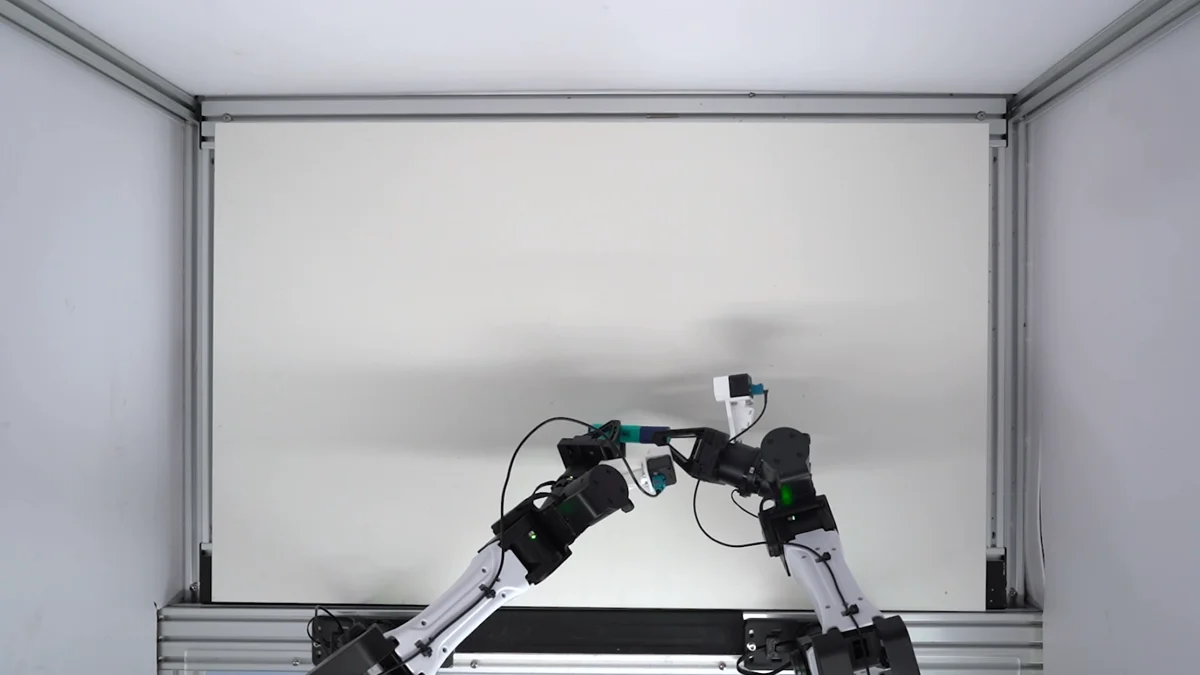
Image: Runway — Praxis-1 driving a bimanual robot (video frame from Runway's announcement)
TL;DR: Runway Praxis-1 open weights explained: Runway released its 27-billion-parameter world action robot model free under the Apache 2.0 licence on 11 November 2026. It learned to move by watching ordinary video, tops NVIDIA's RoboLab-120 leaderboard at 46.2%, and runs on hardware from an H100 down to Jetson Thor — but it still fails more than half of its test tasks, so treat it as a powerful starting point, not a finished robot brain.
📌 Key Highlights
- Runway released Praxis-1 with open weights on 11 November 2026 under the Apache 2.0 licence — free to download, run, fine-tune and use commercially, with no API gatekeeper.
- It is a 27-billion-parameter "world action model": it predicts a short video of what should happen next, then derives the robot's movements from that imagined future.
- It tops NVIDIA's RoboLab-120 leaderboard at 46.2% success (555 of 1,200 episodes), ahead of FLUX 3 Action (42.9%), Cosmos3 Nano (36.8%) and π0.5 (28.0%).
- Three checkpoints are on Hugging Face — a base model, one fine-tuned on the DROID robot dataset and one for the bimanual YAM robot — plus LeRobot versions and a 4-bit build; the code is on GitHub.
- It runs out of the box on NVIDIA hardware from H100 and B200 data-centre GPUs to RTX 5090 workstations and Jetson Thor, the computer that sits inside the robot itself.
What happened?
Runway, the company best known for AI video tools used by filmmakers, has given away a robot brain. On 11 November 2026 it published the weights for Praxis-1, its first world action model for robotics, under the Apache 2.0 licence. Anyone can now download the model, run it on their own hardware, fine-tune it for their own robot and even use it commercially — no licence negotiation, no per-token bill, no API in the middle.
Praxis-1 was first announced on 30 September 2026 and tested with three launch partners since then: Noble Machines on a legged humanoid, Standard Bots on its RO1 six-axis industrial arm, and Ultra on a dual-arm warehouse robot. The November release delivers on the promise Runway made at that announcement — that the model would ship as an open model. It lands in a crowded week for robot models: NVIDIA opened up its GR00T 2 model days earlier, and Google's Gemini Robotics 2.5 is already running on a Mercedes-Benz factory line. Of the three, Runway's is the most permissive — full weights, fine-tuning code and a licence that allows commercial use.
The idea behind it is simple to state and hard to build. Most robot policies are trained on teleoperation — a human steering a robot by remote control, thousands of times, to collect demonstrations. That data is scarce and expensive. Praxis-1 instead starts from Runway's video models, which have already watched enormous amounts of ordinary video and learned how objects move, fall, slide and get picked up. Robot-specific training is then a much smaller step on top.
Runway Praxis-1 open weights: what the download actually includes
The release is unusually complete for an open model. Everything needed to run and adapt Praxis-1 is published — the weights, the inference code and both full and LoRA fine-tuning code — on GitHub, on Hugging Face with native support for the LeRobot robotics library, and in the vLLM-Omni serving engine. Hosted inference is available on Reactor for anyone who wants to try it without a GPU of their own, and NVIDIA's NeMo Automodel project carries hands-on tutorials for post-training it.
| Spec | Praxis-1 |
|---|---|
| What it is | World action model — predicts video and robot actions together |
| Size | 27.2 billion parameters (26.9B video backbone + ~314M action expert); ~2.8B active parameters per token |
| Architecture | Mixture-of-experts diffusion transformer + 16-layer dense action expert |
| Licence | Apache 2.0 — free download, fine-tuning and commercial use |
| Download size | 54.4 GB in bfloat16 (single 80 GB GPU); 17.5 GB as a 4-bit NVFP4 build |
| Checkpoints | Base mid-trained model; DROID fine-tuned; bimanual YAM fine-tuned (plus LeRobot versions) |
| Hardware | H100 / B200 data-centre GPUs, RTX 5090 / RTX PRO 6000 workstations, Jetson Thor on the robot |
| Speed | Each call produces 1.6 seconds of motion (24 action rows at 15 Hz) in about half a second on one H100 |
| Where to get it | GitHub (runwayml/praxis-1-oss), Hugging Face (runwayml Praxis-1 collection), vLLM-Omni, Reactor hosted inference |
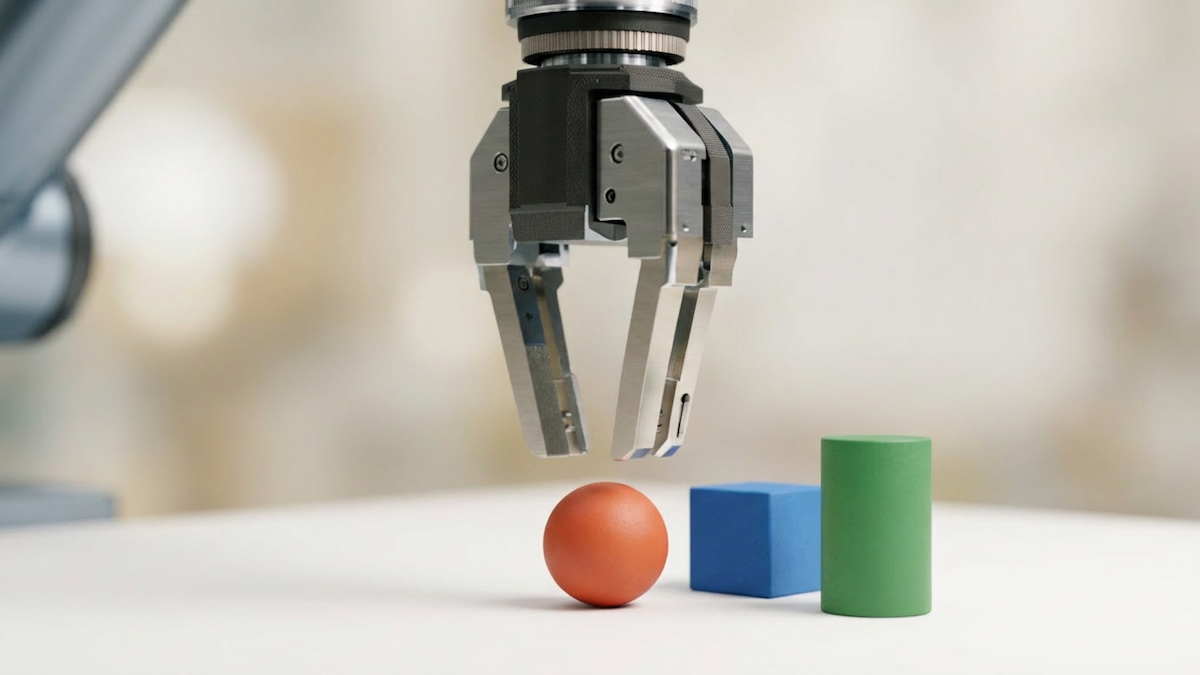
Image: Runway — a robot gripper in a manipulation test (Runway research visual)
How a video model learned to move a robot
The mechanism is what Runway calls a world action model, and it works in two steps. First, the 26.9-billion-parameter video backbone imagines a short clip of what the world should look like next — the cup lifted, the drawer closed, the block placed. Then a much smaller "action expert", a 16-layer transformer of about 314 million parameters, reads the backbone's internal state as it imagines that future and turns it into motor commands. Each call to the model produces 1.6 seconds of motion — 24 action rows at 15 Hz — in roughly half a second on a single H100 GPU, according to Runway's technical write-up.
Training ran in four stages: general video pretraining, chunk-causal embodied video, video and action learned jointly, and finally fine-tuning for a specific robot. The research finding that makes the whole approach work is that ordinary web video is nearly as good as teleoperation footage for pretraining: after fine-tuning, a policy pretrained on web video and one pretrained on teleoperated robot video ended with almost identical placement error — 16.1 cm against 16.0 cm across 93 evaluation pairs. That shifts the bottleneck from "how many robot demonstrations can you afford to collect" to "how much video can you learn from", which is a much cheaper problem.
The same flexibility shows up in the partner results. A single Praxis-1 checkpoint adapted to very different bodies with light fine-tuning — and Noble Machines fine-tuned it for its humanoid on just 154 teleoperated episodes, about 29 minutes of demonstrations. Runway also reports that after fine-tuning on Google's RT-1 robot, which never appeared in its training data, Praxis-1 reached 80.0% success on the SimplerEnv simulation test, well above the original RT-1 policy's 52.4%. That unseen-robot result is the strongest evidence that the video pretraining is doing real work, not just memorising one machine.
The benchmark numbers — and what 46.2% really means
Runway's headline number comes from RoboLab-120, NVIDIA's simulated benchmark of 120 tabletop manipulation tasks with 10 trials each. The DROID fine-tuned version of Praxis-1 completed 555 of 1,200 episodes, a 46.2% success rate — the best result among the listed world action models and open-source robot foundation models.
| Model | RoboLab-120 success | Notes |
|---|---|---|
| Praxis-1 (Runway) | 46.2% | DROID fine-tuned; open weights, Apache 2.0 |
| FLUX 3 Action | 42.9% | Nearest rival on the same leaderboard |
| Cosmos3 Nano (NVIDIA) | 36.8% | NVIDIA's own world action model |
| π0.5 (Physical Intelligence) | 28.0% | Open robot foundation model |
Two caveats belong next to those numbers. First, every figure so far is Runway's own — no independent lab has reproduced the leaderboard result yet, and Runway itself dates the data "as of November 2026". Second, 46.2% is a first-place finish that still means failing more than half the time, on simulated tabletop tasks, not a factory floor. The technical report is candid about the weak spots: the model still struggles with look-alike targets, vague instructions and long multi-step tasks. And open weights do not automatically produce safe robot motion — a model that predicts plausible actions can still crush, drop or misjudge, so any real deployment needs guardrails, supervision and testing that the download alone does not provide.
Why it matters for Indian developers and robotics labs
Runway has announced no India-specific pricing, partnership or deployment for Praxis-1 — and there is nothing to price, because the download is free. That is precisely the point for Indian readers. A robotics lab, startup or university team in India gets exactly the same access as a team in San Francisco: the same weights, the same fine-tuning code, the same permissive licence, with no subscription and no API bill. The real barrier is not the licence but the hardware — the full model needs a single 80 GB GPU — and even that barrier is lower than it looks: the 4-bit NVFP4 build shrinks the weights to 17.5 GB, and Jetson Thor support means the model can run on the computer inside the robot itself rather than in a data centre.
The timing is useful, too. India's robotics work — from warehouse automation to manufacturing and research labs — has mostly had to choose between closed commercial robot software and smaller open models. Praxis-1 is the first open-weight model in this class to beat NVIDIA's and Physical Intelligence's entries on a shared benchmark, and it arrives alongside our earlier explainers on NVIDIA's GR00T 2 robot model and MIT's FLEX robot. For a team deciding what to build on, the honest comparison now starts with downloading all three and testing them on the team's own hardware and tasks — which is exactly what open weights make possible.
Should you download it or wait?
✅ Download it now if: you work in robotics research or development and want a strong open starting point — grab the DROID checkpoint from Hugging Face, try the NeMo Automodel tutorials, and fine-tune it on your own robot and tasks. The Apache 2.0 licence means you can use the result commercially.
⏳ Wait if: you need a production-ready robot controller — 46.2% on simulated tabletop tasks is a research result, not a deployment guarantee. Watch for independent reproductions of the RoboLab-120 score and for the community's fine-tuning reports before putting Praxis-1 on hardware that handles real objects, people or money.
FAQs
What is Runway Praxis-1?
Praxis-1 is Runway's 27-billion-parameter world action model for robotics. It predicts a short video of what should happen next and derives a robot's movements from that imagined future. It was first announced on 30 September 2026, and its weights were released openly on 11 November 2026.
Is Praxis-1 free to use commercially?
Yes. The weights, inference code and fine-tuning code are released under the Apache 2.0 licence, which permits commercial use. You can download Praxis-1 from Hugging Face or GitHub, run it on your own hardware, fine-tune it for your robot and use it in a commercial product — there is no per-token fee to Runway.
How do I download Praxis-1?
From the runwayml Praxis-1 collection on Hugging Face, which lists the base model and the DROID and YAM fine-tunes, including LeRobot and 4-bit NVFP4 versions — or from GitHub at runwayml/praxis-1-oss for the code. Hosted inference is available on Reactor, and NVIDIA's NeMo Automodel project has hands-on tutorials for post-training it.
What hardware do I need to run Praxis-1?
The full model is 54.4 GB in bfloat16 and fits on a single 80 GB GPU, such as an H100. A 4-bit NVFP4 build shrinks the weights to 17.5 GB. Runway says it runs out of the box across NVIDIA hardware, from H100 and B200 data-centre GPUs to RTX 5090 and RTX PRO 6000 workstation cards, and on Jetson Thor inside the robot itself.
Takeaway: Praxis-1 is the most open robot brain released so far — free weights, full fine-tuning code and a commercial-use licence — and it tops NVIDIA's RoboLab-120 leaderboard at 46.2%. The number to remember is the other side of that score: it still fails more than half its test tasks, so download it, test it on your own hardware, and judge it by what it does on your robot. For the week's other big model story, read our Alibaba Qwen4-Max preview explainer.
Sources
- Runway — Praxis-1 Is Now Available (primary source: open-weight release, specs, RoboLab-120 table, partners, hardware)
- Runway Praxis-1 on GitHub (runwayml/praxis-1-oss) (primary source: code and fine-tuning)
- Runway Praxis-1 on Hugging Face (runwayml collection) (primary source: base, DROID and YAM checkpoints, LeRobot and NVFP4 versions)
- AlphaSignal — Runway's Praxis-1 Beats Every Open Robot Model at 46% Success Rate
- madrobot — Runway Praxis-1: free open-weight robot AI model released
- AI Frontier Post — Runway open-sources Praxis-1: the robot model that learned to act by watching video
Comments
Post a Comment