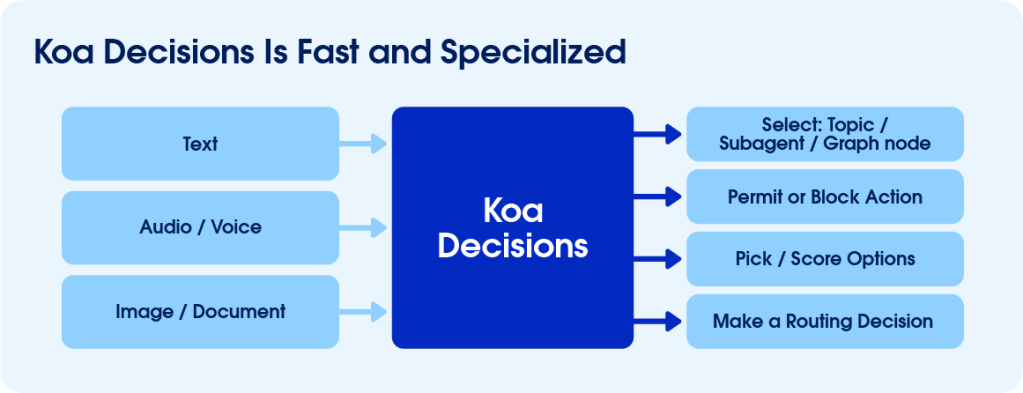
Image: Salesforce — Koa Decisions (official graphic)
📌 Key Highlights
- What it is: Koa Decisions is Salesforce's new decision model, announced on 6 November 2026 — the next version of HyperClassifier, which routes requests inside Agentforce.
- How it works: It reads a request plus a list of categories you define, then returns a choice, a yes-or-no answer, or a score in a single step — often a single token — instead of generating text.
- How fast: Salesforce measured routing at roughly 26 milliseconds, against about 1.4 seconds for a general-purpose large language model doing the same job.
- What is new: Built on Google's open-weight Gemma model, with multimodal support — it can judge text, images and audio together.
- Try it: A demo is open to anyone with a free Trailhead account; wider use in Salesforce flows, Apex, prompt templates and a developer API is planned.
What happened?
Salesforce introduced Koa Decisions on 6 November 2026 in a blog post by Darvish Shadravan, Senior Director of Product Management and product lead for the Koa family of models. It is the successor to HyperClassifier, the decision model Salesforce has used for years to route customer requests inside Agentforce — for example, sending a "Where's my package?" message to the part of the agent that handles shipping and delivery, rather than to FAQs or escalations.
Koa Decisions expands that idea well beyond routing. Salesforce plans to bring it into flows, Apex and prompt templates for Salesforce builders, plus an API for developers. It joins the Koa family alongside a separate Koa reasoning model built with NVIDIA, which Salesforce announced at Dreamforce in September 2026.
The launch lands in a wider shift: TypeSafe AI came out of stealth in mid-September with Jev, a model built to pick from a set of options, and OpenAI made its Decisions API generally available in October. Kakao released its own decision model, Kanana-2-v-decide, on the same day — small models that judge instead of chat are suddenly everywhere.
What is a decision model — and how is it different from an LLM?
A large language model generates text, one token at a time. Much of an AI agent's work, though, is not writing — it is choosing: which team gets this request, which knowledge article to show, which workflow to trigger, whether to allow or block an action. A decision model is built for exactly that job. It reads the whole request at once and produces a compact answer in one step — a choice from a list, a yes or no, or a score — which other software can act on immediately.
Salesforce's example makes the difference concrete. A customer types "I can't log in to my account" into a chat window. Should the request go to engineering, accounts, or sales? A general-purpose LLM can work it out, but it takes more than a second to reason through the question. Koa Decisions identifies "accounts" in milliseconds and returns a clear answer with a confidence score, without the overhead of a larger model.
That matters because the short answer is cheap. An LLM writes its answer token by token, each new token building on the ones before it. A decision model's answer is often a single token, so it takes far less computing to produce — and the agent can move on to the next step straight away.
How fast is it, really?
Salesforce published two sets of numbers, and they measure different things — so it is worth keeping them apart.
| Measurement | Koa Decisions / decision model | General-purpose LLM |
|---|---|---|
| Routing a request in Agentforce (Salesforce's own measurement) | ~26 milliseconds | ~1.4 seconds |
| Production intent-routing benchmark (research preprint) | 85.5% accuracy; ~0.5-second responses | Median up to ~7.5× slower under identical serving conditions |
The 26-millisecond figure comes from Salesforce's own Agentforce routing measurements; the 85.5% accuracy and 7.5× speed figures come from the team's research preprint. Both are Salesforce's own numbers, not independent tests — treat them as the company's claims about its own system, not as a head-to-head review.
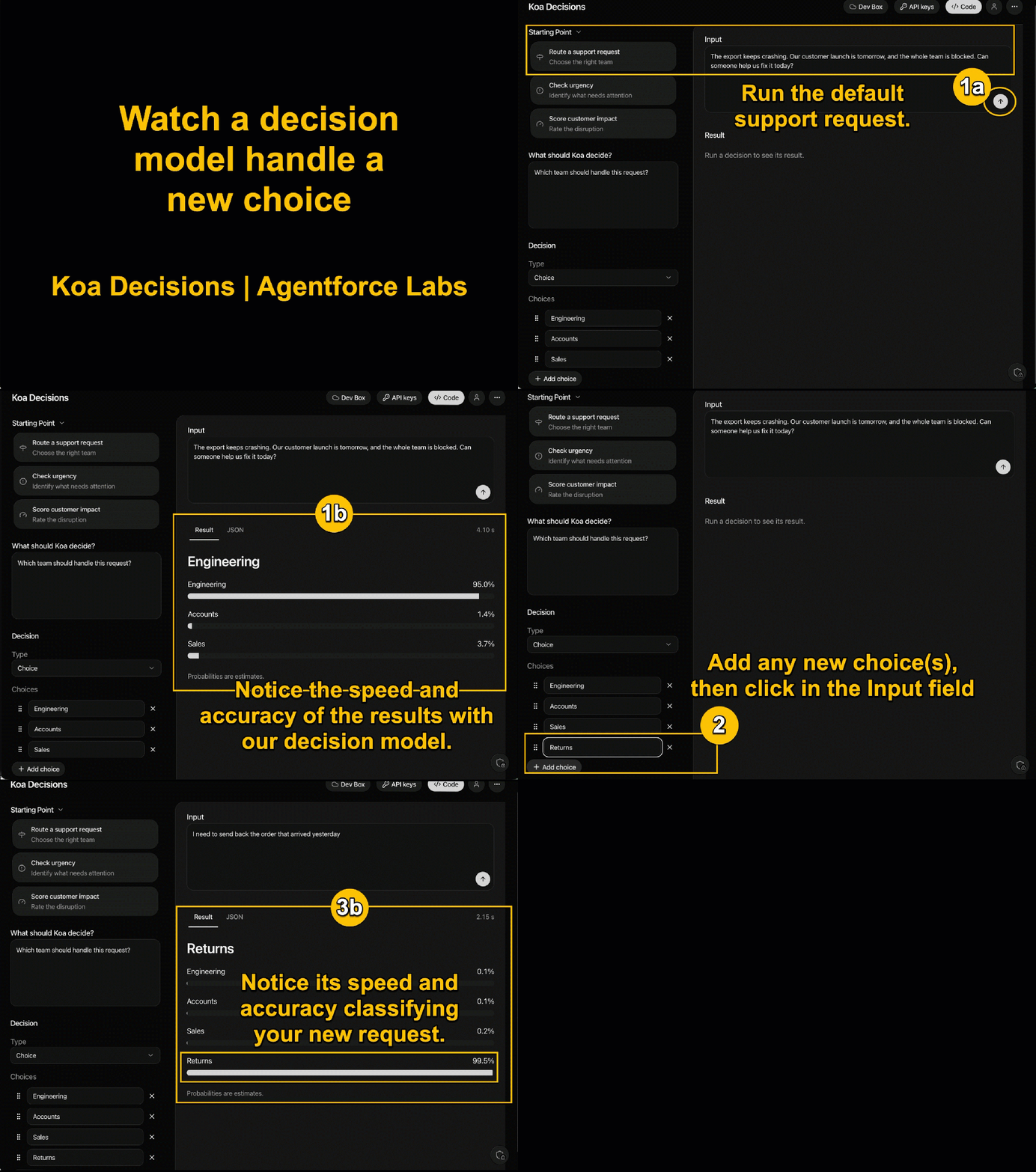
Image: Salesforce — Koa Decisions demo walkthrough (official GIF)
Why it matters for India readers
Indian businesses are among the heaviest users of Salesforce for sales and customer support, and support chat is where slow routing is felt most: every second an agent spends deciding where a query belongs is a second a customer waits. A model that routes in milliseconds — and can judge a photo of a damaged product alongside the written complaint — cuts that wait without sending every small decision to an expensive frontier model.
There is a cost angle too. Running a large general-purpose model for every routing decision is wasteful; a small, specialised model doing the quick calls and saving the big model for writing and reasoning is the cheaper architecture. For Indian startups and mid-size firms running Agentforce, that division of labour is the practical payoff.
One caution: Salesforce says pricing and packaging are subject to change, and availability may vary by region and is governed by customer agreements. Do not assume Koa Decisions is switched on in your Salesforce org — or priced the way the demo suggests — until Salesforce confirms it for your account.
Should you care?
Availability and how to try it
You can test-drive a decision model even if you are not a Salesforce customer. Sign up for a free Trailhead account, then run the Koa Decisions demo from Agentforce Labs: click "Route a support request" and the model routes the default request to engineering, accounts or sales, showing a confidence score for each option. Add a fourth option — say, "Returns" — and the model picks it for return-related requests with no retraining. In Salesforce's walkthrough, the demo routed a request to engineering with 95% confidence, then picked Returns with 99.5% confidence once that option was added.
That no-retraining point is the real change from old-style classification. Traditional predictive models needed teams to define the outcome, gather and label data, train, check and repeat — months of work. A decision model starts from a language model that already understands how "send back the order" relates to "returns", so a team can add a category and sometimes reach production in hours.
FAQs
What is Salesforce Koa Decisions?
Koa Decisions is Salesforce's decision model, announced on 6 November 2026. It reads a request and a list of categories you define, then returns a choice, a yes-or-no answer or a score in a single step, in milliseconds. It is the next version of HyperClassifier, the model that routes requests inside Agentforce, and it is built on Google's open-weight Gemma model.
How is Koa Decisions different from a large language model?
A large language model generates text token by token; a decision model reads the whole request at once and produces a compact answer — often a single token — in one step. That makes it far faster and cheaper for routine choices like routing a support request, while the LLM is kept for writing and reasoning.
Is Koa Decisions available now?
A demo is available to anyone with a free Trailhead account via Agentforce Labs. Wider integration into Salesforce flows, Apex, prompt templates and a developer API is planned, not yet shipped. Pricing and packaging are subject to change, and availability varies by region under customer agreements.
What is the Koa family of models?
Koa is Salesforce's family of purpose-built models for Agentforce. Koa Decisions handles fast decisions; a separate Koa reasoning model, built with NVIDIA on Nemotron, handles complex multi-step CRM reasoning. The reasoning model is in pilot with select customers, with general availability expected in winter 2026. Thinking Machines' Inkling 2 Small takes a different route to the same problem — a giant general model with open weights promised next week.
Takeaway: The most useful AI model in a business is not always the biggest one. Koa Decisions does one narrow job — deciding — in milliseconds, and that is exactly what slows agents down today. Try the free demo before judging it; the routing numbers are Salesforce's own, but the experience of adding a category with no retraining is the part worth seeing first-hand.
Curious how decision models compare? Read our explainer on Kakao's Kanana-2-v-decide, the 0.04-second decision model for AI agents — the same idea, built for a different ecosystem.
Comments
Post a Comment