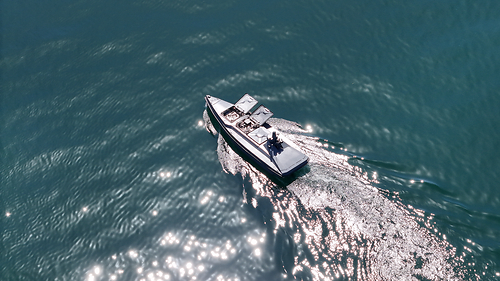
Image: UFORCE — MAGURA MV7.3 + NEMESIS SEASTRIKE (official product image)
TL;DR: UFORCE $700 million Series A explained — the London-headquartered defence-tech company raised $700 million at a $6 billion valuation on 12 November 2026, co-led by Valor Equity Partners and the UK National Wealth Fund. The money scales production of its MAGURA sea drones, NEMESIS strike drones and other autonomous systems, and expands UK manufacturing and high-skilled jobs.
Key Highlights
- What: A $700 million Series A at a $6 billion valuation, announced on 12 November 2026 — the largest venture round ever for a Ukrainian-founded startup.
- Who led it: Valor Equity Partners and the UK National Wealth Fund, which put in £113 million ($150 million) — its largest defence investment to date. The U.S.–Ukraine Reconstruction Investment Fund also took part.
- What it builds: MAGURA uncrewed surface vessels, NEMESIS strike drones, LIUT ground robots, PREDATOR counter-drone turrets, plus the AI command-and-control software that runs them.
- The jump: UFORCE raised $50 million at about a $1 billion valuation in March 2026 — the new round values it six times higher, eight months later. Bookings have more than doubled over the past year, its CEO told CNBC.
- The UK angle: Hundreds of high-skilled jobs are promised, more than 70% of each UK-built MAGURA MV-series boat will come from British suppliers, and Defence Secretary Wes Streeting remotely piloted an MV7 from HMS Prince of Wales — from more than 1,500 miles away.
What happened?
UFORCE, a defence-technology company founded in Ukraine and headquartered in London, announced the $700 million Series A on 12 November 2026. The round was co-led by the US investor Valor Equity Partners and the UK's state-owned National Wealth Fund, with participation from the U.S.–Ukraine Reconstruction Investment Fund.
General (Ret.) Christopher G. Cavoli, the former NATO Supreme Allied Commander Europe and now a partner at Valor, joins UFORCE's board. The U.S.–Ukraine Reconstruction Investment Fund said the deal is its largest investment in the emerging-technology sector to date.
| The round at a glance | Detail |
|---|---|
| Amount raised | $700 million (over £525 million) Series A |
| Valuation | $6 billion |
| Announced | 12 November 2026 |
| Co-leads | Valor Equity Partners and the UK National Wealth Fund |
| National Wealth Fund stake | £113 million ($150 million) |
| Previous round | $50 million at about a $1 billion valuation, March 2026 |
| Headquarters | London, with hubs in Kyiv and Washington, DC |
UFORCE $700 million Series A explained: what the company builds
UFORCE builds autonomous uncrewed platforms across sea, land and air, plus the AI software, orchestration and command-and-control layer that operates them. Its stated goal is to make defence "a hundred times cheaper than offensive operations". The four product families are the MAGURA uncrewed surface vessels, the NEMESIS strike drones, the LIUT ground robots and the PREDATOR counter-drone turrets.
The combat record is the core of the pitch. The company says its MAGURA vessels have contributed to the destruction of more than a dozen Russian warships in the Black Sea and have shot down multiple helicopters and fighter aircraft, while its NEMESIS strike drones have flown more than 300,000 combat flights and are used by more than 100 Ukrainian units. Those are the company's own figures — the reason investors are paying a premium, not independently verified battlefield data.
The new money will expand and distribute production across the US, Europe, Asia-Pacific and the Middle East, so systems are built close to where allies need them, while keeping continuous manufacturing running in Ukraine. UFORCE recently partnered with ReconCraft to scale US manufacturing of MAGURA vessels and is a founding member of the EU–Ukraine Drone Alliance.

Illustrative image: HMS Prince of Wales (R09) in the Atlantic Ocean in 2019 (archive photo). It was aboard this carrier, in Norway, that Defence Secretary Wes Streeting remotely piloted a UFORCE MV7 on 12 November 2026. Image: Wikimedia Commons / U.S. Navy photo by Mass Communication Specialist 2nd Class Cameron Stoner, public domain
Why the UK government is co-leading the round
The National Wealth Fund's £113 million is the largest defence investment the fund has made. It is a UK-backed public finance institution, wholly owned by HM Treasury, with £43.2 billion to deploy — and this deal puts a sovereign balance sheet directly behind a defence startup, alongside private capital.
For Britain, the deal is about factories and skills as much as drones. UFORCE will expand its UK engineering, training and production team and invest in a British supply chain, with hulls, engines, electronics and fit-out sourced in the UK. More than 70% of the content of each UK-built MAGURA MV-series boat will come from British suppliers, and the government says the expansion will create hundreds of high-skilled jobs in engineering, software, artificial intelligence and advanced manufacturing.
The announcement came with a live demonstration. Aboard HMS Prince of Wales in Norway, Defence Secretary Wes Streeting remotely piloted a UFORCE MV7 uncrewed vessel that was more than 1,500 miles away in the Atlantic Ocean near Portugal. "Ukraine is rewriting the rules of warfare," Streeting said. "In just a few years the UK has gone from training Ukraine to being trained by Ukraine."
Why it matters for UK and European readers
This is not a one-off cheque. UFORCE's round sits inside a European defence-tech funding wave: Helsing raised $1.8 billion in July and Quantum Systems raised $1.2 billion this year. Bloomberg describes UFORCE as the UK's most valuable defence startup, and Dealroom notes the company was incorporated only in 2025.
Two caveats matter. First, the $6 billion is a financing valuation, not revenue: UFORCE does not disclose revenue, and its CEO would only say bookings have more than doubled from a base of several hundred million dollars. UFORCE also does not name its customers, so the valuation is a bet on future allied orders, not on sales already booked. For Indian readers there is no direct angle — UFORCE has announced no Indian operations. The relevance is the model: combat-proven autonomy, sovereign money and distributed manufacturing are becoming the template for defence-tech funding.
The same week showed the other side of tech money: IBM's acquisition of AuthMind and SpaceX's $74 billion AI campus plan underline how quickly big-ticket deals are now moving across both startups and big tech.
Should you care?
Verdict: Yes, if you follow startups or defence technology — this is the clearest signal yet that combat-proven autonomous systems can attract sovereign money at startup speed. But treat the $6 billion as a bet on future allied orders, not as a measure of sales today. The markers to watch are whether UK production lines and hiring land on schedule, and whether UFORCE ever discloses revenue.
FAQs
What is UFORCE?
UFORCE is a defence-technology company founded in Ukraine and headquartered in London, with major hubs in Kyiv and Washington, DC. It builds autonomous uncrewed systems for sea, land and air, plus the AI software and command-and-control layer that operates them.
What does UFORCE build?
Its product families are the MAGURA uncrewed surface vessels, the NEMESIS strike drones, the LIUT ground robots and the PREDATOR counter-drone turrets, along with the C2 software that controls them. The MAGURA family is the best known, after its use in the Black Sea.
Who invested in UFORCE's $700 million round?
The round was co-led by Valor Equity Partners and the UK National Wealth Fund, with participation from the U.S.–Ukraine Reconstruction Investment Fund. Menlo Ventures, Xantium and Hiro Capital joined as new investors, and existing backers including Shield Capital, Ballistic Ventures, Lakestar and Squadra increased their stakes.
Why is UFORCE valued at $6 billion?
The valuation is six times the roughly $1 billion at which UFORCE raised $50 million in March 2026. Investors are paying for a combat record — more than 300,000 NEMESIS combat flights, by the company's count — plus bookings that have more than doubled in a year and sovereign backing from the UK and US. Revenue itself is not disclosed, so the figure reflects expected future orders rather than current sales.
Takeaway
UFORCE turned battlefield-proven drones into the largest venture round in Ukrainian startup history — $700 million at a $6 billion valuation, co-led by a US growth investor and the British state. The next test is execution: UK factories, UK jobs, and allied orders that justify the price.
For a sense of how the same week's money moved in AI, read our explainer on LangChain's $300 million funding round at a $3 billion valuation.
Sources
UFORCE — UFORCE raises $700M at $6 billion valuation (PR Newswire, 12 November 2026)
GOV.UK — Ukraine's drone pioneers bring battle-tested tech and high-skilled jobs to Britain (12 November 2026)
UFORCE — Newsroom
Dealroom — Ukrainian-founded drone maker UFORCE raises $700M at a $6B valuation
Tech.eu — Defencetech UFORCE raises $700M (13 November 2026)
Modern Robotics — UFORCE raises $700m at a $6bn valuation (13 November 2026)
Comments
Post a Comment