
Illustrative image: book pages being digitised with a document scanner (Wikimedia Commons / Prajwalps123, CC BY-SA 4.0). Xiaomi-OCR-0 is software, not a device — it reads pages like these once they are scanned or photographed.
TL;DR — Xiaomi OCR 0 open source document model explained in one line: Xiaomi has open-sourced a tiny 0.8-billion-parameter AI that reads scanned and photographed documents and turns them into structured Markdown, extracts key fields as JSON, and answers questions about the page — free under Apache 2.0 and small enough to run locally.
📌 KEY HIGHLIGHTS
- The model: Xiaomi-OCR-0 (0.8B), built from Alibaba's Qwen3.5-0.8B-Base and trained on a ~170-million-sample OCR corpus by Xiaomi's SeerRay team.
- Three jobs in one model: parse pages into Markdown (tables, formulas, reading order), extract structured fields as JSON, and answer questions about document images.
- Vendor-reported scores: 96.83 on OmniDocBench v1.6 and 95.24 on Real5-OmniDocBench — but the public Real5 leaderboard lists it at 92.73, so the "first place" claim comes with an asterisk (see below).
- Free and local: Apache 2.0 weights and code, an online demo, an MCP service and an Agent Skill; community builds run it in Ollama in under 1 GB.
- Unveiled 30 October 2026 by Xiaomi on X, with the technical report on arXiv and weights on Hugging Face.
Xiaomi OCR 0 open source document model explained: what Xiaomi announced
On 30 October 2026, Xiaomi's @XiaomiTech_ account announced Xiaomi-OCR-0, a unified vision-language model built specifically for documents. Unlike a general chatbot that happens to read images, this model is trained for one domain: turning pictures of pages into usable, structured text. The announcement package is complete — model weights, inference code, an interactive demo on Hugging Face Spaces, an MCP service that lets AI assistants call it as a tool, and an Agent Skill file that tells an agent how to install and use it.
The training story is the interesting part. Xiaomi did not hand-label 170 million examples. Instead, an automated data engine let a panel of eight existing OCR models — including PaddleOCR-VL, MinerU2.5-Pro, GLM-OCR, TeleOCR and OvisOCR2 — annotate each document region, keeping only the answers on which three experts agreed, and re-checking disputed regions by re-rendering them as images. Training then ran in three stages: Q-Mask text anchoring (matching each text fragment to its position on the page), continued pre-training on the OCR corpus, and mixed-task reinforcement learning (Mix-RL) on hard examples with automatically checkable answers.
What Xiaomi-OCR-0 can do: parsing, extraction and questions
The model handles three tasks through one instruction interface. Document parsing converts a whole page into Markdown in reading order, with tables expressed in OTSL (a compact table language the repo converts to HTML tables) and mathematical formulas in LaTeX. Key information extraction (KIE) pulls requested fields — invoice numbers, dates, totals — out as JSON. OCR visual question answering lets you ask questions about a document image, such as which quarter recorded the highest revenue in a report.
It also runs in two modes. Full-page mode reads everything in one pass and is the recommended choice for handwriting, calligraphy, old books and irregular layouts. Region mode first runs a PP-DocLayoutV3 layout detector that crops text, table and formula regions, then processes the crops in parallel — better suited to clean, printed, regular documents. The catch, disclosed by Xiaomi's own numbers: the headline scores use the two-stage region pipeline, and without the external layout detector the Real5 score drops from 95.24 to 93.45.
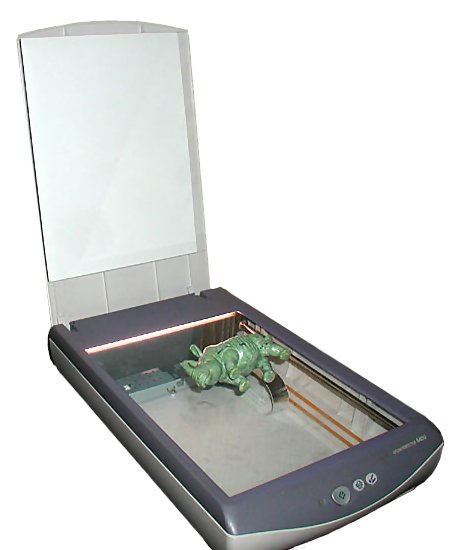
Illustrative image: an open flatbed scanner (Wikimedia Commons / Arpingstone, public domain). Xiaomi-OCR-0 works on images from scanners and phone cameras alike.
Xiaomi-OCR-0 vs rival small document models: the benchmark table
Every score below is vendor-reported by Xiaomi in its technical report — no independent reproduction has been published yet. The top four OmniDocBench v1.6 scores sit within 0.54 points of each other, so the ranking hangs on very little.
| Model | Size | OmniDocBench v1.6 | Real5-OmniDocBench | Wild-OmniDocBench |
|---|---|---|---|---|
| Xiaomi-OCR-0 | 0.8B | 96.83 | 95.24* | 87.94 |
| TeleOCR | 1.2B | 96.87 | n/a | 88.53 |
| OvisOCR2 | 0.8B | 96.58 | 92.29 | 87.91 |
| PaddleOCR-VL-1.6 | 0.9B | 96.33 | 93.19 | 87.36 |
| MinerU2.5-Pro | 1.2B | 95.75 | 88.94 | 87.33 |
| GLM-OCR | 0.9B | 95.22 | 90.32 | 85.08 |
*Xiaomi's figure, measured with its own evaluation code and the two-stage pipeline — see the dispute below. On document questions, Xiaomi-OCR-0 averages 83.2 across five benchmarks (DocVQA, InfoVQA, ChartQA, OCRBench, TextVQA), beating Qwen3.5-2B (80.9) with less than half the parameters and the 8B MiniCPM-V-4.5 (82.6), though Qwen3.5-4B reaches 84.9. On formulas it reports 97.84 on UniMER-Test and on tables 92.27 (TEDS) on PubTabNet.
The benchmark asterisk: why 95.24 is disputed
Here is the part worth knowing before quoting the headline. The public Real5-OmniDocBench leaderboard on Hugging Face lists Xiaomi-OCR-0 at 92.73 — second behind PaddleOCR-VL-1.6 at 93.19, not first. The benchmark's curators attribute the gap to the evaluation code version: Real5 aligns with OmniDocBench v1.5, while Xiaomi's v1.6 code changed enough that results are not directly comparable. When the curators re-scored Xiaomi's own predictions with the v1.5 code, they got 92.79, in line with the leaderboard entry, and the result was accepted. The curators have announced Real5 will be updated to the latest benchmark. Until then, the honest summary is: Xiaomi-OCR-0 is competitive at the top of the small-model class, but "first place" is not proven — and whoever measures is an interested party in both cases.
How to try Xiaomi-OCR-0: demo, local install and the Agent Skill warning
The quickest route is the free online demo on Hugging Face Spaces — but do not upload confidential documents there, since it is a hosted service. For local use, the official route is SGLang or vLLM, or Transformers, which can even fall back to CPU. The community has also packaged it for Ollama and llama.cpp: the recommended Q8_0 quant is about 0.83 GB plus a 0.2 GB vision projector, and the BF16 package is about 1.8 GB. Xiaomi has explicitly not evaluated those community builds, and skipping the repo's image preprocessing, no-reasoning prompt and decoding settings can change result quality — so treat local scores as approximate until you test your own pages.
One caution on the Agent Skill: it is a SKILL.md file that an agent reads and then executes, and the README warns that with your authorisation it can create a Python environment, install dependencies, download the weights, configure the runtime and register an MCP server. Read that file before handing it to any agent, because a remote file an agent executes is effectively a script. The repository has also moved on Hugging Face from the SeerRay-Lab organisation to xiaomi-research; the old address redirects, but many posts still cite the first name.
Why it matters for India readers
No India-specific launch or partnership has been announced — the India angle here is practical, not local news. India runs on paperwork: invoices, contracts, receipts, application forms and records that exist first as paper or phone photos. A small, locally runnable parser fits exactly the jobs Indian startups, accountants, clinics, schools and digitisation services do every day: converting documents without sending sensitive pages to a foreign API. Xiaomi is also one of India's biggest phone brands, so a Xiaomi-built open model will get attention here regardless of where it was announced.
The honest limit is the same as for every document model: the model card does not document which languages are supported, and the benchmarks rest mostly on English and Chinese documents. Mixed Hindi-English pages, handwriting, stamps and seals over text, and low-quality phone photos in bad light are all unproven territory. Test it on your own worst ten pages — not the demo's clean samples — before trusting it in production. Our earlier MiniCPM-OCR open source document parsing explainer covers a rival 1.3B parser with a built-in quality checker, and the checker was even tested on Xiaomi-OCR-0's output — a useful pairing if you adopt either model.
Should you care?
✅ Verdict: Yes, if you digitise documents — a genuinely small, free, locally runnable parser with strong reported scores is worth an hour of testing on your own archive. ⏳ But do not replace a production pipeline on the headline numbers alone: every score is vendor-reported, the Real5 "first place" is disputed by the public leaderboard, and language support beyond English and Chinese is undocumented.
FAQs
What is Xiaomi-OCR-0? It is a 0.8-billion-parameter open-source vision-language model from Xiaomi's SeerRay team that reads documents — text, tables, formulas and layout — from scans and photographed pages, and outputs structured Markdown, JSON fields, or answers to questions about the page.
Is Xiaomi-OCR-0 free and open source? Yes. The weights and code are released under the Apache 2.0 licence, which allows commercial use, and the repository ships a third-party notices file to read before business use. The project is generally described as an open-weight release.
Can Xiaomi-OCR-0 run locally on my computer? Yes. The official runtimes are SGLang, vLLM and Transformers (which can fall back to CPU), and community packages run it in Ollama or llama.cpp in roughly 1–2 GB. Running it locally means your document images never leave your machine — unlike the hosted demo.
Does Xiaomi-OCR-0 read PDFs, tables and formulas? Yes, with a step in between: the model itself sees images, so the MCP service or demo converts PDF pages into images first (using Pillow and pypdfium2). Tables come out in OTSL format, convertible to HTML tables, and formulas in LaTeX.
Is Xiaomi-OCR-0 really the best small document model? Not proven. Its 96.83 on OmniDocBench v1.6 leads same-size rivals, but its claimed 95.24 on Real5-OmniDocBench scores 92.73 on the public leaderboard under the older evaluation code, behind PaddleOCR-VL-1.6. Treat it as a top contender, not a confirmed winner, until independent tests land.
Takeaway: A 0.8B model that reads messy documents this well, for free, on your own machine, is a real step for open document AI — just test it on your own pages before believing any leaderboard. Read our Qwen model Beijing upload test explainer for why the Qwen family behind this model is under scrutiny, and our DeepSeek MiniMax China AI export registration explainer for the filing rules now shaping Chinese open models.
Follow World Tech on TechByCountry for tomorrow's update.
📸 Get tech in the last 24 hours on Instagram — follow @_techinlast24hrs for daily posts (9 AM–9 PM) and reels at 12:30 PM & 8:30 PM.
Sources
- Xiaomi-OCR-0 Technical Report (arXiv:2609.36136, SeerRay Team)
- Hugging Face Spaces: Xiaomi-OCR-0 online demo
- GitHub: xiaomi-research / Xiaomi-OCR-0 (weights, code, MCP service, Agent Skill)
- Pasquale Pillitteri: Xiaomi unveils Xiaomi-OCR-0 (31 Oct 2026, incl. Real5 leaderboard dispute)
- Lapaas Voice: Xiaomi unveils Xiaomi-OCR-0 (31 Oct 2026)
Comments
Post a Comment