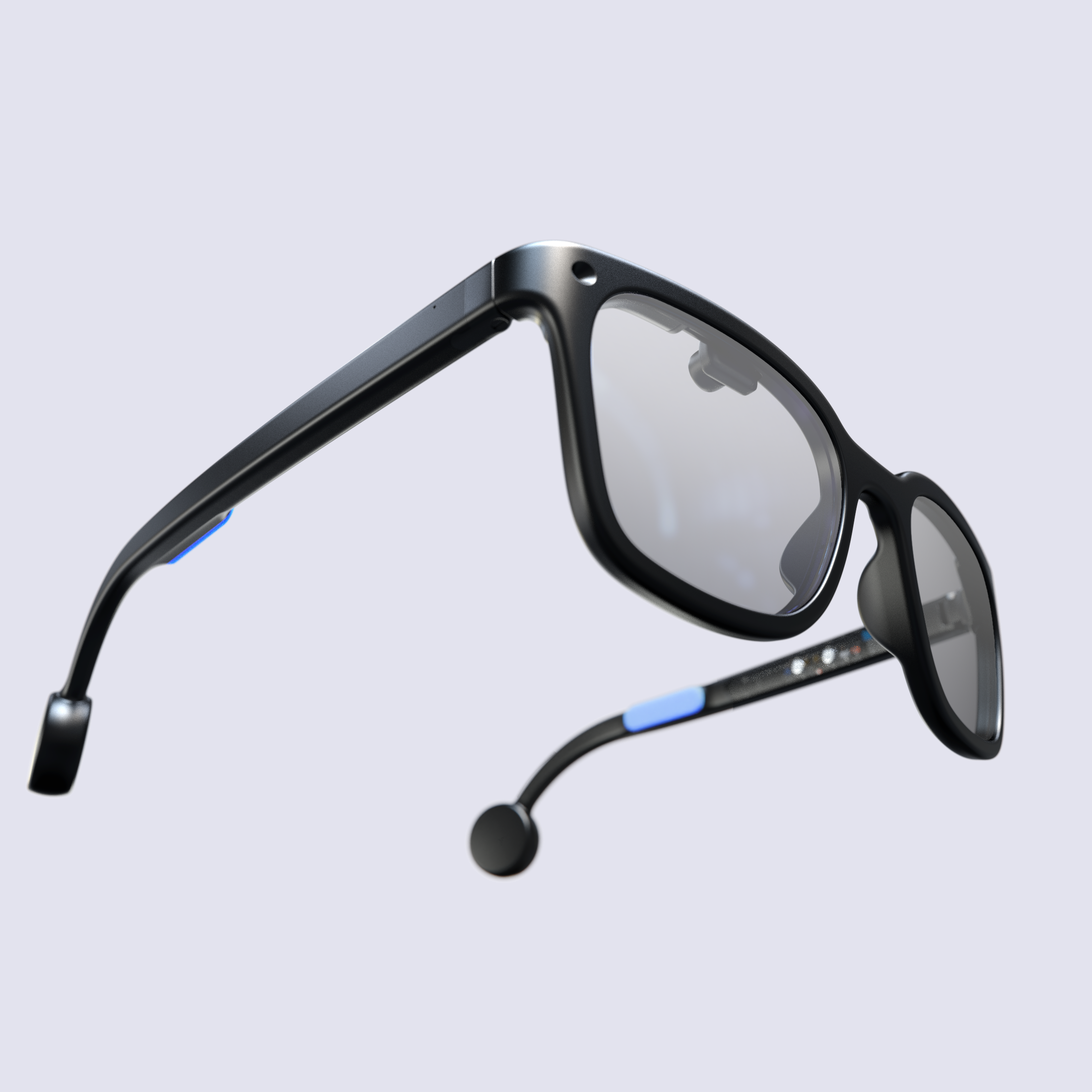
Image: Brilliant Labs — Halo Glasses (official product image, from the official product page).
TL;DR — Brilliant Labs Halo Glasses launch price explained in one line: the privacy-first smartglasses go on sale today, 27 October 2026, at $399 from brilliant.xyz, with a new adaptive-gaming experience called Narrative and an AI companion called Noa that runs on-device — but note the honest twist: Halo is not appearing out of nowhere, it was sold on pre-order in 2025, so today is its general-availability launch, not its first-ever announcement.
📌 KEY HIGHLIGHTS
- Launch today: Brilliant Labs says Halo Glasses officially launch on 27 October 2026, priced at $399, available now at brilliant.xyz.
- What's new: Narrative, a new category of "adaptive gaming" that turns everyday moments into an evolving open-world game, backed by new funding from Goodwater Capital.
- Privacy-first pitch: open-source hardware and software, on-device processing, and a low-resolution sensor that gives visual context without acting as a photo or video camera — images are processed on-device and discarded, never stored.
- Hardware: full-colour microOLED display, bone-conduction speakers, Bluetooth 5.3, up to 14 hours of battery life, just over 40 grams.
- The honest history: Halo was already sold on pre-order in 2025 (from $299, rising to $349) — today's $399 is the general-availability price, not the pre-order price.
- India answer: no India price, launch date or local seller has been announced — $399 is the US store price.
Brilliant Labs Halo Glasses Launch Price Explained: What Happened?
Singapore-based Brilliant Labs announced the launch of Halo Glasses on 27 October 2026 through a Business Wire release, its primary announcement channel. The release frames Halo as "a new generation of privacy-first smartglasses" and pairs the launch with two pieces of news: a new funding round led by Goodwater Capital, with participation from Brendan Iribe and others, and the debut of Narrative, the adaptive-gaming experience Halo is built to run.
That framing needs one immediate correction for readers who follow wearables: Halo is not a brand-new device appearing for the first time today. Independent guides and a 2025 review record that Brilliant Labs opened Halo pre-orders in 2025 — at $299, with a stated rise to $349 after launch — with shipping expected from late 2025. What 27 October 2026 brings is the general-availability launch at $399, with Narrative as the new flagship experience and fresh funding behind the company. If you saw Halo covered last year, you are not imagining it; today's announcement is the "now actually on sale" moment, with a higher price and a new game to sell it.
How Halo Works: Ask, Make, Play
At the centre of Halo is Noa, a personal AI companion that builds long-term memory around what matters to each user, learns from patterns over time, and responds conversationally in real time. Unlike an assistant that resets with every chat, Noa carries context forward, so conversations build and preferences are remembered. Brilliant Labs organises the experience into three modes:
- Ask. Talk to Noa naturally, like a personal assistant that is always with you — questions, ideas and in-the-moment context, with memory carrying forward between conversations.
- Make. Build mini-apps and custom workflows using just your voice, then share what you make with the Halo community on its App Store — no code or technical setup, according to the company.
- Play. Narrative, the flagship game experience, turns everyday moments into "the game of life", where ordinary moments become opportunities for discovery, collaboration and play, evolving as the player does.
The hardware is deliberately light and unobtrusive. The 27 October release lists a full-colour microOLED display, microphones, bone-conduction speakers, optical-grade lenses, Bluetooth 5.3, on-device AI and up to 14 hours of battery life, in a frame weighing just over 40 grams. Independent guides add the finer detail the release skips: a small 0.2-inch colour OLED-on-silicon micro-display in the right lens (640×400, 20° field of view), an Alif B1 processor with an on-device neural processing unit, dual bone-conduction speakers, and a display optic adjustable from +2 to −6 dioptres, with prescription lenses through SmartBuyGlasses. Treat the 14-hour figure as the company's claim — no independent endurance test is cited in the launch coverage.
| Feature | Halo Glasses | Source / note |
|---|---|---|
| Price (27 Oct 2026) | $399, available now at brilliant.xyz | Business Wire release |
| Earlier price | $299 pre-order (2025), rising to $349 | 2025 coverage / review |
| Display | Full-colour microOLED; 0.2-inch OLED-on-silicon, 640×400, 20° field of view | Release + independent guides |
| Audio / connectivity | Bone-conduction speakers, microphones, Bluetooth 5.3 | Business Wire release |
| Processor | Alif B1 with on-device NPU | Independent guides |
| Battery / weight | Up to 14 hours (company claim); just over 40 g | Business Wire release |
| Camera | Low-resolution sensor for AI context only — not a photo/video camera | Business Wire release |

Image: Brilliant Labs — Halo Glasses worn outdoors (official release photo, via Business Wire).
The Privacy Argument — And Its Limits
Halo's real selling point is not the display, which is small and text-focused, but the privacy architecture around it. Core functionality runs locally whenever possible, minimising reliance on the cloud. The low-resolution image sensor is the clearest expression of that: Brilliant Labs describes it as "visual note-taking" — Halo can see, understand and remember what you see, while the images themselves are processed privately on-device, immediately discarded and never stored. There is no traditional camera for photography or video, which is both a privacy feature and a capability limit: these glasses will not replace your phone camera.
The open-source foundation is the second half of the pitch. Halo's hardware and software are fully open-source, inviting developers and creators to extend, remix and shape the platform — with an SDK and community app store as the route in. That makes Halo a developer-first product in a market where the best-known smart glasses are closed ecosystems. Independent guides are blunt about the trade-off: Halo is early-stage hardware with ambitious software, not the polished consumer experience of the best-known camera glasses. If you want a mature, mainstream pair of AI glasses, this is not that product yet; if you want an open, privacy-forward platform you can tinker with, there is little else like it.
Why It Matters for World Tech Readers — Including in India
Smart glasses are splitting into two philosophies, and Halo draws the line clearly. One camp — the big-platform glasses — bets on cameras, cloud AI and content capture. Halo bets the opposite way: less capture, more on-device intelligence, and a game instead of a camera roll. For readers in India, the direct relevance is limited today: Brilliant Labs has announced no India price, launch date or local seller, and the $399 figure is the US store price on brilliant.xyz. An Indian buyer would be looking at an import purchase with shipping, customs and warranty questions the announcement does not answer — so do not treat $399 as an India price.
The indirect relevance is stronger. India's developers and researchers are exactly the audience for an open-source, on-device AI wearable: a hackable platform with an SDK, a voice-built app store and a privacy story that sidesteps the always-recording camera debate. And the Narrative idea — an AI that turns daily life into an evolving game — is a genuinely new use case for glasses, whether or not it succeeds. Watch whether Narrative finds an audience; if it does, expect bigger players to copy the "glasses as game console" idea fast. Our earlier coverage of Samsung's Android XR glasses leak, Google's Fitbit Edge launch and RayNeo's GT Max iO smart glasses shows how crowded the face-worn computing race already is — Halo is the privacy-first outlier in it.
Should You Care?
✅ Verdict: Yes — if you are a developer, a privacy-conscious early adopter, or curious about AI glasses. At $399, Halo is the most open, most private take on smart glasses you can actually buy, and Narrative is a genuinely new idea. ⏳ But wait if you want a polished mainstream product or an India launch: the software is early, the display is text-focused, there is no real camera, and there is no India price or seller yet. Judge it as a platform bet, not a finished consumer gadget.
Price, Availability & Alternatives
Halo Glasses are priced at $399 and available now from brilliant.xyz, according to the 27 October 2026 launch announcement. That is up from the 2025 pre-order price of $299 (rising to $349 after launch) — early backers paid less, and the general-availability price reflects the finished product plus the Narrative launch. No subscription price is mentioned in the release, and no India pricing or availability has been announced. Alternatives depend on what you want: mainstream camera glasses offer a more polished, more social experience at a similar or higher price; display-focused glasses offer bigger virtual screens; Halo's case rests on privacy, openness and the Narrative game — not on beating rivals at photography or display size. We have not tested Halo ourselves; every performance claim here is the company's or independent guides', not a hands-on verdict.
FAQs
What are Brilliant Labs Halo Glasses?
Halo Glasses are lightweight, privacy-first smartglasses from Brilliant Labs with a small colour microOLED display, bone-conduction audio and an AI companion called Noa, built on a fully open-source hardware and software foundation.
What is Narrative on Halo Glasses?
Narrative is Halo's flagship "adaptive gaming" experience, launched with the 27 October 2026 announcement: it turns everyday moments into an open-world game that evolves with the player's actions, decisions and discoveries in real time.
Do Halo Glasses have a camera?
Not a traditional one. Halo has a low-resolution image sensor that gives its AI visual context; Brilliant Labs says images are processed privately on-device, immediately discarded and never stored, and the glasses do not take photos or videos.
Can I buy Halo Glasses in India?
Not officially yet. The 27 October 2026 announcement lists $399 availability at brilliant.xyz with no India price, launch date or local seller announced — an Indian buyer would currently face an import purchase with unanswered shipping and warranty questions.
Is $399 the first price for Halo Glasses?
No. Halo was sold on pre-order in 2025 from $299, with a stated rise to $349 after launch; $399 is the 27 October 2026 general-availability price, higher than the pre-order price.
Takeaway: Halo's 27 October launch is best read as a statement of intent: AI glasses do not have to be cameras that phone home to the cloud. Whether Narrative makes that idea fun — and whether buyers pay $399 for a text-sized display — is the experiment to watch.
Follow World Tech on TechByCountry for tomorrow's update.
📸 Get tech in the last 24 hours on Instagram — follow @_techinlast24hrs for daily posts (9 AM–9 PM) and reels at 12:30 PM & 8:30 PM.
Sources
- Business Wire — Brilliant Labs Launches Halo Glasses (27 Oct 2026, primary announcement)
- Treeview — Best Smart Glasses & AI Glasses in 2026 (independent guide: Alif B1, display, weight, $399)
- Skywork — Brilliant Labs Halo AI Glasses Review (2025 pre-order history: $299 → $349, Engadget launch coverage)
Comments
Post a Comment