Intel Acquires Classiq Quantum Acquisition Explained: Full-Stack Quantum Bet, Reported $2.3 Billion Price and the CEO Question

Image: Wikimedia Commons / Markus Spiske, CC0 — Illustrative image: code on a computer monitor. Classiq is software, not a device, so there is no product photo; this image illustrates the quantum software at the centre of the deal.
TL;DR — Intel acquires Classiq quantum acquisition explained: On 26 October 2026, Intel agreed to buy Classiq, a Tel Aviv quantum-software company, to turn its quantum unit into a full-stack business spanning chips and software. Intel disclosed no price — Israeli outlets report about $2.3 billion — and the deal is expected to close in the first half of 2027, subject to regulatory approval. Until then, the two companies keep operating independently.
📌 KEY HIGHLIGHTS
- What happened: Intel signed a definitive agreement to acquire Classiq, whose platform designs quantum programs automatically instead of gate by gate.
- The reported price: About $2.3 billion in cash and stock, according to CTech — Intel itself disclosed no financial terms, and Globes put the figure at $2.2 billion.
- When it closes: Expected in the first half of 2027, subject to regulatory approvals and customary closing conditions.
- What Intel gets: A hardware-agnostic software layer it plans to pair with its silicon spin-qubit chips, adding Quantum Processing Units (QPUs) to its CPU, GPU and ASIC portfolio.
- The open question: Intel CEO Lip-Bu Tan previously invested in Classiq and reportedly recused himself from the talks; Intel had not said publicly whether he still holds shares.
What happened?
Quantum computing has a software problem. Today's quantum machines are noisy, small and each built differently, so writing a program for one often means hand-crafting circuits gate by gate — the equivalent of writing a modern app in machine code. Classiq's answer, built since its founding in 2020, is to let developers describe what they want a quantum program to do at a high level and let software generate, optimise and re-target the low-level circuit for different hardware.
That is what Intel announced it is buying. In a press release issued on 26 October 2026, Intel said it has entered into a definitive agreement to acquire Classiq, described as a leading provider of quantum computing software. Intel's chief executive, Lip-Bu Tan, said: "Joining forces with Classiq transforms Intel's Quantum Computing Group into a full-stack quantum computing business." Classiq co-founder and chief executive Nir Minerbi said the two companies together "can help unlock the benefits of quantum computing and accelerate its adoption sooner."
Bloomberg reported the agreement the same day, noting that Intel did not disclose the price and that Classiq's clients include BMW and AT&T. The distinction matters: the acquisition is agreed, not completed, and everything about the price below is reported, not confirmed by either company.
Intel acquires Classiq quantum acquisition explained: what Intel is buying
Intel's pitch is an old analogy with a new target. Forty years ago, electronic design automation (EDA) software let chip designers stop drawing transistors by hand and work at a higher level of abstraction — and classical computing scaled because of it. Intel says Classiq plays the same role for quantum computing: a unifying software platform that is agnostic to the underlying qubit technology and hardware, so the same program can run on different machines as they improve.
On Intel's side of the combination sit a decade of quantum work: since 2015 it has been developing silicon spin-qubit technology — qubits built from the spin of single electrons held in silicon — and it says it is the only company capable of producing qubit chips and complex cryogenic control electronics at scale using conventional semiconductor manufacturing processes. Classiq adds the synthesis platform: AI agents, a high-level quantum modelling language and design automation, plus hardware benchmarking and cost and performance optimisation.
| Deal fact | Detail |
|---|---|
| Buyer / target | Intel Corporation acquires Classiq (Tel Aviv, founded 2020) |
| Announced | 26 October 2026 — definitive agreement, not a completed deal |
| Price | Not disclosed by Intel; reported at about $2.3 billion in cash and stock (CTech) / $2.2 billion (Globes) |
| Expected close | First half of 2027, subject to regulatory approvals and customary conditions |
| What Intel adds | Quantum Processing Units (QPUs) alongside CPUs, GPUs and ASICs |
| Multi-platform pledge | Intel intends to keep supporting Classiq's existing multi-platform integrations after close |
| Classiq background | $110M Series C (May 2025, Entrée Capital-led); $173M total then, about $200M cumulative (reported); ~150 employees |
| Named customers | BMW, Citi, Deloitte, Rolls-Royce, Mizuho, Toshiba (company statements) |
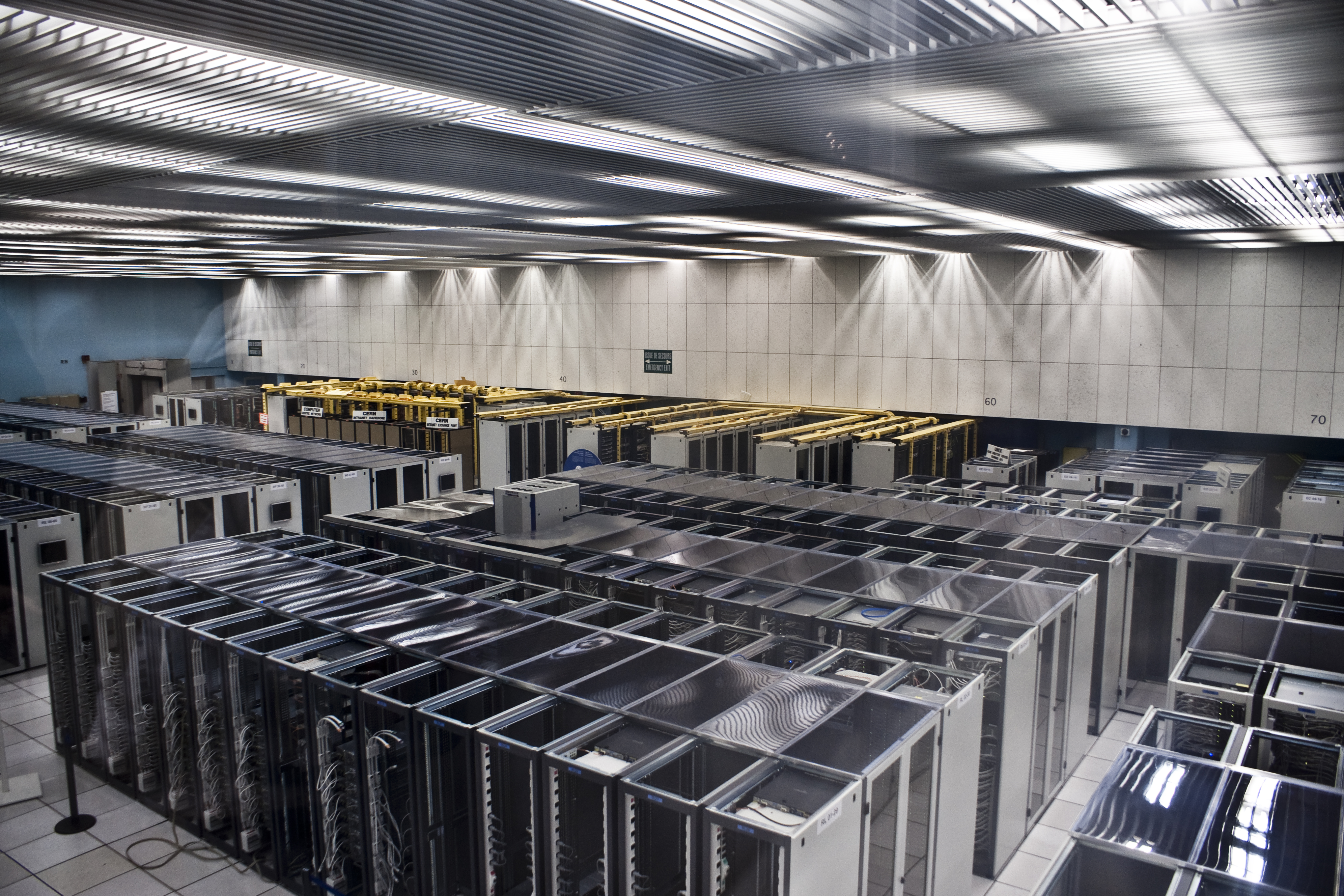
Image: Wikimedia Commons — Illustrative image: server racks in a data centre. The combined platform is aimed at enterprise and research users running quantum workloads through cloud and on-premise infrastructure.
Why the reported price and the CEO question both need care
Two parts of this story are easy to get wrong, so they deserve plain language. First, the price. Intel's announcement gives no financial terms at all — no price, no cash-and-stock split, no termination fee, no expected contribution to earnings. The $2.3 billion figure comes from CTech (Calcalist), which describes the deal as a combination of cash and stock and as a record for the quantum industry, measured against IonQ's $1 billion acquisition of Oxford Ionics last year. Globes, another Israeli outlet, put the value at $2.2 billion. Until Intel or Classiq confirms a number, every price in this post is a report, and the $100 million gap between the two Israeli reports is itself a reason not to state one figure as fact.
Second, the chief executive. CTech reports that Lip-Bu Tan invested in Classiq's February 2022 funding round, was still listed among its investors in May 2025, and recused himself from the acquisition talks. As of Monday afternoon, Intel had not said publicly whether Tan still holds Classiq shares or how the deal treats any such stake. That is an open governance question for investors and reporters to keep asking — it is not, on the current record, an allegation of wrongdoing, and this post makes no such claim. Recusal, where reported, is the standard mechanism for handling exactly this kind of prior interest.
One more timing trap: Intel shares closed at $90.47 on Monday, up about 4% in the regular session — but the acquisition announcement came after the market closed. The day's share rise therefore cannot be read as the market's reaction to the deal, and any article that implies otherwise has the sequence backwards.
Why it matters for India readers
No India-specific terms were announced, and this deal will not put a quantum computer in an Indian office next month — quantum machines remain rare, expensive and largely research tools, with only about 117 in the world according to CTech's count. The relevance for Indian readers is structural, not immediate.
Indian enterprises, banks, research labs and startups exploring quantum computing mostly do so through cloud platforms, not by owning hardware. A hardware-agnostic software layer is exactly what makes that exploration portable: the same model can be tested on one provider's machine today and another's tomorrow, without rewriting the program each time. If Intel keeps Classiq genuinely multi-platform after the close — as its announcement pledges — Indian teams gain a mainstream vendor behind that portability. If the platform quietly drifts toward Intel-only hardware, that benefit narrows, and the pledge is worth watching rather than taking on trust.
The deal also sets a valuation marker for the whole quantum-software field. A reported $2.3 billion exit for a roughly 150-person software company, against about $200 million raised, will be read by investors everywhere — including in India — as evidence that the software layer, not just the hardware, is where near-term quantum value sits. It also echoes a pattern Indian readers have seen before: Intel's biggest Israeli acquisitions, from Habana Labs to Moovit, were bets on a team and a platform rather than a finished mass-market product.
For context, this is the latest in a run of large technology combinations covered here, including Salesforce's $5.66 billion Braze acquisition and S&P Global's acquisition of OpenZeppelin — each a case of a large company buying a specialist platform rather than building one from scratch. Readers following the quantum hardware race itself may also want the Triple Quantum Dot spin qubit explainer, which covers a different approach to the same underlying problem: making qubits faster without making them noisier.
Should you care?
✅ Yes — if you follow quantum computing or chip strategy. This is Intel's clearest statement yet that it intends to sell quantum as a full stack, not just a chip — and the reported $2.3 billion price, if confirmed, makes it the largest quantum acquisition to date. ⏳ Wait before treating anything as closed: regulatory approval and a first-half-2027 close stand between announcement and reality, and the price is still unconfirmed. 🔍 Watch: whether Classiq stays truly hardware-agnostic after the close, and whether Intel clarifies the CEO's shareholding question.
FAQs
Is Intel buying Classiq? Yes — Intel announced on 26 October 2026 that it has entered into a definitive agreement to acquire Classiq. The deal is agreed, not yet closed: completion is expected in the first half of 2027, subject to regulatory approvals and customary closing conditions.
What does Classiq do? Classiq builds quantum software that turns high-level models of a problem into optimised low-level quantum circuits, automatically. Its platform combines AI agents, a high-level quantum modelling language and design automation, and it is designed to run the same program across different quantum hardware platforms and cloud services.
How much is Intel paying for Classiq? Intel has not disclosed the price. Israeli outlets report about $2.3 billion in cash and stock (CTech/Calcalist), while Globes reports $2.2 billion. Treat both figures as reports until Intel or Classiq confirms a number.
When will the Intel-Classiq deal close? Intel expects the transaction to close in the first half of 2027. Until closing, Intel and Classiq continue to operate as separate, independent companies, and the deal still needs regulatory approvals.
Did Intel's CEO invest in Classiq? CTech reports that CEO Lip-Bu Tan invested in Classiq's February 2022 funding round, was still listed among its investors in May 2025, and recused himself from the acquisition talks. Intel had not said publicly, as of Monday afternoon, whether Tan still holds Classiq shares.
Will Classiq still work with other companies' quantum hardware? Intel says that after the close it intends to continue supporting Classiq's existing multi-platform integrations and to keep the software modality- and hardware-agnostic, as part of an open and collaborative quantum software ecosystem. Whether that holds in practice is the key thing to watch after the deal closes.
Takeaway: Intel is not buying a quantum computer — it is buying the software layer that could make quantum computers usable. The strategy is sound, the reported price is large, and the two questions that matter most — the real price and the platform's future independence — are both still open.
Follow World Tech on TechByCountry for tomorrow's 6 PM update.
📸 Get tech in the last 24 hours on Instagram — follow @_techinlast24hrs for daily posts (9 AM–9 PM) and reels at 12:30 PM & 8:30 PM.
Sources
- Intel press release (reproduced) — Intel to Acquire Classiq to Create a Full-stack Quantum Computing Platform (26 October 2026)
- Business Wire via Seeking Alpha — Intel to Acquire Classiq (26 October 2026)
- Bloomberg Law — Intel to Acquire Startup Classiq in Quantum Computing Push (26 October 2026)
- CTech/Calcalist — Intel to acquire Israeli quantum startup Classiq for $2.3 billion (26 October 2026, reported price)
- AIStockWire — Intel to buy Classiq, a startup its CEO backed (26 October 2026)
- Classiq — Classiq Raises $110M in Largest-Ever Quantum Software Funding Round (12 May 2025)
Comments
Post a Comment