Triple Quantum Dot Spin Qubit Explained: Osaka's Third Dot Fixes the Speed-vs-Noise Trade-Off (World Tech)
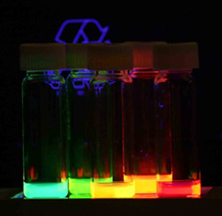
Image: Wikimedia Commons — glowing quantum dots in vials (illustrative photo of quantum dots, not the Osaka device reported in this paper).
📌 KEY HIGHLIGHTS
- The result: A gallium arsenide triple-quantum-dot flopping-mode spin qubit with electrically driven spin rotations above 100 MHz — reaching 271 ± 20 MHz under one tuning condition — and a π/2 gate fidelity of 99.56% in 4.05 nanoseconds.
- The trick: Tuning the third dot's detuning flattens the qubit frequency's dependence on voltage noise (orbital-band engineering), so speed and noise resistance can be adjusted more independently.
- The feedback: A feedforward neural-network system tracks slow qubit-frequency drift, cutting its standard deviation to 388 kHz and stretching the estimated dephasing time from about 52 nanoseconds to 580 nanoseconds.
- The paper: "High-fidelity flopping-mode single-spin operation via triple-dot orbital-band engineering" by Y. Matsumoto and colleagues, published in npj Quantum Information on 24 October 2026.
- The honest limit: This is a single-qubit demonstration in gallium arsenide — multi-qubit operation, logic gates and transfer to silicon or germanium devices are still to be shown.
What happened?
Semiconductor spin qubits store information in the spin of a single electron trapped in a quantum dot — a tiny puddle of electrons defined by voltages on metal gates above a semiconductor crystal. They are attractive because they are small and could, in principle, be manufactured with the same techniques as ordinary computer chips. But they come with a frustrating trade-off: driving a spin electrically, fast, means mixing its spin with its charge motion, and that same mixing makes the qubit sensitive to tiny voltage fluctuations. Faster usually means noisier.
In the usual two-dot "flopping-mode" design, an electron shuttles between two dots, and the speed boost and the noise sensitivity are tied to the same quantity — the orbital splitting between the dots. You cannot improve one without worsening the other, and once the device is made, you are stuck with the trade-off you got.
The Osaka team, led by Yuta Matsumoto with Takafumi Fujita and Akira Oiwa among the authors, changed the geometry instead of accepting the trade-off. They added a third, auxiliary quantum dot whose energy can be adjusted electrically. Tuning this extra dot reshapes the electron's orbital energy structure — a strategy the paper calls orbital-band engineering — creating a broader operating region that is less sensitive to voltage noise while preserving the strong coupling needed for fast spin control.
triple quantum dot spin qubit explained: the numbers
The headline figures from the paper and its coverage, side by side:
| Measure | Result | What it means |
|---|---|---|
| Electrically driven spin rotation (Rabi frequency) | Above 100 MHz; 271 ± 20 MHz under another tuning condition | Fast electrical control of the spin, without a magnet |
| π/2 gate fidelity | 99.56% with a 4.05 ns gate time | The headline gate accuracy in the paper |
| With additional pulse optimisation | 99.72% (as reported in coverage) | Further tuning squeezes out more accuracy |
| Frequency-drift suppression (neural-network feedback) | Standard deviation cut to 388 kHz | Slow drift tracked and corrected in real time |
| Estimated dephasing time | About 52 ns → 580 ns | How long the qubit keeps its quantum phase |

Image: Wikimedia Commons / Notezik, CC0 — Bloch sphere diagram showing a qubit state (illustrative diagram explaining the qubit state, not the experiment reported in this paper).
Why the third dot helps
Think of the qubit's frequency as a curve plotted against the voltage that controls the dots. In a two-dot device, the sweet spot — the flat part of the curve where small voltage wobbles barely change the frequency — is narrow, and its width is locked to the same orbital splitting that sets the speed. The third dot adds a second knob: by tuning its detuning, denoted ε34 in the paper, the team flattens that curve over a wider voltage range without weakening the spin-charge coupling that makes fast control possible.
That matters after manufacturing, not just in theory. Real devices vary from chip to chip, and a device that comes out of the fab slightly off-target can now be tuned back into a good operating region electrically, instead of being written off. As Takafumi Fujita put it, the extra dot "introduced an extra degree of freedom for tuning the qubit frequency" so the team could "explore operating regions that are less sensitive to electrical noise." The researchers expect the same idea to apply to silicon- and germanium-based spin qubits, not just the gallium arsenide device demonstrated here.
The second ingredient is feedback. Slow drifts in the qubit's frequency — from electronics and temperature wander — were tracked by a feedforward neural network that continuously corrected the drive, rather than a one-off calibration. Combined with the flattened operating point, that is what connects the device physics to the high-fidelity gates: the qubit stays where it should be, long enough to be useful.
How it compares with the silicon scaling work
This paper solves a different half of the spin-qubit problem from the RIKEN result covered widely in mid-October, in which five silicon spin qubits were driven through one shared microwave line at around 99.9% fidelity. RIKEN tackled parallel operation: keeping many qubits accurate at once. Osaka tackles the single qubit itself: making one qubit fast and stable at the same time. A future processor needs both, so the two results complement rather than compete with each other.
Why it matters for World Tech readers
For readers in India, where semiconductor manufacturing and quantum research are both national priorities, the lesson travels well beyond one laboratory device. The same orbital-band idea, applied to silicon spin qubits, would feed directly into chip-scale quantum processors — and the neural-network feedback trick is a reminder that modern quantum hardware is as much a control-systems problem as a physics problem.
Should you care?
✅ Verdict: Yes, if you follow quantum hardware — this is a clean, practical fix to a real trade-off, with numbers (100+ MHz, 99.56% gates) that beat what two-dot flopping-mode qubits could offer. ⏳ Wait on: calling it a quantum computer breakthrough — this is one qubit in gallium arsenide, and multi-qubit gates, error correction and silicon transfer are all still ahead. 🔍 Honest caveat: the 99.72% figure comes from additional pulse optimisation reported in coverage, while the paper's headline π/2 fidelity is 99.56% — both are single-qubit results, not a full processor benchmark.
FAQs
What is a flopping-mode spin qubit? A spin qubit in which an electron is shuttled back and forth between two quantum dots ("flopping" between locations), so its spin can be controlled electrically rather than with magnetic fields. Electrical control is fast and chip-friendly, but it mixes spin with charge motion, which invites electrical noise.
What does the third quantum dot actually do? It acts as an extra electrical tuning knob. By adjusting the third dot's energy, the researchers flatten how the qubit's frequency depends on voltage, creating a wider sweet spot that tolerates voltage noise while keeping the strong coupling that makes control fast.
How fast and accurate are the gates? The paper reports electrically driven spin rotations above 100 MHz (up to 271 ± 20 MHz under one tuning condition) and a π/2 gate fidelity of 99.56% in 4.05 nanoseconds, with 99.72% reported after additional pulse optimisation. A neural-network feedback system also cut slow frequency drift to a 388 kHz standard deviation.
Does this mean silicon quantum computers are ready? No. The demonstration used a gallium arsenide device with a single qubit. The authors expect the technique to transfer to silicon and germanium spin qubits, but that transfer, plus multi-qubit gates and error correction, remains future work.
Takeaway: One extra quantum dot turned a fixed trade-off into a tunable one — fast spin control and noise resistance at the same time, in a device that can be tuned back into shape after it is built. For spin qubits, that is the kind of practical step that makes scaling plausible.
Follow World Tech on TechByCountry for tomorrow's update.
📸 Get tech in the last 24 hours on Instagram — follow @_techinlast24hrs for daily posts (9 AM–9 PM) and reels at 12:30 PM & 8:30 PM.
Sources
1. Y. Matsumoto et al. — "High-fidelity flopping-mode single-spin operation via triple-dot orbital-band engineering", npj Quantum Information, published 24 October 2026 (DOI: 10.1038/s41534-026-01400-1): https://www.nature.com/articles/s41534-026-01400-1
2. Independent coverage — "One extra quantum dot helps balance speed and stability in spin qubits", phys.org, 26 October 2026: https://phys.org/news/2026-10-extra-quantum-dot-stability-qubits.html
3. Related reading on this blog: Single trapped ion autonomous quantum error correction — 11.6 ms qubit life with no measurements; Andreev qubit supercurrent readout — reading a qubit without destroying it; Quantinuum Helios error-correction record — 99.9995% fidelity
Comments
Post a Comment