Nvidia and AMD Invest in Meta's $97.5 Billion AI Equity Offering Explained: The Circular Funding Debate

Illustrative image: the New York Stock Exchange facade. Meta's equity offering is a sale of shares, not a product — there is no product photo for this story. Image: Wikimedia Commons / Ryan Schwark, CC0.
TL;DR: Meta 97.5 billion equity offering explained in one line: Meta upsized its record share sale to $97.5 billion to pay for AI infrastructure, and its own chip suppliers are helping fund it — Nvidia is putting in $3 billion and AMD $1 billion — which is why analysts are now asking whether AI's money is moving in a circle.
📌 KEY HIGHLIGHTS
- The raise: Meta upsized its equity fundraising on 27 October 2026 to $97.5 billion — the largest in its history — to bankroll AI infrastructure and its "personal superintelligence" plan.
- Nvidia: $3 billion. The chipmaker will invest $3 billion in Meta's offering and expand its work on Meta's Muse AI agent, with more Vera Rubin systems and Vera CPUs going into Meta's data centres.
- AMD: $1 billion. AMD will invest $1 billion, while its first Helios rack-scale AI systems are installed and being tested at Meta.
- What is actually priced: $25 billion of common stock at $625 a share plus $12.5 billion of preferred depositary shares at $50 each. The remaining up to $60 billion is a planned future share-sale programme, not money already raised.
- The uncomfortable question: Reuters reports concerns about an "increasingly circular flow of capital" — suppliers investing in a customer that then spends the money on their hardware.
Meta 97.5 billion equity offering explained: what happened?
On Monday 26 October 2026, Meta announced it planned to raise up to $95 billion by selling shares, to pay for the data centres and chips behind its AI push. A day later it went bigger: the offering was upsized to $97.5 billion. It is the largest equity fundraising in Meta's history, and one of the largest ever by an AI company — following Alphabet's roughly $85 billion equity fundraising earlier in 2026.
The $97.5 billion figure needs unpacking, because it is a programme total, not a single cheque. It is made of three pieces, and only the first two are priced:
| Piece of the raise | Size and terms | Status |
|---|---|---|
| Class A common stock | $25 billion at $625 per share (upsized from $22.5 billion), sold via forward-sale agreements | Priced 26–27 Oct; expected to close 29 Oct |
| Mandatory convertible preferred depositary shares | $12.5 billion — 250 million depositary shares at $50 each | Priced 26–27 Oct |
| At-the-market share-sale programme | Up to $60 billion, sold gradually at prevailing market prices | Planned only — starts after Meta's new non-voting Class C shares begin trading, expected in Q1 2027; timing and terms not finalised |
That distinction matters for every headline you read about this deal. The $60 billion tranche has not been raised yet, and the common-stock tranche uses forward-sale agreements, which means Meta receives that cash at settlement rather than at pricing. Treat "$97.5 billion raised" as shorthand for "$97.5 billion planned" until the later tranches actually sell.
What Nvidia's $3 billion buys — and what it does not
Nvidia's announcement, in a company release dated 26 October 2026, has two halves: money and machines. The money is a $3 billion investment in Meta's equity offering, subject to closing conditions — a commitment, in other words, not a completed transfer. The machines are the bigger story for Meta's AI plans: Meta will expand deployment of Nvidia's Vera Rubin systems and Vera CPUs for next-generation AI agents, along with Spectrum-X Ethernet networking and BlueField-4 infrastructure, and the two companies will jointly optimise Muse's training and inference performance and total cost of ownership.
Muse is the thread running through all of this. It is Meta's family of AI models and personal AI agent — the product at the centre of chief executive Mark Zuckerberg's "personal superintelligence" pitch — and it already runs on Nvidia infrastructure. Nvidia chief executive Jensen Huang framed the deal in agent terms: "AI agents represent a new computing paradigm — software that understands our goals, reasons, uses tools and gets work done on our behalf." Zuckerberg's line was simpler: "Muse is how we bring personal superintelligence to everyone."
One part of the Nvidia deal is explicitly not yet agreed. The companies said they will "consider" further work on Nvidia's OpenShell Reference Architecture for safe agent deployment and its Sentry tool for monitoring agent behaviour. Consideration is not a commitment — if you read coverage that presents OpenShell and Sentry as done deals, it has gone further than the announcement.
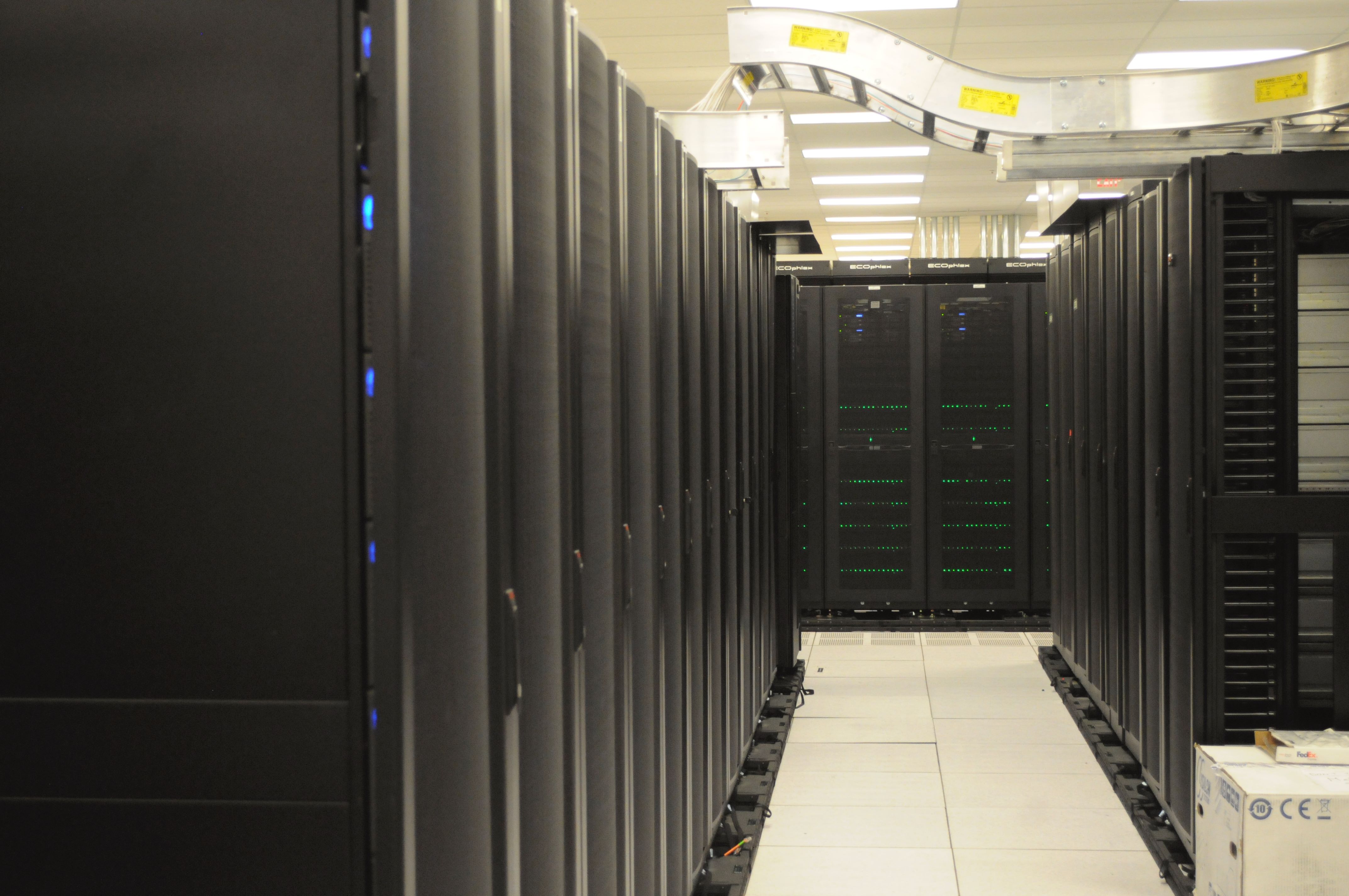
Illustrative image: server racks in a data centre — the kind of infrastructure Meta's raise is paying for. Image: Wikimedia Commons. This is not a Meta facility.
What AMD's $1 billion buys: Helios racks go live at Meta
AMD's announcement, on 27 October 2026, mirrors Nvidia's structure but with different hardware. AMD will invest $1 billion in Meta's equity offering, and — the operational news — its first Helios rack-scale systems are installed at Meta and undergoing testing, with broader deployment expected in the near future. A rack-scale system packages chips, networking and software into a ready-to-deploy unit, so a first installation being tested is a milestone, not yet a fleet-wide rollout; AMD gave no timetable or volume for the wider deployment.
The AMD–Meta relationship is not starting from scratch, and AMD's release is careful to separate what is already in production from what is new. Meta has deployed millions of AMD EPYC server processors across multiple generations, and EPYC processors power the dedicated computing environments behind Muse. AMD Instinct GPUs are already in production at Meta for AI training, ranking and recommendation workloads. New in this announcement: Meta plans to deploy a custom AMD Instinct GPU built for its own workloads, AMD provides Day-0 (launch-day) support for Meta's Muse Spark Open model on Instinct GPUs and Muse Glimmer on Ryzen AI PCs and Radeon GPUs, and the two companies are collaborating on future processors including AMD's Verano CPUs and MI500-series GPUs, at gigawatt scale.
AMD chair and chief executive Lisa Su put it like this: "With Helios now running at Meta, we are taking that partnership to a new scale in the superintelligence era." Meta's Zuckerberg returned the compliment, calling AMD "a key partner in building out the compute that is running our frontier models."
The third name in the story is Broadcom — and it is the one to handle carefully. Meta named Nvidia, AMD and Broadcom as showing non-binding interest in buying up to $5 billion of its Class A shares between them. Nvidia's $3 billion and AMD's $1 billion account for $4 billion of that envelope; Broadcom has not confirmed a separate figure, and this post does not invent one.
Is Meta's AI funding circular? The case, and the counter-case
Here is the argument worrying analysts. A chip supplier invests in a customer; the customer uses the money to buy the supplier's chips; the supplier's revenue and share price rise; the cycle repeats. Reuters put it plainly: the funding interest "adds to concerns about an increasingly circular flow of capital in the AI industry, as chip suppliers help finance the expansion of one of their biggest customers." Analysts at William Blair wrote that they "expect investors to continue to question the financing and potential for future capital raises," while adding that Meta "will ultimately produce a profitable AI business," though "the path may not be linear."
The sharper version comes from Nigel Green, chief executive of the financial advisory firm deVere Group, who said such deals blur how much AI demand comes from customers spending their own money: "Sooner or later, someone outside the circle has to pick up the bill."
The counter-case deserves equal weight. First, these are equity investments, not loans dressed up as revenue: Nvidia and AMD are buying shares and taking real downside risk if Meta's stock falls — and Meta's shares did fall about 1.4% in Tuesday morning trading, after closing down nearly 2% on Monday at $630.56, while AMD's rose about 5% on its announcement. Second, the hardware deals stand on their own: Helios systems being tested at Meta and expanded Vera Rubin deployments are engineering partnerships that would exist with or without the share purchases. Third, the scale of Meta's spending dwarfs the supplier stakes — Meta has projected capital spending of up to about $145 billion this year alone, and has warned it will need to raise "hundreds of billions of dollars" over several years. Against that, $4 billion of supplier equity is a signal of alignment, not the funding itself.
None of that settles the question. "Circular" is an analysts' characterisation of a financing pattern, not evidence of wrongdoing, and no regulator has alleged anything improper about these investments. The honest way to watch it is through the numbers that will arrive over the next year: whether Meta's AI products generate revenue that justifies the spending, whether the $60 billion at-the-market programme sells at healthy prices, and whether the supplier stakes grow into larger hardware orders — or quietly shrink.
Why it matters for India readers
No India-specific figure, product launch or price was announced with this deal, and this post claims none. The India relevance is the sheer scale of Meta's products here: WhatsApp, Instagram and Facebook are among the most-used apps in India, and the AI features inside them — including Muse-powered assistants — run on exactly the infrastructure this money is paying for. When Meta's AI spending rises, Indian users feel it first as better (or more aggressively pushed) AI features in apps they already open every day, and only later, if ever, as a local announcement.
There is a second, quieter India angle. This week's AI money story is not just Meta: it sits alongside Anthropic's S-1 IPO filing, which showed the staggering compute commitments behind frontier AI, and Oracle's expanded partnership with OpenAI to bring its apps and data into ChatGPT. Read together, they describe one industry-wide shift: AI is now financed like heavy infrastructure — with stock sales, forward contracts and supplier stakes — not like software. Indian startups, investors and policymakers watching the AI buildout should read the financing, not just the model launches, because the financing is what decides who can afford to stay in the race.
For readers following the model race itself, OpenAI's GPT-6.1 Terra, which cut API prices for computer-use work, shows the other side of the same coin: cheaper models for users, paid for by vastly more expensive infrastructure behind them.
Should you care? ✅ Worth understanding — not a stock tip
Verdict: ✅ This deal matters because it reveals how AI is actually paid for in 2026: not from profits alone, but from record share sales partly funded by the industry's own suppliers. ⏳ But do not read it as a buy or sell signal — the $97.5 billion is a programme, not cash in hand, the supplier stakes are subject to closing conditions, and whether the spending pays off will only be visible in Meta's results over the next year. Watch the $60 billion at-the-market programme and the Helios rollout, not the headline.
FAQs
What is Meta's $97.5 billion equity offering? It is Meta's plan, upsized on 27 October 2026, to raise up to $97.5 billion by selling shares: $25 billion of common stock at $625 a share, $12.5 billion of preferred depositary shares at $50 each, and a planned programme to sell up to $60 billion more shares gradually once its new Class C shares begin trading, expected in early 2027.
Why are Nvidia and AMD investing in Meta? Both are deepening AI infrastructure partnerships with Meta, not just writing cheques. Nvidia is expanding its work on Meta's Muse agent with Vera Rubin systems and Vera CPUs; AMD's Helios rack-scale systems are being tested at Meta and its EPYC processors already power Muse. The equity stakes align the suppliers with their customer's success.
Is Meta's AI funding circular? Analysts, including Reuters' reporting and William Blair, have raised concerns about a "circular flow of capital" — suppliers funding a customer that buys their hardware. It is a characterisation of a financing pattern, not evidence of wrongdoing, and the supplier stakes ($4 billion confirmed) are small beside Meta's roughly $145 billion of projected capital spending this year.
What will Meta spend the money on? AI infrastructure — data centres, chips and networking — and its consumer AI tools, principally the Muse family of models and agents, as Meta competes with OpenAI and Anthropic for "personal superintelligence."
When will Meta actually receive the money? Not all at once. The priced tranches were expected to close around 29 October 2026, but the common stock uses forward-sale agreements, so Meta receives that cash at settlement. The up-to-$60 billion at-the-market programme has not started and has no finalised timing or terms.
Takeaway: Meta's $97.5 billion raise is the clearest picture yet of AI's new economics — infrastructure-scale spending, financed at infrastructure scale, with suppliers now sitting on both sides of the deal. The question to carry forward is not whether AI is expensive — it plainly is — but whether the revenue eventually covers the bill.
Follow USA Tech on TechByCountry for tomorrow's update.
📸 Get tech in the last 24 hours on Instagram — follow @_techinlast24hrs for daily posts (9 AM–9 PM) and reels at 12:30 PM & 8:30 PM.
Sources
- Dow Jones / Morningstar: Nvidia to invest $3 billion in Meta's equity offering (27 Oct 2026)
- Unite.AI: Meta deepens Nvidia partnership on Muse AI models and infrastructure (Nvidia Newsroom release, 26 Oct 2026)
- dpa-AFX / TradingView: AMD deepens AI infrastructure partnership with Meta, to invest in equity offering (27 Oct 2026)
- TipRanks: AMD stock soars over 5% on an expanded AI partnership with Meta (27 Oct 2026)
- Reuters: Meta eyes record $97.5 billion equity raise to fund AI expansion (27 Oct 2026)
Comments
Post a Comment