Node.js 26 LTS October 28 2026 Explained: The Last Old-School Release Before One Major a Year (World Tech)
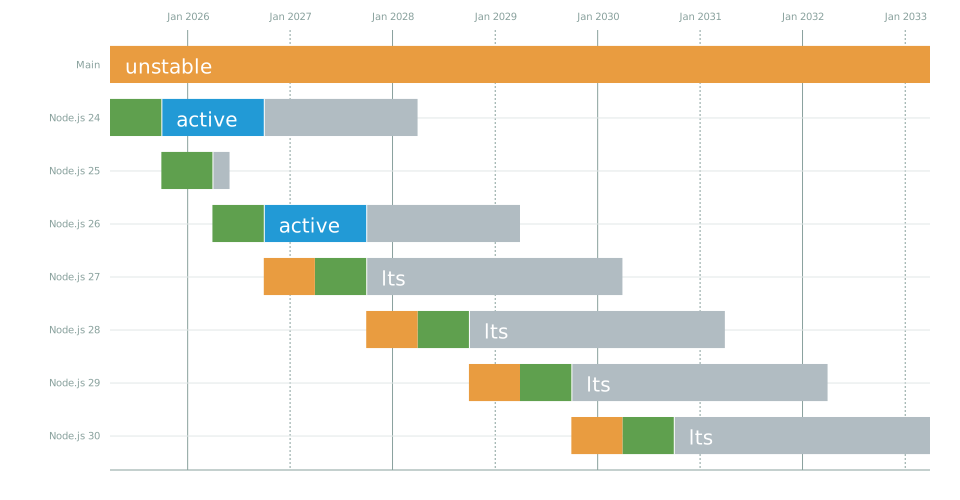
Image: Node.js — the new release schedule diagram (official image, via the Node.js blog "Evolving the Node.js Release Schedule").
UPDATE 29 October 2026 — the LTS version number is confirmed: Node.js 26.13.0 "Lithium". The Node.js project published version 26.13.0 on 28 October 2026, promoting the whole 26.x line into Active LTS — the version now recommended for production, supported until 30 April 2029 (maintenance phase from 20 October 2027). Release manager Richard Lau's notes are deliberately terse: other than updating metadata such as the process.release object, no further changes from Node.js 26.12.1 are included — so 26.13.0 adds no new code; it is a support milestone, not a feature drop. What the line ships: the Temporal date-and-time API enabled by default, V8 14.6, and Undici 8 as the HTTP layer behind fetch(). Removed in the line: http.Server writeHeader(), the legacy _stream_* modules, module.register() (runtime-deprecated) and the --experimental-transform-types flag; the NODE_MODULE_VERSION bump to 147 means prebuilt native add-ons need rebuilding. LTS users also inherit the October security patch set sitting underneath 26.13.0 (26.12.1, 21 October 2026): ten CVEs across the supported lines, four High severity, headlined by CVE-2026-111497, a High-severity out-of-bounds write in the bundled Brotli decoder permitting remote code execution — Imperva's red team reportedly published a working exploit dubbed "Node2Shell", though as of late October no live exploitation had been confirmed. Operational note: a running process keeps the old decoder in memory until it exits, so upgrade AND restart processes, rebuild container images, and rebuild single-executable apps. Looking ahead, Node 27 opens an alpha channel on the same day 26 goes LTS, with the release due April 2027 under the new annual model. Sources: Node.js official download page, Linux Compatible, Konfirmity, DEV Community, FireUp (all October 2026).
📌 KEY HIGHLIGHTS
- The date: Node.js 26 is promoted to Active LTS on 28 October 2026, supported until 30 April 2029.
- The last of the old model: Node 26 is the final release under the twice-a-year, even-only-LTS schedule that ran for a decade.
- The new model: from Node 27, one major release each April, every release becomes LTS, and version numbers match the calendar year.
- Node 27 alpha opens the same day: 27.0.0-alpha builds start 28 October 2026 for library authors to test in CI — not for production.
- Patch first: before any upgrade, make sure you are on the October security patch — 26.12.1 for the 26 line.
What happened?
On 28 October 2026, Node.js 26 moves from Current to Active LTS — the project's stamp that a release line is ready for production. It is a routine promotion with an unusual backdrop: it is the last one under a schedule that is about to be replaced. Node.js announced the change in March 2026 in a post titled "Evolving the Node.js Release Schedule", and the new rules take effect "as of October 2026".
The week leading up to it has already been busy. Node.js 24, the previous Active LTS line, dropped to Maintenance on 20 October 2026, meaning it now receives critical and security fixes only. Node.js 26.12.0 landed on 14 October, followed a week later by the 26.12.1 security release that fixed ten vulnerabilities, including a HIGH-severity Brotli flaw. Guides tracking the schedule flagged one quirk of the handover: between 24 leaving Active LTS on 20 October and 26 entering it on 28 October, no Node.js line sits in Active LTS for eight days.
Nodejs 26 LTS October 28 2026 explained: the dates that matter
Here is where every supported line stands, from the Node.js release schedule and the project's own announcement:
| Release line | Status now | Next change | End of life |
|---|---|---|---|
| Node.js 22 (Jod) | Maintenance LTS | None — security and critical fixes only | 30 April 2027 |
| Node.js 24 (Krypton) | Maintenance LTS since 20 October 2026 | None — security and critical fixes only | 30 April 2028 |
| Node.js 26 | Current (latest: 26.12.1) | Active LTS on 28 October 2026; Maintenance October 2027 | 30 April 2029 |
| Node.js 27 | Not yet released | Alpha begins 28 October 2026; 27.0.0 in April 2027; LTS October 2027 | April 2030 |
| Node.js 20 and older | End of life | No patches, ever | Already passed (20: April 2026) |

Illustrative image: a data centre server room — the kind of infrastructure Node.js 26 will run on as the new LTS line. Image: Wikimedia Commons / BalticServers.com.
Why the old schedule is ending
The old model is ten years old, created during the io.js merger: even-numbered majors shipped in April, spent six months as Current, became LTS in October, and lived about three years; odd-numbered majors lived about seven months and never became LTS. A decade of data changed the project's mind. Its own announcement puts it plainly: odd-numbered releases see minimal adoption, most users wait for LTS, and the odd-even distinction confuses newcomers.
There is also a sustainability argument. Node.js is maintained mostly by volunteers, and managing security releases across four or five active lines at once has become hard to sustain — every extra line adds backporting work. Cutting the cadence to one major a year, with every release becoming LTS, shrinks that burden while keeping the support window familiar: six months of alpha, six months as Current, then 30 months of LTS, for 36 months in total.
The new alpha channel is the interesting part. It fills the early-testing role odd releases once played, but with a key difference: semver-major (breaking) changes are allowed during alpha, and builds are signed, tagged and tested against popular packages through the project's CITGM tool. The project is explicit about who alpha is for — library authors and CI pipelines testing compatibility — and that it is not intended for production. Version numbers also get simpler: they align with the calendar year of the first Current release, so 27.0.0 arrives in 2027, 28.0.0 in 2028, and so on.
Why it matters for World Tech readers
For most teams, the project's own summary holds: if you already only upgrade to LTS versions, little changes beyond version numbering. But the edges matter. If you are still on Node.js 22, upgrade guides agree on one thing — do not stop at 24. Going straight to 26 buys an extra year of support for the same migration effort, since 22 reaches end of life in April 2027. If you are on 24, there is no rush: it is supported until April 2028, just in maintenance now.
For Indian developers and teams — among the world's largest Node.js communities — the practical work is the same upgrade planning, plus one caution guides flagged: floating tags and version-manager shortcuts need a second look. The Docker image project had not, at the time of writing, published what lts, current and latest will mean under the new schedule, and lts/* shortcuts in version managers may behave differently once odd-numbered lines can be LTS. Pin an explicit major version until your tooling documents the new behaviour. And if you missed it, our Node.js October 2026 security release guide covers the 26.12.1 patch you should install before upgrading anything.
Should you care?
What to do now
First, patch: run node -v everywhere that matters and get to your line's October fix (26.12.1, 24.22.1 or 22.23.4). Second, pick your target: 22 users should aim at 26, 24 users can stay put, and new projects can start on 26 and ship once it reaches LTS. Third, if you maintain a library, put the Node 27 alpha builds in CI from 28 October — the project specifically asks for this, because bugs found only after LTS are bugs your users find first. The same week also brought related developer news: VS Code 1.143 making Copilot the default and GitHub's Package Firewall for agent-written code — the tooling around Node is moving just as fast as the runtime itself.
FAQs
When does Node.js 26 become LTS?
Node.js 26 is promoted to Active LTS on 28 October 2026. It then stays in Active LTS for about a year, moves to Maintenance in October 2027, and reaches end of life on 30 April 2029.
What is new in Node.js 26?
Node.js 26.0.0 shipped in spring 2026; upgrade guides highlight Temporal enabled by default, V8 14.6 and Undici 8, plus the usual performance and API updates. The 26.12.x patch line adds the October 2026 security fixes, so install 26.12.1, not the original 26.0.0.
What happens to Node.js 24 and Node.js 22?
Node.js 24 moved to Maintenance LTS on 20 October 2026 and is supported until 30 April 2028 with critical and security fixes only. Node.js 22 is already in Maintenance and reaches end of life on 30 April 2027 — if you are on 22, plan a move to 26 rather than stopping at 24.
Should I upgrade to Node.js 26 now or wait?
From 28 October 2026, Node 26 is the project's recommended LTS line, so new projects and 22 users should target it. If you are on 24, there is no urgency — you can wait for a convenient maintenance window. Whatever you run, install the October security patch first.
Takeaway: Node.js 26's LTS promotion on 28 October closes a decade-old chapter — the last even-only LTS — and opens a simpler one: one major a year, every release an LTS, and version numbers that match the year. Patch to 26.12.1, plan the jump from 22, and put the 27 alpha in CI.
Follow World Tech on TechByCountry for the next hourly update.
📸 Get tech in the last 24 hours on Instagram — follow @_techinlast24hrs for daily posts (9 AM–9 PM) and reels at 12:30 PM & 8:30 PM.
Comments
Post a Comment