Quantum Elements Qarakal BIRD Grant Catalyst Simulation Explained: $2.4M Project to Model Catalyst Reactions on Quantum Hardware (World Tech)

Illustrative image: a superconducting quantum computer. Image: Wikimedia Commons / OJB Quantum, CC BY 4.0. This is NOT Qarakal Quantum's machine — Qarakal's modular Pangaea system has no public product photo in the announcement — but it shows the superconducting hardware family this project belongs to.
TL;DR: Quantum Elements Qarakal BIRD grant catalyst simulation explained in one line: a US–Israeli team has won backing for a $2.4 million project to simulate the chemical reactions on catalyst surfaces with quantum computing — building the hardware and the software together, instead of treating them as separate problems.
📌 KEY HIGHLIGHTS
- Announced 28 October 2026: Quantum Elements (California) and Qarakal Quantum (Tel Aviv) were selected by the Israel–US Binational Industrial Research and Development (BIRD) Foundation to build a quantum simulation platform for catalyst chemistry.
- Budget, not grant: the project budget is $2.4 million — BIRD funds up to 50% of a project, capped at $1.5 million, so the grant itself is at most $1.2 million. Headlines calling it a "$2.4M grant" overstate it.
- One of seven: the project was approved in BIRD's September 2026 cycle, which awarded $7.4 million in conditional grants across seven deep-tech collaborations.
- The goal: a validated prototype that turns real industrial catalyst problems into quantum-ready computational workflows, with benchmark chemistry models and APIs for chemists and materials engineers.
- The honest limit: no catalyst has been discovered, no qubit count or delivery date has been announced — this is a funded research project, not a product.
Quantum Elements Qarakal BIRD grant catalyst simulation explained: what was announced
On 28 October 2026, Quantum Elements and Qarakal Quantum announced they had been selected by the BIRD Foundation — the joint US–Israeli government fund set up in 1977 — to develop a quantum simulation platform for understanding and designing the chemical reactions that occur on material surfaces. Trade publication Quantum Computing Report had already reported on 24 October that the partnership won conditional grant funding in BIRD's September 2026 cycle, one of seven collaborations chosen by the foundation's Board of Governors and reviewed by experts appointed by the US National Institute of Standards and Technology (NIST) and the Israel Innovation Authority.
The two companies split the work along a natural line. Qarakal Quantum, based in Tel Aviv, contributes modular superconducting quantum hardware and a hardware–software co-design approach. Quantum Elements, based in Westlake Village, California, contributes software for fault-tolerant quantum computing: AI-driven co-design, error suppression, error correction and decoders. Together they aim to produce something the field currently lacks — a working pipeline that takes an industrially relevant catalyst problem as input and returns a quantum computation a chemist can actually use.
| Project piece | What it is |
|---|---|
| Partners | Qarakal Quantum (Tel Aviv, Israel) + Quantum Elements (Westlake Village, California, USA) |
| Funder | BIRD Foundation (US–Israeli governments, founded 1977; ~$470M across 1,200+ projects) |
| Project budget | $2.4 million total; BIRD grant covers up to 50%, capped at $1.5M — so at most $1.2M of it |
| Cycle context | One of seven September 2026 projects; $7.4M conditional grants unlocking ~$20M total investment |
| Deliverable | Validated prototype: benchmark chemistry models, quantum algorithms, demos and APIs for chemists |
| Target users | Catalyst manufacturers, specialty-materials firms, chemical suppliers, industrial R&D teams |
Why catalysts are so hard to simulate — and why quantum might help
Heterogeneous catalysis is the chemistry of reactions on solid surfaces: a gas or liquid meets a solid catalyst, molecules stick, break apart and recombine, and the surface itself changes as it works. It is everywhere in industry — catalytic processes are involved in an estimated 80–90% of chemical products, in a global chemical processing industry worth $5–6 trillion a year, according to a MarketLine study cited in the announcement. The reactions on catalyst surfaces sit at the centre of clean hydrogen production, CO₂ conversion, nitrogen-fixation chemistry (the basis of fertilisers), hydrocarbon processing and advanced coatings.
Today these systems are studied with supercomputers and methods such as density functional theory (DFT). Those tools are powerful, but the announcement and the trade coverage agree on where they strain: strong electronic correlation, surface defects, transition-metal active sites and complex bond-breaking pathways all force significant approximations. As Quantum Computing Report puts it, electron correlation across active sites needs multi-reference methods that scale factorially, so classical DFT and post-Hartree-Fock approximations frequently hit precision limits when predicting reaction barriers and intermediate states. A quantum computer, which natively represents quantum behaviour, could in principle calculate active-site binding energies and kinetic pathways more accurately — if the hardware and algorithms are good enough. That "if" is exactly what this project is funded to test.
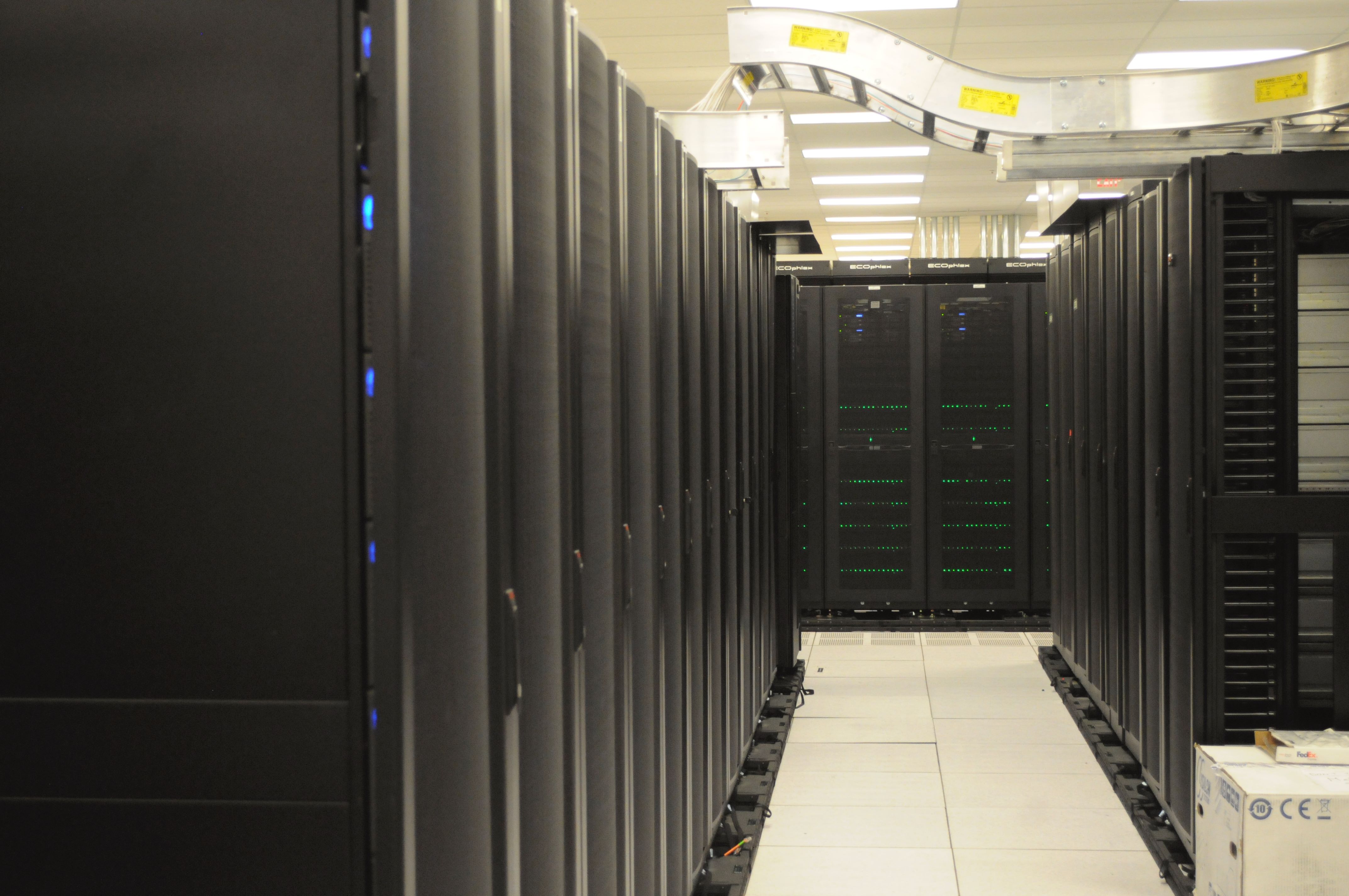
Illustrative image: server racks at NERSC. Image: Wikimedia Commons, CC0. Classical supercomputers run today's catalyst simulations with DFT — the approximations this quantum project aims to improve on, not replace overnight.
The co-design idea: build the machine and the maths together
The project's most interesting claim is methodological, not numerical. Rather than treating quantum chemistry as an algorithm that runs independently of the machine, the team will jointly optimise multiple layers of the computing stack. Quantum Elements' "digital twin" technology models the behaviour and noise environment of Qarakal's superconducting system in software, supporting decisions about compilation, calibration, pulse-level execution, error suppression and algorithm design before scarce quantum hardware time is spent.
"Useful quantum applications cannot be developed in isolation from the hardware that has to run them," said Izhar Medalsy, co-founder and CEO of Quantum Elements. Qarakal's CEO, Dr. Nissan Maskil, made the matching point from the hardware side: "Our architecture is modular by design and tailorable for real-world workloads… Quantum Elements' digital twins can model each module in detail, so we can make smart design decisions before we optimize the hardware."
Qarakal's hardware pitch is its modular three-dimensional "Pangaea" architecture, which connects specialised quantum modules through a protected quantum bus and routing motherboard, assigning dedicated physical resources to distinct computational roles — the same principle, the company says, that let classical computers scale. The claimed payoff is fewer qubits for fewer operations and less noise. Treat that as a company claim, not a measured result: the announcement gives no qubit counts, no error rates and no benchmark numbers for the hardware.
Why it matters for World readers — including in India
No Indian institution is part of this project, and this post claims none. The relevance is in what catalysts decide. India is one of the world's largest producers of chemicals, fertilisers and pharmaceuticals, and its green hydrogen mission depends on catalysts that make hydrogen production cheaper and CO₂ conversion practical. Better catalyst simulation shortens the path from a promising material to a working plant — and today that path runs through expensive trial-and-error lab work, exactly the bottleneck this platform targets.
There is also a funding-model lesson. BIRD's structure — government money covering up to half a bilateral project, no equity taken, repaid through royalties only once commercial revenue arrives — is designed to de-risk exactly the kind of long-horizon research private investors avoid. India's National Quantum Mission and its CSIR laboratories, IITs and IISc groups track this model closely, because the same structure could pair Indian materials researchers with quantum hardware abroad. If the Qarakal–Quantum Elements prototype produces verified catalyst results, its methods will spread through papers, benchmarks and APIs; if it stalls, it will still show where the real bottleneck sits — hardware noise, algorithm design, or the chemistry itself.
Read it alongside the week's other quantum news for the pattern: SoftBank's six-company quantum materials platform in Japan is attacking the same discovery bottleneck from the materials-data side, IBM's 99% quantum coupler result attacked the hardware problem of linking quantum chips, and Quantum Art's geometric quantum algorithm attacked the algorithm side of simulation. Hardware, data, algorithms — all three have to arrive before any of them pays off.
Should you care?
✅ Worth watching if you follow quantum computing, computational chemistry or industrial R&D — a government-vetted, hardware–software co-design project aimed at a real $5–6 trillion industry problem is a serious signal. ⏳ Wait for proof if you want results: no catalyst, benchmark or delivery date exists yet, and the $2.4M figure is the project budget, not the grant. Judge it on its first verified prototype, not this announcement.
FAQs
What is the Quantum Elements Qarakal project? A joint US–Israeli research project, selected by the BIRD Foundation, to build a quantum simulation platform for heterogeneous catalysis — the chemical reactions on catalyst surfaces. Qarakal provides modular superconducting quantum hardware; Quantum Elements provides AI-native digital-twin software, error suppression and error correction.
Is the $2.4 million a grant? No — $2.4 million is the total project budget. BIRD funds up to 50% of a project's costs, capped at $1.5 million per project, and takes no equity. So the BIRD grant for this project is at most $1.2 million, with the partners funding the rest; the grant is also repaid via royalties once commercial revenue is generated.
What is the BIRD Foundation? The Israel–US Binational Industrial Research and Development Foundation, established by the two governments in 1977 to fund joint R&D between American and Israeli companies. It has invested roughly $470 million across more than 1,200 bilateral projects, with technical review by NIST and the Israel Innovation Authority.
Why is catalyst simulation hard for classical computers? Because reactions on catalyst surfaces involve strong electronic correlation, surface defects and transition-metal active sites. Classical methods like density functional theory approximate these effects, and the more accurate multi-reference methods scale factorially — too expensive for large, realistic systems. Quantum computers could model the quantum behaviour directly, if hardware and algorithms mature enough.
When will the platform be ready, and who will use it? No delivery date has been announced. The stated deliverable is a validated prototype with benchmark chemistry models, quantum algorithms and API outputs for chemists and materials engineers, aimed at catalyst manufacturers, specialty-materials companies, chemical suppliers and industrial R&D teams that already use computational screening and lab experiments.
TAKEAWAY
Catalysts run the chemical world, but simulating them still defeats supercomputers — this $2.4M US–Israeli project bets that building the quantum machine and its software together is the way through. Watch for the prototype, not the press release.
Follow World Tech on TechByCountry for the next hourly update.
📸 Get tech in the last 24 hours on Instagram — follow @_techinlast24hrs for daily posts (9 AM–9 PM) and reels at 12:30 PM & 8:30 PM.
Sources
- EINPresswire — Quantum Elements and Qarakal Quantum Receive BIRD Foundation Grant for Quantum Computing Innovation with a $2.4M Budget (company announcement, 28 October 2026)
- Quantum Computing Report — BIRD Foundation Backs Qarakal Quantum and Quantum Elements for Quantum-Accelerated Catalysis Modeling (independent trade coverage, 24 October 2026)
- The Quantum Insider — Qarakal Quantum and Quantum Elements Receive BIRD Foundation Grant for Quantum Computing Innovation with a $2.4 Million Budget (28 October 2026)
Comments
Post a Comment