Vertiv UtilityInnovation Group 1.45 Billion Acquisition Explained: Why AI Data Centers Now Buy Their Own Power

Image: Vertiv (official press image) — Vertiv's acquisition of UtilityInnovation Group extends its data-centre solutions from the grid interconnect to the chip. Source: Vertiv press release, 27 October 2026.
TL;DR — Vertiv UtilityInnovation Group 1.45 billion acquisition explained in one line: Vertiv has completed a $1.45 billion cash acquisition of microgrid specialist UtilityInnovation Group (UIG), plus up to $1.15 billion more if earnings targets are hit, so it can sell AI data-centre operators power itself — not just the cooling and racks that use it — and cut the years-long wait for a grid connection.
📌 KEY HIGHLIGHTS
- The deal: Vertiv completed its acquisition of UtilityInnovation Group on 27 October 2026 for approximately $1.45 billion in upfront cash.
- The earnout: Up to a further $1.15 billion in cash is payable if UIG hits EBITDA targets over 12 and 24 months — a maximum total of about $2.6 billion.
- The price tag in context: $1.45 billion is about 13 times UIG's expected 2027 EBITDA, implying roughly $112 million of expected 2027 earnings.
- What Vertiv gains: Microgrid controls, onsite generation orchestration, microgrid-specific switchgear and behind-the-meter power architecture.
- Why now: Vertiv says access to power has become a competitive advantage for AI data-centre operators, as grid-connection queues stretch for years.
- The honest limit: No India-specific terms were announced — the India angle is Vertiv's existing footprint here, not a promised UIG rollout.
Vertiv UtilityInnovation Group 1.45 Billion Acquisition Explained: What Happened?
Vertiv Holdings Co. (NYSE: VRT), the Ohio-based critical digital infrastructure company, announced on 27 October 2026 that its wholly owned subsidiary Vertiv Corporation has completed the acquisition of Utility Innovation Holdings, Inc., which operates as UtilityInnovation Group (UIG). The deal was announced as completed the same day — there was no separate earlier announcement in the release — and Vertiv expects it to add to adjusted earnings per share in the first year after completion.
The headline numbers, from Vertiv's own release, are straightforward:
| Deal term | Figure | What it means |
|---|---|---|
| Upfront cash price | ~$1.45 billion | What Vertiv paid on completion |
| Contingent earnout | Up to $1.15 billion | Cash tied to EBITDA targets over 12 and 24 months |
| Maximum total value | ~$2.6 billion | Upfront plus full earnout, by simple addition |
| Valuation multiple | ~13x expected 2027 EBITDA | Implies roughly $112 million of expected 2027 EBITDA |
| Earnings expectation | Accretive in year one | Vertiv's expectation for adjusted EPS, not a guarantee |
On the deal's advisers: J.P. Morgan Securities advised Vertiv and Buchanan Ingersoll & Rooney acted as its legal counsel; Morgan Stanley advised UIG and Davis Polk & Wardwell acted as its legal counsel.
What UIG Actually Brings: Microgrids, Explained Simply
UIG, founded in 2020 and headquartered in Raleigh, North Carolina, with European headquarters in Dublin, Ireland, and manufacturing in North Carolina and New Jersey, designs power systems for data centres. Its kit has three parts: proprietary controls software, customised microgrid switchgear, and energy storage.
A microgrid is a local energy system that can generate, store and manage power on a site, balancing load and frequency in real time across both behind-the-meter systems (power made on site) and utility-connected resources. For a data centre, that means the operator is no longer entirely dependent on the public grid: onsite generation and storage can top up grid power, cover peaks, and keep the site running while a grid upgrade is pending.
Vertiv says the combination gives customers three things: faster access to power without waiting on utility interconnection timelines; behind-the-meter site capacity that can scale beyond what the grid alone provides; and a single accountable supplier from the grid interconnect through to rack-level infrastructure. Vertiv CEO Giordano Albertazzi put it bluntly: "As AI data center operators work to accelerate deployment in an increasingly power-constrained environment, access to power has become a critical competitive advantage." UIG founder and CEO Sidney Hinton said the deal lets UIG bring its microgrid and behind-the-meter expertise "to a broader set of customers globally."
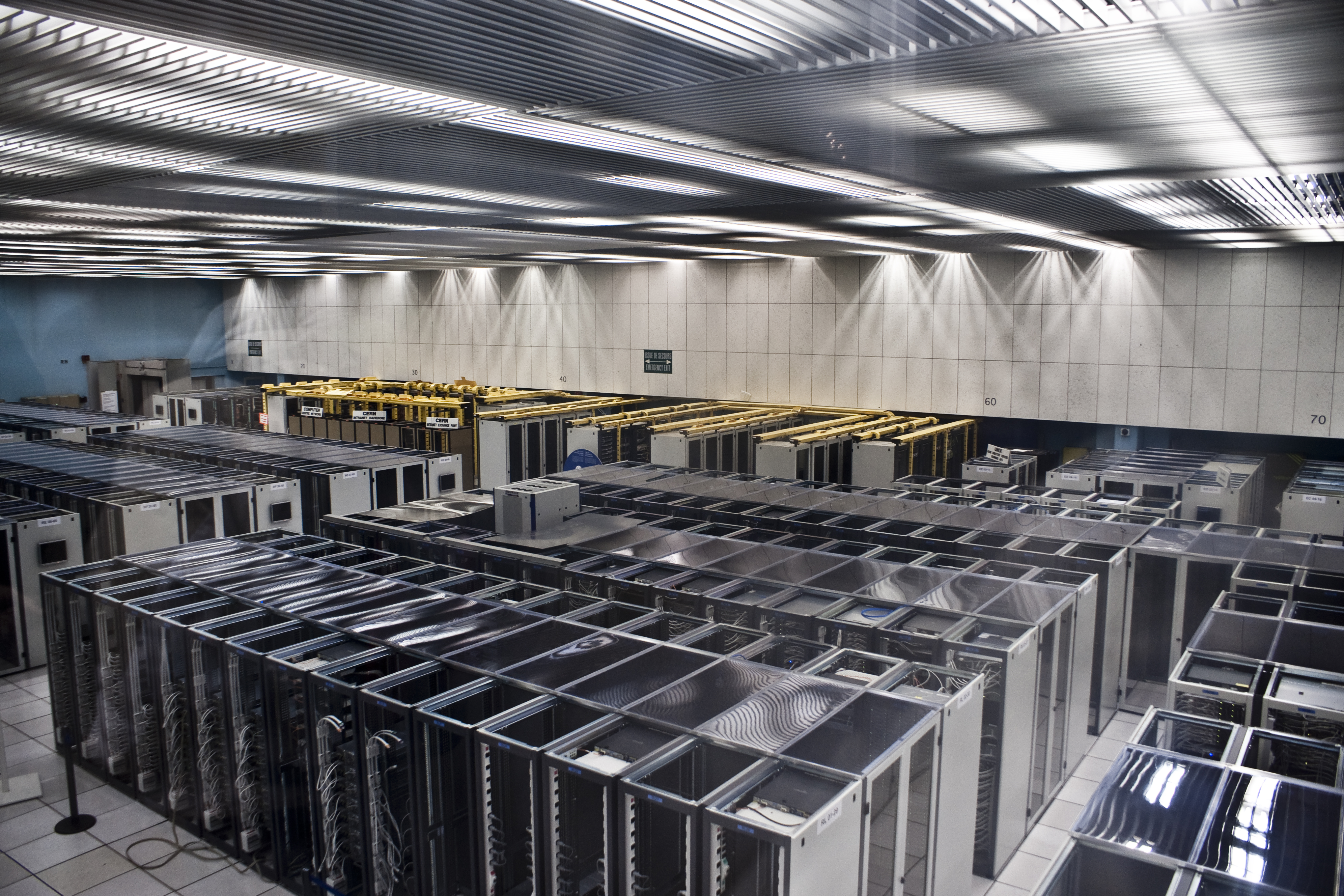
Illustrative image: server racks in a data centre hall. Image: Wikimedia Commons / Florian Hirzinger, CC BY-SA 3.0. This is not a Vertiv or UIG facility — it illustrates the data-centre power loads the deal is about.
Why Power, Not Chips, Is Now the AI Bottleneck
This deal only makes sense against the backdrop of the AI power crunch. AI racks draw far more power than traditional enterprise racks, and new AI campuses can demand gigawatts — comparable to the consumption of a whole city. Grid interconnection queues in major hubs now run to several years, while a data centre building itself can go up in under two years. The result: operators can buy GPUs faster than they can buy electricity to run them.
That is why "behind-the-meter" generation — gas turbines, fuel cells, batteries and renewables built on the data centre's own side of the meter — has gone from a niche resilience measure to a mainstream strategy. Vertiv's pitch is to own the whole chain: it already sells power distribution, cooling and IT infrastructure inside the building; UIG extends that chain upstream, to the utility interconnect and the onsite power sources themselves, "from behind-the-meter power generation to chip," in Albertazzi's words, without tying customers to a single generation technology or supplier.
The same day's deal flow underlines the theme: TechCrunch reported General Compute's $100 million Series A at an $800 million valuation for bare-metal AI inference infrastructure built on non-Nvidia chips — another bet that the AI buildout's scarcest resource is no longer the chip, but the power and infrastructure around it.
Why It Matters for India Readers
Vertiv has not announced any India-specific terms for the UIG deal, and this post does not invent any. The India relevance is Vertiv's existing and growing footprint here. In October 2026, Vertiv delivered India's first direct-to-chip high-density liquid cooling deployment at CapitaLand India Trust's CLDC Mumbai 01 data centre in Airoli, Navi Mumbai — a system supporting 30 MW of AI workloads for a hyperscale customer — and Vertiv India managing director Subhasis Majumdar has pointed to "meaningful growth potential" in India's high-density cooling market.
India's data-centre sector is expanding fast on AI demand, and Indian operators face the same constraint as their global peers: grid capacity and connection timelines. Industry analyses cited by Vertiv's own India commentary put Indian data centres' share of national electricity rising toward around 3% by the end of the decade, from under 1% today. If UIG-style microgrid and behind-the-meter systems reach Indian projects, they would address exactly that constraint — but that is a prospect to watch, not something Vertiv has announced for India yet.
For context on this week's deal-making, see our coverage of Bedrock Robotics' $600 million Series C, the Anthropic S-1 IPO filing, and Intel's acquisition of Classiq — three more signs that AI infrastructure, not just AI models, is where the money is moving.
Should You Care?
✅ Verdict: A strategically sound deal at a full price — watch the earnout, not the headline. Vertiv is buying the scarcest thing in AI infrastructure — faster time to power — and UIG's microgrid controls are genuinely complementary to its existing portfolio. ⏳ But $1.45 billion upfront plus up to $1.15 billion more is a big cheque for a company founded in 2020, and the 13x multiple only looks cheap if UIG's expected 2027 earnings materialise. Judge this deal in 12 and 24 months, when the earnout targets fall due.
Deal Terms, Risks and What to Watch
Three things to track. First, the earnout: whether UIG hits its EBITDA targets over the next 12 and 24 months will tell us whether Vertiv underpaid or overpaid. Second, integration: Vertiv's own release lists the standard risks — retaining UIG's team, keeping its customers and suppliers, and realising the expected synergies. Third, geography: UIG's European headquarters in Dublin is a foothold for selling microgrid systems into Europe's equally power-constrained data-centre markets, and any future India announcement would be the signal that this technology is coming to Indian projects.
Vertiv does business in more than 130 countries from its Westerville, Ohio headquarters. If the UIG integration goes smoothly, expect Vertiv to start pitching "grid-to-chip" power as a single package on its next big AI data-centre bids — and expect its rivals in power and cooling to answer with their own acquisitions.
FAQs
What did Vertiv pay for UtilityInnovation Group? Approximately $1.45 billion in upfront cash, plus up to $1.15 billion more in contingent payments tied to UIG's EBITDA targets over 12 and 24 months — a maximum of about $2.6 billion if the earnout is fully earned.
What is UtilityInnovation Group? UIG is a microgrid company founded in 2020, headquartered in Raleigh, North Carolina, with European headquarters in Dublin, Ireland. It designs power systems for data centres, including proprietary controls software, customised microgrid switchgear and energy storage, balancing load and frequency across onsite and utility-connected power.
What is behind-the-meter power for data centres? Power generated on the data centre's own site — from gas turbines, fuel cells, batteries or renewables — rather than drawn entirely from the public grid. It lets operators bypass grid-connection queues and scale site capacity beyond what the grid alone can supply.
Why are AI data centres buying power companies? Because grid capacity, not chip supply, is now the binding constraint on AI expansion: interconnection waits of several years mean operators can buy GPUs faster than electricity. Owning power capability shortens "time to power" and has become a competitive advantage.
What does the Vertiv UIG deal mean for India? No India-specific terms were announced. The relevance is Vertiv's existing India business — including its October 2026 Mumbai high-density liquid-cooling deployment for 30 MW of AI workloads — and the shared Indian constraint of data-centre power demand outpacing grid capacity.
TAKEAWAY: Vertiv just spent up to $2.6 billion to sell AI data centres something more valuable than servers right now: electricity, on time. The earnout will show whether it was worth it.
Follow USA Tech on TechByCountry for tomorrow's 6 PM update.
📸 Get tech in the last 24 hours on Instagram — follow @_techinlast24hrs for daily posts (9 AM–9 PM) and reels at 12:30 PM & 8:30 PM.
Sources
- Vertiv press release: Vertiv Completes Acquisition of UtilityInnovation Group (PRNewswire, 27 October 2026)
- Ohio Tech News: Vertiv closes $1.45 billion acquisition of UtilityInnovation Group (27 October 2026)
- citybiz: Vertiv Completes $1.45 Billion UtilityInnovation Group Acquisition (27 October 2026)
- CXOToday: Vertiv & CapitaLand India Trust unveil India's first high-density liquid-cooled AI data center (October 2026)
- Express Computer: Navigating power challenges in the age of AI (Vertiv guest blog, India data-centre power context)
Comments
Post a Comment