Gemini 4 Hydrogen Price in India Explained: Google's Fast $1.50 Model, Free Access and What It Replaces
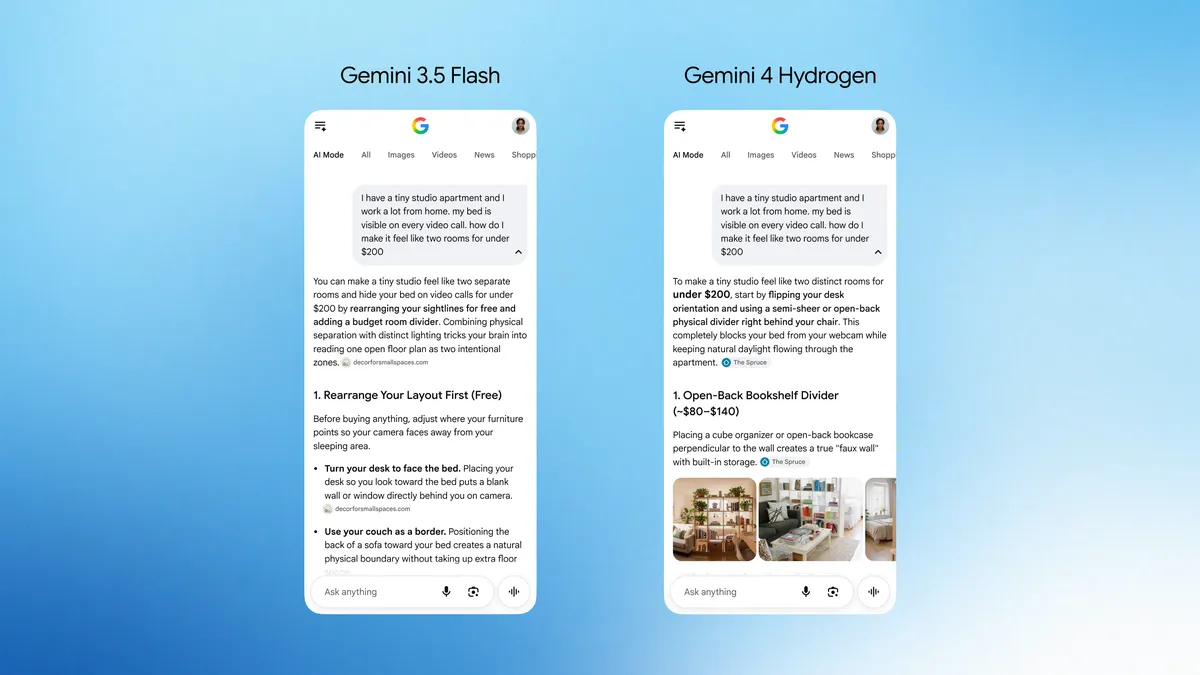
Image: Google — Gemini 4 Hydrogen in the Gemini app (official launch visual)
📌 KEY HIGHLIGHTS
- Google launched Gemini 4 Hydrogen on 12 November 2026 — the fast, everyday tier of the Gemini 4 family, built for coding and multi-step "agentic" work.
- Price: $1.50 per million input tokens and $7.50 per million output tokens, flat across a 1-million-token context window. Google has published no separate rupee price list; API billing is in US dollars.
- Speed: 2.5 times faster than Gemini 3.8 Flash, with its Terminal-Bench 4.1 coding score jumping to 57% from 18.2%.
- Free access in India: every Google Search user gets it, and free Gemini app users get it when the app's automatic model selection picks it.
- Honest caveat: all speed and benchmark figures are Google's own claims — rival Claude Sonnet 5.5 still leads on Terminal-Bench 4.1 at 63.9%.
What is Gemini 4 Hydrogen?
Gemini 4 Hydrogen is the speed-focused member of Google's Gemini 4 family. Google's frontier models, Gemini 4 Carbon and Gemini 4 Argon, handle deep, long-horizon reasoning on the hardest problems. Hydrogen is built for the opposite job: rapid execution across everyday coding and agentic workflows — tasks where the AI carries out several steps on its own, such as fixing bugs, running tests, researching a topic or drafting documents.
Google DeepMind's Koray Kavukcuoglu, who announced the model on Google's blog, calls Hydrogen the company's "daily driver for agentic workflows". According to DeepMind's model card, Hydrogen is adapted from Carbon. It accepts text, images, audio and video in a combined window of up to 1 million input tokens and can produce up to 1 million output tokens in a single request. Its API model ID is gemini-4-hydrogen, and its knowledge cutoff is March 2026.
Hydrogen offers four thinking levels — low, medium, high (the default) and a new xhigh tier — so you only wait and pay for the reasoning depth a task needs. Google has also added Orchestrator to its Antigravity coding platform: it switches between models such as Carbon and Hydrogen inside one session. On Terminal-Bench 4.0, Google says Orchestrator reached near-Carbon task success while using 24% less quota on average and finishing 19% faster.
Gemini 4 Hydrogen price in India and what's included
Google prices Hydrogen flat across its entire 1-million-token context window — there is no long-context surcharge. At the 12 November exchange rate of about ₹94 to the dollar, the headline prices work out to roughly ₹141 per million input tokens and ₹705 per million output tokens. These are approximate conversions: Google lists the price in US dollars only, and Indian developers are billed in dollars through the Gemini API. Cached input costs $0.075 per million tokens through implicit caching, and Google AI Studio offers a free tier with rate limits.
| Model | Role | Input / 1M tokens | Output / 1M tokens |
|---|---|---|---|
| Gemini 4 Hydrogen | Fast everyday execution | $1.50 (~₹141) | $7.50 (~₹705) |
| Gemini 4 Argon | Frontier reasoning | $2.00 (~₹188) | $10.00 (~₹940) |
| Gemini 4 Carbon | Deepest reasoning | $2.00 (~₹188)* | $10.00 (~₹940)* |
*Carbon's price rises to $4 input and $20 output from 1 December 2026. Prices are Google's listed API rates; rupee figures are approximate conversions at ~₹94 per dollar.
For most Indian readers, the more important number is zero. Hydrogen is rolling out globally from 12 November in Google AI Studio (all tiers), the Gemini API, Android Studio's paid tier, Gemini for business, the Gemini app, Google Search for all users, and Google Antigravity for paid AI Pro and Ultra subscribers. Free Gemini app users reach it through automatic model selection — the app picks Hydrogen when it suits the prompt — while Search serves it to everyone.
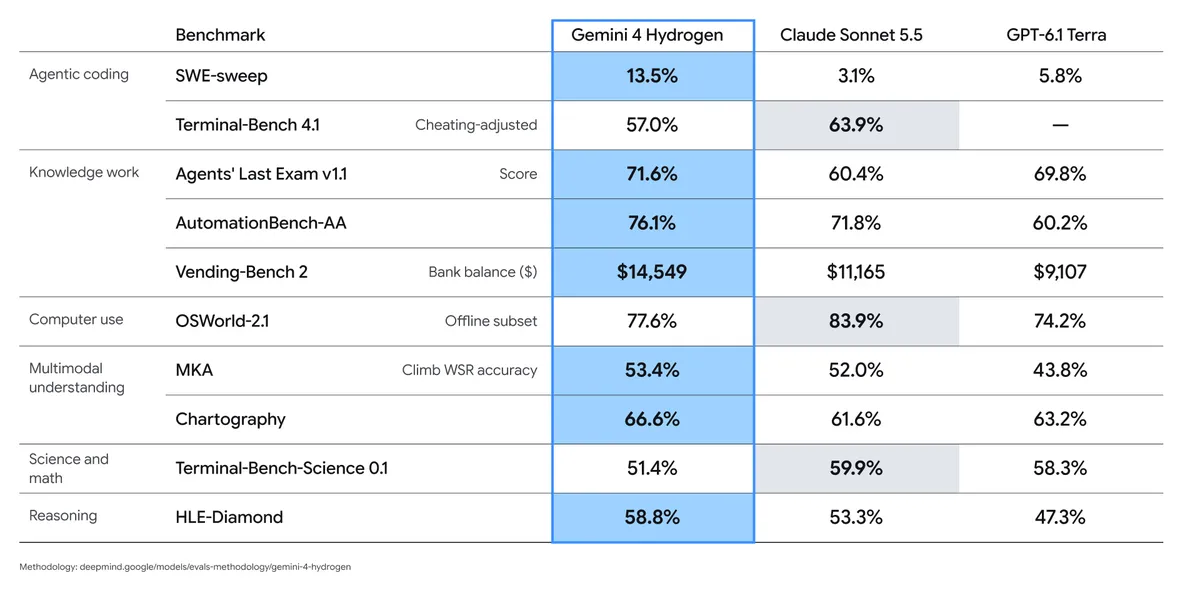
Image: Google — Gemini 4 Hydrogen benchmark chart from the launch announcement (official visual)
How fast is it, really? Benchmarks and honest caveats
Google's headline claims are striking. At its default high thinking setting, Hydrogen finishes tasks 2.5 times faster than Gemini 3.8 Flash, more than triples its Terminal-Bench 4.1 score (57% against 18.2%), and cuts fabricated claims by more than five times. On the Artificial Analysis Intelligence Index it scores 51 at default high — one point above the larger Argon — and reaches 54 at xhigh. It leads its class on HLE-Diamond (58.8%), ranks fifth on the live Agent Arena benchmark, tops the Vals Tax Agent Bench (52.3%) and ties for first on the Vals Legal Research Bench (55.8%).
But these are Google's own figures from Google's own tests, and the fine print matters. On Terminal-Bench 4.1, Google's own model card lists Claude Sonnet 5.5 higher, at 63.9%. The model card also notes that unjustified refusals are higher than on 3.8 Flash — by 5.57 percentage points on one check — particularly for multimodal prompts, and that a full safety and security report is still to come. Independent benchmarks have not yet had time to verify Google's claims, so treat the speed numbers as a launch promise, not a settled verdict.
On safety, Google says Hydrogen cuts overreach in agentic tasks by up to 81% and under-service by up to 79% versus 3.8 Flash, cuts misaligned actions and task shortcutting by 12 times, and is more than 2.3 times more resilient to indirect prompt injection on the Gray Swan benchmark. When faced with impossible or blocked tasks, it is up to two times less likely to bypass a permission boundary, with a 96.7% honesty rate on Google's internal evaluation.
Why it matters for India readers
Hydrogen matters in India for a simple reason: it is the first Gemini 4 model most Indians will actually use for free. Google's Robby Stein, VP of Product for Search, calls this the biggest model upgrade to Search yet. It is live in Google Search for all users globally — including India — with better handling of multi-part questions, typos and highly specific requests, more visual answers, and a wider range of links through improved query fan-out.
That free access is a real change. Free Gemini app accounts were limited to Flash-Lite on 9 October 2026, so a Gemini 4 model reaching free users at all is new. For Indian developers and startups, the API price is the story: at $1.50/$7.50, Hydrogen is the cheapest Gemini 4 tier — 25% below Argon's introductory rate — which makes it a realistic engine for agent loops that fire hundreds of small requests per task. And for students and professionals, the Gemini app now drafts, summarises and prototypes with a model that follows instructions more closely across multi-turn conversations, pulling context from Gmail, Drive and uploads.
One caution for Indian developers: the free API tier in AI Studio carries rate limits, and free-tier prompts can be used to improve Google's products — check the current pricing page before building a production workload on it.
Should you care?
FAQs
What is Gemini 4 Hydrogen?
Gemini 4 Hydrogen is Google's fast, low-cost Gemini 4 model, launched on 12 November 2026 for everyday coding and agentic workflows. Carbon and Argon remain the frontier models for deep, long-horizon reasoning, while Hydrogen is built for rapid execution — the "daily driver" tier of the family.
How much does Gemini 4 Hydrogen cost in India?
Google charges $1.50 per million input tokens and $7.50 per million output tokens, flat across a 1-million-token context window. That works out to roughly ₹141 and ₹705 at the 12 November rate of about ₹94 to the dollar. Google has published no separate rupee price list, and Indian developers are billed in US dollars through the Gemini API.
Is Gemini 4 Hydrogen free?
Yes, for everyday use. It is free for all users in Google Search, and free Gemini app users get it through automatic model selection when the app judges it the right model for the prompt. Developers also get a free tier in Google AI Studio with rate limits; paid API use is billed at the $1.50/$7.50 rate.
How is Gemini 4 Hydrogen different from Gemini 4 Argon and Carbon?
Hydrogen is the fast, cheap execution tier: it scores 51 on the Artificial Analysis Intelligence Index at its default setting, one point above Argon, and runs 2.5 times faster than Gemini 3.8 Flash. Argon and Carbon are the frontier models for deep reasoning — Carbon is the strongest of the three — and they cost more: Argon lists at $2/$10, and Carbon rises to $4/$20 from 1 December 2026.
Takeaway: Gemini 4 Hydrogen is Google's cheapest and fastest Gemini 4 model — and, unusually, the free tier is the headline: it reaches every Search user and every free Gemini app user in India from day one. Developers get a genuinely cheap agent engine; everyone else just gets better answers.
Try it free in the Gemini app or Google Search today, and if you build with the API, check Google's current pricing page before scaling up. For the frontier tier of the family, read our Gemini 4 Carbon India explainer — and for the week's other big Google AI launch, see Google A2UI 1.0, which lets AI agents answer with interactive screens.
Sources
- Google — "Introducing Gemini 4 Hydrogen for Agentic Workflows", 12 November 2026
- iThinkDiff — "Gemini 4 Hydrogen Launches at $1.50 per Million Input Tokens"
- StartupHub — "Google pitches Hydrogen as fast agent worker"
- American Bazaar — "Google launches Gemini 4 Hydrogen, targets faster AI workflows"
- ForexInvestors — USD/INR exchange rate, 12 November 2026 (about ₹94 per $1)
Comments
Post a Comment