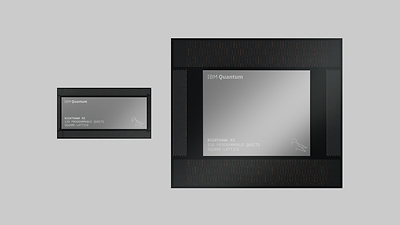
Image: IBM — IBM Quantum Nighthawk r3 (left) and Nighthawk r2 (right) renders (official image)
TL;DR: IBM Quantum Nighthawk r3 explained: announced on 11 November 2026, IBM's next quantum processor is designed to run 10,000 quantum operations across 520 programmable qubits, and two of them will be linked into a 1,040-qubit system in 2027. These are design targets, not a finished chip — the working hardware today is still the Nighthawk r2.
Key Highlights
- IBM announced the Quantum Nighthawk r3 on 11 November 2026: 520 programmable qubits out of 2,034 total physical qubits, designed for 10,000 quantum operations.
- In 2027, IBM plans to connect two Nighthawk r3 processors into a single 1,040-qubit system — its first machine past the 1,000-qubit mark.
- The r3 keeps the Nighthawk r2's square-lattice layout and fast operations, and adds 10 chip-to-chip links called l-couplers — the key to scaling beyond one chip.
- IBM has already tested the linking technology: two Nighthawk r1 processors connected with four l-couplers reached 99.3% quantum state transfer fidelity, against a 99.9% target.
- No release date or price has been given for the single r3 chip, and no error rate was disclosed — the headline numbers are targets to be proved, not measured results.
What happened?
IBM announced its next-generation quantum processor, the IBM Quantum Nighthawk r3, on 11 November 2026 at its Quantum Developer Conference. The announcement, carried in IBM's official release, sets out what the chip is designed to do: accurately execute 10,000 quantum operations across 520 programmable qubits, while keeping the speed and quality of the current Nighthawk r2. In 2027, IBM plans to link two r3 processors into one system with 1,040 programmable qubits.
The timing matters. The Nighthawk r2 was only introduced in September 2026, so the r3 announcement arrives barely two months later — a sign of how fast IBM is moving its quantum roadmap. But the two announcements are different kinds of news. The r2 is a working processor that customers are already running jobs on. The r3 is a design: IBM says it "will be built" to hit its targets. Nothing in the announcement says the chip exists yet, and IBM gave no date for when outside users will be able to run jobs on it.
That distinction is the single most important thing to understand about this story. A qubit count on a slide is a promise; a qubit count on a working chip is a result. This post explains both — what IBM is promising, and what it has already proved.
IBM Quantum Nighthawk r3 explained: the specs in plain English
A qubit is the basic unit of a quantum computer — the counterpart of the bit in an ordinary computer. Where a bit is either 0 or 1, a qubit can hold a mixture of both at once, which lets a quantum chip explore many possibilities in parallel. The catch is that qubits are fragile: they lose their quantum state quickly, and every operation adds a little error. So the two numbers that matter most are how many qubits a chip has, and how many operations it can run before errors swamp the answer.
Here is how the Nighthawk family lines up:
| Processor | Programmable qubits | Quantum operations | Status |
|---|---|---|---|
| Nighthawk r2 | 120 | More than 7,500 | Working since September 2026; up to 100,000 samples per second |
| Nighthawk r3 | 520 (2,034 physical qubits in total) | 10,000 (design target) | Announced 11 November 2026; to be built |
| Two linked r3 chips | 1,040 | Not specified | Planned for 2027 |
Three numbers in that table need careful reading. First, 520 programmable qubits is about 4.3 times the r2's 120 — a big jump. Second, the 10,000-operation target is only about a third higher than the r2's 7,500-plus, which tells you IBM is prioritising scale and speed over a dramatic leap in circuit depth. Third, the 2,034 total physical qubits are not the same thing as 520 programmable ones: the extra quantum components include couplers and reset elements that support the programmable qubits. None of these are error-corrected logical qubits — the kind a fault-tolerant machine needs — so the r3 will not break encryption or replace ordinary computers.
The chip keeps the r2's square-lattice layout, in which each qubit connects to its neighbours in a grid, and its fast operations. The genuinely new hardware is the set of 10 chip-to-chip interconnects, called l-couplers, built into the r3. They are what make the 2027 two-chip system possible.

Image: IBM Quantum System One — Wikimedia Commons / OJB Quantum, CC BY 4.0 (illustrative image of IBM quantum hardware; not the Nighthawk r3 processor)
The l-coupler: how two chips become one machine
There is a practical limit to how many qubits you can cram onto a single chip before the wiring, the cooling and the error rates become unmanageable. IBM's answer is modularity: build very good medium-sized chips, then link them together so they behave like one larger machine. The l-coupler is the link.
IBM has already demonstrated the idea at small scale. Earlier this year it connected two Nighthawk r1 processors using four l-couplers and achieved 99.3% quantum state transfer fidelity — a measure of how faithfully quantum information moves from one chip to the other. That is progress toward IBM's 99.9% target, but it is not there yet, and the gap matters: every imperfect transfer adds error to the computation. IBM also connected two cryogenic modules into a single system for the first time, reaching operating temperature in under five days and cooling below 15 millikelvin — colder than outer space, and a practical necessity, since superconducting qubits only work near absolute zero.
We covered the l-coupler demonstration in detail in our IBM Quantum l-coupler explainer. The r3 announcement is best read as the next step in that same programme: the r1 experiment proved chips can be linked; the r3 is designed from the start with ten l-couplers so that linking is a core feature, not an add-on.
What Nighthawk r2 has already proved
The r2 numbers are the ones that carry real weight, because they come from a working machine. IBM says the r2 delivers up to 100,000 samples per second — samples matter because a quantum computer delivers its answer by running a circuit many times, and applications increasingly need millions or billions of samples. Its high-speed qubit reset technology cuts the wait between runs to about 25 nanoseconds, which is a large part of where that speed comes from.
Clients and partners including E.ON, Algorithmiq and Q-CTRL have run more than 34 billion circuits on the r2, reporting speedups of up to 19 times over previous IBM processors. The named results include a 15-times speedup reported by E.ON on quantum machine learning for energy-grid optimisation, a 12-times speedup for an IBM–Oak Ridge National Laboratory experiment simulating real magnetic materials, and an Algorithmiq experiment on a heterogeneous quantum material that ran 8 times faster on the r2 than on IBM's earlier Heron processor — with circuits that would need an estimated 240 times more memory for a classical computer to simulate at comparable accuracy. These are company- and partner-reported figures, not independent benchmarks, but they are specific, attributed claims about a working system rather than projections.
IBM is also tying the quantum hardware more tightly to classical computing. The enhanced IBM Quantum Platform now brings high-performance classical resources into the same managed environment as the quantum processors, so researchers can run hybrid workflows without moving data between systems. IBM says its sample-based quantum diagonalization workflow with RIKEN ran about 5 times faster with 100 times more computations in the new environment, and that Cleveland Clinic and RIKEN processed 608 million samples for modelling biologically relevant structures 33 times faster with workflow automation. A new co-design platform for quantum error correction with Oak Ridge National Laboratory and AMD physically co-locates Nighthawk hardware with AMD Instinct MI355X GPUs and 5th Gen EPYC CPUs — error correction being the research problem the whole roadmap is ultimately aimed at. Our IBM–ORNL–AMD error-correction platform explainer covers that partnership in detail.
Why it matters for Indian readers
Quantum computing is not a consumer story, and no Indian reader will run a job on a Nighthawk r3 next week. But India is already inside this roadmap. TCS announced in May 2025 that it would work with IBM and the government of Andhra Pradesh on a Quantum System Two installation in Amaravati, built around a 156-qubit Heron processor, alongside algorithm and application development. That puts Indian researchers and enterprises on the same hardware family — Heron today, Nighthawk tomorrow — that IBM is scaling toward fault tolerance.
More immediately, the Nighthawk hardware is available through the cloud on the IBM Quantum Platform, so Indian researchers, startups and students can run experiments on the same r2 processor behind these announcements without owning any hardware. The practical skills that matter — writing quantum circuits, understanding error mitigation, building hybrid quantum-classical workflows — are the same whether the chip has 120 qubits or 520. The r3 announcement is a reason to start learning them now, not a reason to wait for bigger hardware.
The other Indian angle is cautionary. Every qubit-count headline invites hype, and the r3 numbers will be quoted out of context. The honest summary is that IBM has a credible, demonstrated path — working high-speed chips, tested chip-to-chip links, real partner workloads — and a set of targets for 2027 that are not yet hardware. That is genuinely significant, and it is not the same as a 1,040-qubit computer existing today.
Should you care?
✅ Follow it if: you are a researcher, developer or student working on quantum computing, or you track the road to fault-tolerant machines — the l-coupler scaling strategy and the 2027 two-chip target are the milestones to watch.
⏳ Wait if: you are looking for something that changes your phone, laptop or business this year — Nighthawk r3 is a research roadmap, not a product launch, and its headline numbers are targets, not measured results.
FAQs
What is IBM Quantum Nighthawk r3?
Nighthawk r3 is IBM's next-generation superconducting quantum processor, announced on 11 November 2026. It is designed to execute 10,000 quantum operations across 520 programmable qubits, keeping the speed of the current Nighthawk r2 while scaling up. It is a design target for now — IBM says the processor "will be built" — and no date has been given for general availability of the single chip.
How many qubits does IBM Nighthawk r3 have?
The r3 is designed with 520 programmable qubits out of 2,034 total physical qubits. The two figures are not interchangeable: programmable qubits are the ones that run computations, while the physical total includes supporting quantum components such as couplers. Neither figure means error-corrected logical qubits, which fault-tolerant computing requires.
When will IBM Nighthawk r3 be available?
IBM has not given a general-availability date for the single r3 chip. The only firm date in the announcement is 2027, when IBM plans to connect two r3 processors into a single 1,040-qubit system. Until then, the working hardware is the Nighthawk r2, introduced in September 2026 and available through the IBM Quantum Platform.
Is Nighthawk r3 a fault-tolerant quantum computer?
No. Nighthawk r3 uses physical, noisy qubits, not the error-corrected logical qubits a fault-tolerant machine needs. IBM's longer-term goal is Starling, its planned fault-tolerant system, and the r3's modular design — especially the l-coupler links between chips — is a step on that road, not the destination.
Takeaway
IBM's Nighthawk r3 is a serious scaling bet — 520 programmable qubits, 10,000 operations, and a 1,040-qubit linked system in 2027 — built on working r2 hardware and a demonstrated chip-to-chip link. Treat the headline numbers as targets to watch, not results already achieved.
Read IBM's full announcement and compare the r3 targets with what the r2 has actually delivered — the gap between the two is where the real story is.
Sources
- IBM — "IBM Quantum Nighthawk Demonstrates New Levels of Speed and Quality, with Plans to Scale Beyond 1,000 Qubits in 2027" (official announcement, 11 November 2026)
- SiliconANGLE — "IBM Quantum announces upcoming Nighthawk r3 processor designed to execute 10,000 operations" (11 November 2026)
- The Quantum Insider — "IBM Plans 1,040-Qubit Quantum System with Next-Generation Nighthawk Processors" (11 November 2026)
- TechByCountry — IBM Quantum l-coupler explainer (27 October 2026)
- TechByCountry — IBM–ORNL–AMD quantum error-correction platform explainer (6 November 2026)
Comments
Post a Comment