Meta Astryx Design System Explained: 15,000+ GitHub Stars, 150+ React Components and a CLI Built for AI Agents
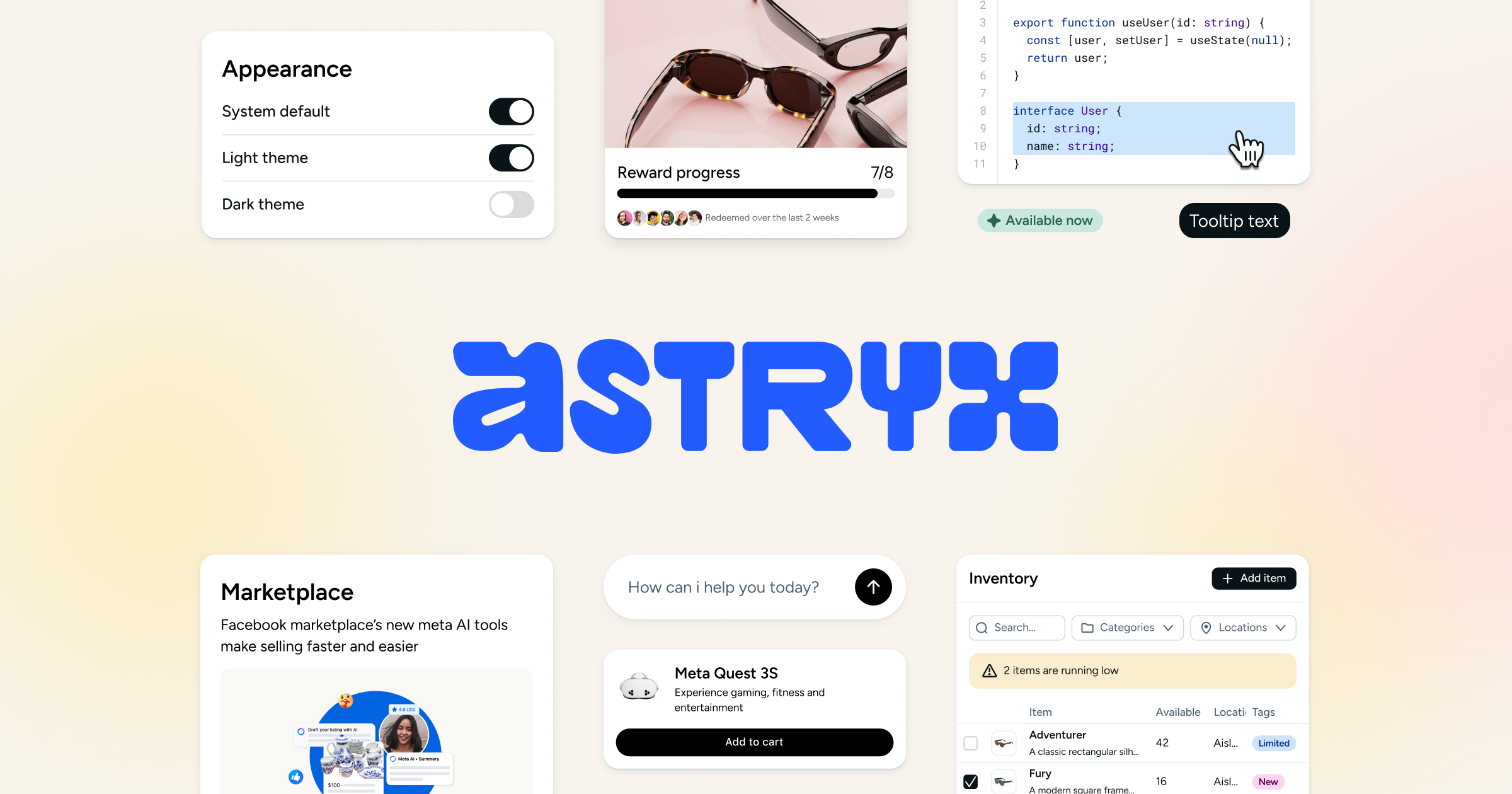
Image: Meta — Astryx (official banner)
📌 KEY HIGHLIGHTS
- Astryx gained 863 GitHub stars in 24 hours on 8 November 2026, reaching 15,080 — and stood at 15,212 stars with 1,238 forks when this post was prepared.
- Version 0.7.11 shipped on 7 November 2026, the sixth release in six days (v0.7.6 to v0.7.11 landed between 2 and 7 November).
- It ships 150+ accessible components, ten ready-made themes, dark mode, page templates and a CLI — all under the MIT licence.
- The "agent-ready" pitch is real tooling, not marketing: a CLI that returns a machine-readable manifest and a hosted MCP server, so AI coding agents use the same API as developers.
- It is still a public beta, so APIs can change between 0.x releases — check the changelog before adopting it for a long-lived project.
What happened?
On 8 November 2026, Meta's open-source design system Astryx surged to the top of GitHub's TypeScript daily trending list. The repository picked up 863 stars in a single day, taking it past 15,000 stars in total, with 1,238 forks. The surge followed a run of rapid releases: v0.7.11 shipped on 7 November, v0.7.10 and v0.7.9 on 6 November, v0.7.8 on 4 November and v0.7.7 on 3 November.
That pace is part of the story. Astryx is not a weekend experiment that went viral. It is the design system that grew inside Meta over eight years, became the company's most-used and largest design system, and now powers more than 13,000 internal products. Meta announced it as an open-source public beta on 18 June 2026, and the public repository has been gathering momentum ever since — from roughly 13,000 stars in October to more than 15,200 in early November.
The timing also fits a wider shift in how developers work. Coding agents now write a large share of new code — 40% of pull requests on GitHub are now agent-drafted — and Astryx is one of the first major design systems built from the start for both people and agents. That is why it is trending, and why it matters beyond a star count.
Meta Astryx design system explained: what's inside
Astryx is a component library with a whole system wrapped around it: typed React components shipped with pre-compiled CSS, foundations (colour, typography, spacing, motion, accessibility), brand-level theming, dark mode, page templates and a command-line interface. It is built on React 19 or later and StyleX, Meta's compile-time CSS engine, which turns style objects into atomic CSS at build time — so there is no style engine running in the browser. The codebase is about three-quarters TypeScript, and the TypeScript 7.1 beta is worth a look if you are modernising a TypeScript codebase at the same time.
| Fact | Detail |
|---|---|
| Licence | MIT — free for personal and commercial use |
| Stack | React 19+ and StyleX; about three-quarters of the codebase is TypeScript |
| Components | 150+ accessible components, according to Meta's documentation |
| Themes | Ten ready-made themes, including neutral, butter, matcha and y2k |
| CLI | @astryxdesign/cli — scaffold templates, print component docs, build themes |
| Agent tooling | Machine-readable CLI manifest (npx astryx manifest --json) plus a hosted MCP server |
| Status | Public beta — latest release v0.7.11 (7 November 2026) |
| GitHub | meta/astryx — 15,212 stars, 1,238 forks (checked 8 November 2026) |
| Install | npm install @astryxdesign/core @astryxdesign/theme-neutral |
Two design choices stand out. First, there is no styling lock-in: components accept a typed xstyle prop or a plain className, so you can override styles with Tailwind, CSS modules or plain CSS. Second, theming is a token layer — colour, typography, radius, spacing and motion live in a theme config, so changing one value restyles every component that reads it. If you need deeper control, the "swizzle" command ejects a component's full source into your own repo — though that takes you off the shared upgrade path.

Illustrative image: Meta's headquarters in Menlo Park, California. Image: Wikimedia Commons / LPS.1, CC0
Why the "agent-ready" part matters
Most design systems treat AI as an afterthought: an agent reads the docs like a human and guesses the props. Astryx designs the API, docs and CLI together so agents and humans work from the same source of truth. Components carry JSDoc annotations with composition hints. The CLI exposes the same operations a developer uses, and one command — npx astryx manifest --json — returns a self-describing JSON payload listing every command, its arguments, flags, defaults and response types, so an agent reads a structured contract instead of scraping help text. A hosted MCP server lets agents search components and fetch their documentation directly.
This is the same direction GitHub is moving on the infrastructure side: GitHub's Project Rubicon rebuilt Git storage for 5,000 AI agents on one repo, because agents push code around the clock and turn short bursts of writes into sustained load. Astryx answers the other half of that problem — when agents also build the interface, they need components they cannot hallucinate props for.
For Indian developers, the practical point is simple: Astryx is free, MIT-licensed and installable with one npm command, and it targets exactly the internal tools, dashboards and admin panels that Indian startups and enterprises build in large numbers. The catch is the React 19 floor and the modern-browser requirement — older codebases will need an upgrade first.
Should you use Astryx?
✅ Try it now if you are starting a new React 19 project — an internal tool, dashboard or admin panel — and you want accessible components plus AI-agent-friendly tooling without paying for a design system or writing one from scratch.
⏳ Wait if you need a stable API, long-term support guarantees or a charts package. Astryx is still a 0.x beta: breaking changes between minor versions are possible, and the v0.6.0 upgrade alone changed CSS selectors and a Stepper API. Established alternatives such as shadcn/ui or MUI are safer bets for production apps that cannot absorb churn.
The honest verdict: Astryx is the most complete "agent-ready" design system available today, and the star count shows developers agree — but treat it as a fast-moving beta, pin your version, and read the changelog on every upgrade.
Price, availability and how to try it
Astryx is free and open source under the MIT licence, with packages on npm and documentation, a component playground and a Storybook on the official docs site. To try it, install the core package and a theme — npm install @astryxdesign/core @astryxdesign/theme-neutral — and add the CLI as a dev dependency with npm install -D @astryxdesign/cli. The pre-compiled path needs no build plugin: import the stylesheet and use the components. The advanced path builds from TypeScript and StyleX source, so your bundler includes styles only for the components you import.
FAQs
What is Meta Astryx?
Astryx is Meta's open-source design system for building internal tools and web apps. It ships 150+ accessible React components, brand-level theming, dark mode, page templates and a CLI, built on React 19+ and StyleX. It grew inside Meta for eight years across 13,000+ internal products before its public beta in June 2026.
Is Astryx free to use?
Yes. Astryx is released under the MIT licence, so it is free for personal and commercial use. The packages are published on npm, and the documentation, component playground and Storybook are public while the project is in beta.
Does Astryx need React 19?
Yes. React 19 or newer is a hard requirement — @astryxdesign/core lists react and react-dom at 19.0.0 or above as peer dependencies, alongside StyleX. Projects on older React versions must upgrade before they can use Astryx.
Is Astryx production ready?
Not yet, officially. Astryx is in public beta on 0.x releases, and breaking changes between minor versions are possible — the v0.6.0 upgrade changed CSS selectors and a Stepper API. It is production-tested inside Meta, but treat it as a fast-moving beta: pin your version and read the changelog on every upgrade.
TAKEAWAY: Astryx is Meta's eight-year-old internal design system, now open source and suddenly the most-starred React design system of the week — 150+ components, a CLI and MCP server that AI agents can actually read. Free and MIT-licensed, but still beta: try it on a new project, pin the version, and watch the changelog.
To try it yourself, install the core package from npm and run npx astryx manifest --json to see the full machine-readable CLI contract — that one command shows what makes Astryx different from every other design system.
Sources
- Astryx — official documentation (Meta)
- meta/astryx — GitHub repository (Meta)
- How Astryx works — Astryx blog (Meta)
- Meta's Open-Source Astryx Surges on GitHub with 15,080 Stars — Blockchain.News, 8 November 2026
- A First Look at Astryx, Meta's Design System — OpenReplay
- Meta's Astryx Brings a CLI and MCP Server to an Open-Source React Design System Agents Can Read — MarkTechPost
Comments
Post a Comment