GitHub Octoverse 2026 AI Agents Pull Requests Explained: 40% Agent-Drafted, India Second at 32 Million Developers
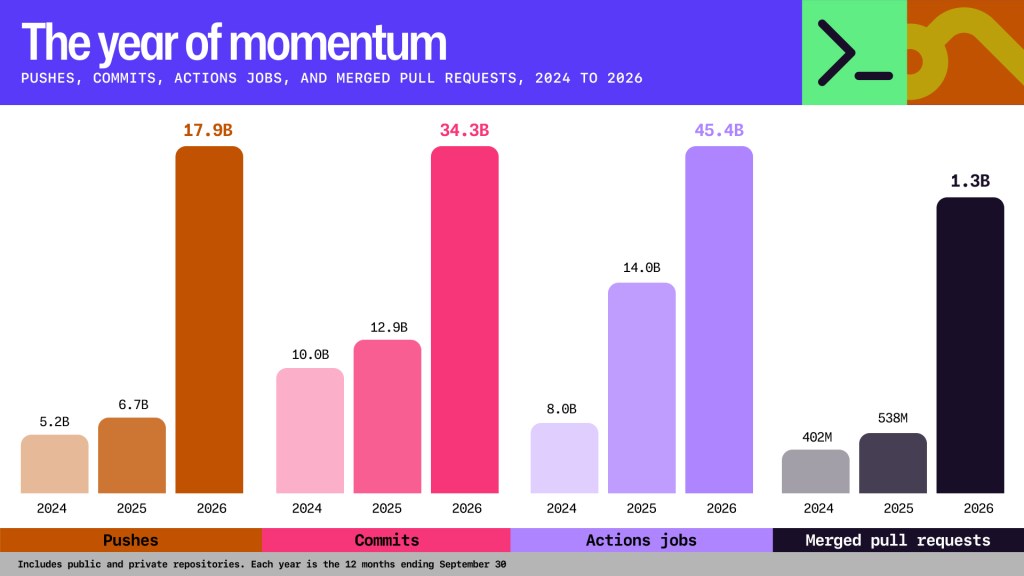
Image: GitHub — Octoverse 2026 (official chart: pushes, commits, Actions jobs and merged pull requests, 2024–2026).
TL;DR: github octoverse 2026 ai agents pull requests explained: GitHub's Octoverse 2026 report, presented at GitHub Universe on 28 October 2026, shows more than 40% of pull requests started with an agent's first draft in September — up from 17% in March — while India held second place worldwide with 32 million developers.
📌 KEY HIGHLIGHTS
- Agents draft the first move: over 40% of pull requests began with an agent's first draft in September 2026 (17% in March) — 110 million agent-started pull requests in September alone, about 6 times March's volume.
- Record activity: 17.9 billion pushes, 34.3 billion commits and 1.3 billion merged pull requests in the 12 months to 30 September 2026 — pushes alone beat 2024 and 2025 combined.
- India second worldwide: 32 million developers on GitHub, behind only the United States (38.3 million); each country added more than 10 million developers this year.
- Agents merge faster: 90% of agent-involved pull requests merged within two weeks in September, against about 86% for pull requests without detected agent involvement.
- Model choice explodes: paying Copilot users ran 47 distinct models in September (29 in May), and 61% of Copilot users who picked a model used more than one.
GitHub Octoverse 2026 AI agents pull requests explained: what happened?
GitHub's annual Octoverse report is the platform's own census of how the world's developers work, and the 2026 edition — presented at GitHub Universe in San Francisco on 28 October 2026 — tells one story above all: coding agents went from an experiment to the default first step. Activity bent sharply upward around June 2026, just as agents moved from single-session tools to persistent ones that track work across days, run in the cloud, and orchestrate other specialised agents.
The headline numbers cover the 12 months ending 30 September 2026, across public and private repositories:
| Measure | 2024 | 2025 | 2026 |
|---|---|---|---|
| Pushes | 5.2 billion | 6.7 billion | 17.9 billion |
| Commits | 10.0 billion | 12.9 billion | 34.3 billion |
| Merged pull requests | 402 million | 538 million | 1.3 billion |
| GitHub Actions jobs | 8.0 billion | 14.0 billion | 45.4 billion |
Merged pull requests averaged 3.5 million a day, and Actions ran a job 1,440 times every second. Public contributions alone more than doubled, to 2.5 billion from 1.12 billion last year.

Image: Wikimedia Commons / GitHub (Octicons mark, MIT licence) — illustrative.
The agent shift in numbers
The agent figures are the report's core. New repositories created in 2026 that shipped with an agent configuration file averaged eight times as many commits as new repositories without one — an association, not proof that agents alone caused the difference, but a stark gap. Agent-started pull requests also change more files: about 87% touch multiple files, against 79% for pull requests without detected agent involvement. And they land: in February, 83% of agent-involved pull requests merged within two weeks, slightly behind the comparison group's roughly 86%; by September, agent pull requests had reached 90% while the comparison group held at about 86%.
Developers are also delegating more, not just chatting. Among GitHub Copilot's monthly active users, 55% now use agentic features, up from 35% a year ago, and the most hands-off mode — the Copilot cloud agent, where a developer assigns a task and the agent works independently — grew 230% year over year, against 85% for agent chat. Review is where humans still shape the work: stacked pull requests, which split related changes into smaller pieces for sequential review, launched as a preview on 30 July and had over 264,000 users by September, while AI-assisted code review and GitHub Advanced Security usage each grew more than 90% year over year.
Language choice is shifting with the agents. TypeScript stayed the most-used language on GitHub by contributors, ahead of Python and JavaScript, adding 3.62 million monthly contributors in the year to September 2026 (Python added 3.23 million, JavaScript 1.82 million). Rust grew fastest in percentage terms, doubling. And in the fastest-growing communities, AI involvement is highest: about 44% of TypeScript's merged pull requests, 41% of Python's and 40% of Rust's show detected AI involvement.
Why it matters for India readers
India is now firmly the world's second-largest developer community on GitHub, and the gap to the top is closing. The report puts India at 32 million developers in September 2026, behind the United States at 38.3 million, with each country adding more than 10 million developers this year. India also ranks second for pushes to public repositories, behind only the United States. GitHub's regional note credits Asia-Pacific growth to government investment in AI infrastructure and talent — the same tailwind behind India's developer surge.
GitHub's own 2030 projection still has India overtaking the United States — 57.5 million developers against 54.7 million — but the report is unusually candid that the crossover date is now uncertain. One year into the five-year projection window, the United States has closed 38.6% of the distance to its 2030 figure while India has closed 28.3%, and GitHub's 43 forecasting models to 2031 spread from under 2x growth to over 6x. Treat 2030 as a direction, not a date.
For Indian developers, the practical read is about workflow, not just headcount. The GitHub Copilot Fusion generally available launch at the same Universe event — automatic model routing across the 47 models developers actually used — and the Visual Studio Code 1.144 agent sessions that keep running after the editor closes are the tools this data describes. Knowing how to write an agent configuration file, review multi-file agent pull requests, and pick models per task is becoming core developer literacy, and India's 32 million developers are adopting it at the same pace as everyone else.
Should you care? ✅ Yes — but read the numbers honestly
Verdict: if you write code, manage a team, or hire developers, Octoverse 2026 is the clearest signal yet that agent-first development is the normal workflow, not a niche. But keep three caveats in mind: these are GitHub's own platform figures, not the whole software industry; "agent" counts measure detected agent involvement, so they are a floor, not a census; and volume is not quality — the report measures how much code moves, not whether it is good. Review skill, not prompt skill, is the bottleneck the data points to.
What to watch next
Three things will show whether this surge sustains or stalls: whether agent-started pull requests keep their 90% merge rate as volumes grow; whether India's developer growth closes the 2030 projection gap faster than the United States'; and whether review tooling — stacked pull requests, AI-assisted review, push protection's 5.8 billion secret scans this year — keeps pace with code volume. Also worth watching: construction had the highest share of agent-opened pull requests of any industry (about 9%), and mining's public repository footprint grew roughly 65 times since 2022 from a small base — agents are spreading well beyond software companies. Readers tracking the runtime side should also note the Node.js 26 LTS October 28 2026 release, which gives agent-built JavaScript a supported long-term runtime.
FAQs
What is GitHub Octoverse? Octoverse is GitHub's annual report on developer activity across its platform, drawn from public and private repository data. The 2026 edition covers the 12 months ending 30 September 2026 and was presented at GitHub Universe on 28 October 2026.
How many developers are on GitHub in 2026? More than 225 million developers, according to the Octoverse 2026 report. The United States leads with 38.3 million, India is second with 32 million, followed by China (12.4 million), Brazil (10.2 million) and Japan (7.15 million).
What percentage of pull requests are started by AI agents? More than 40% of pull requests on GitHub started with an agent's first draft in September 2026, up from 17% in March 2026 — about 110 million agent-started pull requests in September alone, roughly six times March's volume.
Will India overtake the US on GitHub by 2030? GitHub's projection says India will reach 57.5 million developers by 2030 against 54.7 million for the United States, but the report itself warns the date is uncertain: after one year, the US has closed 38.6% of its distance to the target and India 28.3%, and GitHub's 43 forecasting models disagree widely on growth to 2031.
TAKEAWAY: Agents now draft the first version of over 40% of GitHub pull requests, code volume has roughly tripled in two years, and India — 32 million developers and counting — is at the centre of the shift. Learn to direct and review agents; that is the skill the data rewards.
Follow World Tech on TechByCountry for tomorrow's 6 PM update.
📸 Get tech in the last 24 hours on Instagram — follow @_techinlast24hrs for daily posts (9 AM–9 PM) and reels at 12:30 PM & 8:30 PM.
Sources
- GitHub Blog — Octoverse: Commits, pushes, reach new highs in 2026 as developers build with agents (28 October 2026)
- The Indian Express — GitHub to developers: Copilot Fusion promises frontier-level AI coding at half the cost (29 October 2026)
- Digit — GitHub Octoverse 2026: India is the second largest developer hub and growing faster than the US (28 October 2026)
Comments
Post a Comment