Northwood Space 375 Million Series C Funding Explained: $2 Billion Valuation for the Ground Network Connecting Satellites to Earth

Image: Wikimedia Commons / Paul Dench (ILLUSTRATIVE — satellite earth-station dishes; Northwood's Portal antennas are flat phased-array panels, not dishes like these, and this is not a Northwood site).
TL;DR: Northwood Space 375 million Series C funding explained: the satellite ground-network startup closed a $375 million Series C on 2 November 2026, co-led by Andreessen Horowitz and DFJ Growth, at a reported valuation of about $2 billion. The money will scale its shared, multi-orbit ground network — the antennas and software that link satellites to Earth — with sites capable of 100+ Gbps in high-demand regions by the end of 2027.
📌 KEY HIGHLIGHTS
- $375 million Series C: closed 2 November 2026, co-led by Andreessen Horowitz (a16z) and DFJ Growth, with Alpine Space Ventures, Washington Harbour Partners, Stepstone Activate, In-Q-Tel and others joining.
- About $2 billion valuation: reported by Payload and Axios; the round takes Northwood's total capital raised past $500 million, plus a separate multi-year credit facility from HSBC Innovation Banking.
- Why now: active satellites grew from about 3,000 in 2020 to more than 14,000 by end-2025, while ground infrastructure built for an earlier era has not kept pace — Northwood calls the ground the bottleneck.
- What the money buys: faster delivery on existing contracts, hiring (400 jobs planned over three years), and a global buildout of its shared ground network for commercial, US government and allied missions.
- Progress since the last round: six multi-orbit-capable sites on two continents, a 185,000-square-foot Torrance factory opened in September 2026, and a nearly $50 million US Space Force contract earlier this year.
What happened?
Northwood Space, a Torrance, California startup building the network that connects satellites to Earth, announced on 2 November 2026 that it has closed a $375 million Series C equity financing round. The round was co-led by Andreessen Horowitz and DFJ Growth, with participation from Alpine Space Ventures, Washington Harbour Partners, Stepstone Activate, In-Q-Tel (the US intelligence community's venture arm) and other investors. Alongside the equity, Northwood secured a separate multi-year credit facility from HSBC Innovation Banking, whose size was not disclosed.
The pitch is simple, and it is about plumbing, not rockets. Every satellite needs ground stations to send commands up and bring data down, and the old model — each operator spending millions on its own dedicated dishes — cannot keep up with a sky that now holds more than 14,000 active satellites. Northwood designs and manufactures its own modular antennas and sells time on a shared network instead: operators book the capacity they need through an API, rather than building ground infrastructure of their own. A new site takes about three months to build rather than years, and a new antenna goes from truck arrival to live links in three to four hours, according to the company.
The round comes less than nine months after Northwood's $100 million Series B earlier this year, and it is one of the largest space Series C rounds on record — Dealroom places it in the 97th percentile of all-time US Series C deals in space. Andreessen Horowitz general partner Katherine Boyle, who sits on Northwood's board, said the firm has backed the company in every round since seed, because ground infrastructure is essential to making space infrastructure more abundant.
Northwood Space 375 million Series C funding explained: the deal in numbers
| Detail | Figure | Status |
|---|---|---|
| Series C equity raised | $375 million | Closed 2 November 2026 |
| Valuation | About $2 billion | Reported by Payload / Axios |
| Co-leads | Andreessen Horowitz, DFJ Growth | Announced |
| Other participants | Alpine Space Ventures, Washington Harbour Partners, Stepstone Activate, In-Q-Tel, others | Announced |
| Credit facility | Multi-year, HSBC Innovation Banking | Amount undisclosed |
| Total capital raised | More than $500 million | Including this round |
| Previous round | $100 million Series B, earlier in 2026 | Closed |
| Network target | Sites capable of 100+ Gbps in high-demand regions | By end of 2027 |
Northwood's network runs on two antenna products. Portal is a phased-array antenna for command and control: it steers beams electronically to talk to several satellites at once, and the company recently combined 10 Portal units to match the receive performance of a 20-foot dish. Prism is a parabolic dish built for multi-gigabit payload data — the heavy downloads from Earth-observation and communications satellites. Together, the company says, they will take the network to global coverage, with the 100+ Gbps sites arriving by the end of 2027. Customers already include US government agencies, commercial new-space operators and traditional satellite operators, and the company has grown to more than 140 employees, with 400 jobs planned across Torrance and Washington, DC over three years.
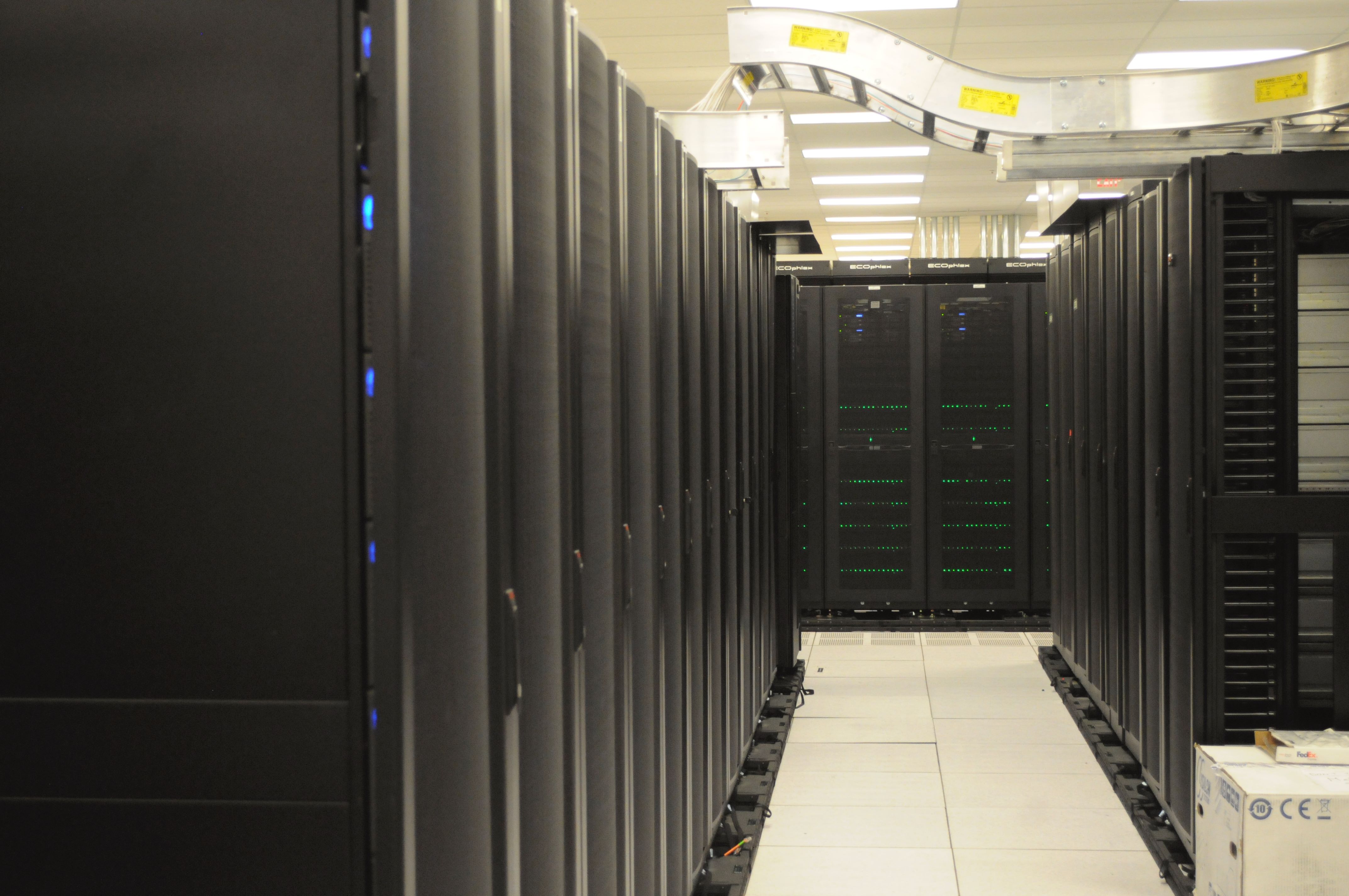
Image: Wikimedia Commons / NERSC, CC0 (ILLUSTRATIVE — server racks in a data centre; the ground network's job is to move satellite data into infrastructure like this).
Why it matters for India readers
No India-specific fact attaches to this deal — Northwood announced nothing India-related, and this post does not invent one. The relevance is structural, and it cuts both ways for India. India is building its own satellite constellations and a private launch sector — covered in our Rocket Lab Electron 99th launch explainer — and every one of those satellites will need ground capacity in more places, with more capabilities, exactly the bottleneck Northwood is selling into. At the same time, the funding shows where venture money now flows in space: not only to rockets and constellations, but to the unglamorous ground layer underneath them. For Indian readers tracking the space economy, that is the signal — the companies that own the ground links will shape what constellations can actually deliver, including over India.
It also belongs to a remarkable week for big-ticket tech deals. Just a day earlier, Marvell and Lumentum signed a $115 billion all-stock agreement — see our Marvell–Lumentum $115 billion acquisition explainer — and Northwood's round, while far smaller, makes the same point from the startup side: the AI and satellite buildout is now limited less by what goes up than by the infrastructure that connects it back to Earth.
Should you care?
✅ Verdict: Yes, if you follow the space economy — as a trend to watch, not a stock to buy. Northwood is private, so there are no shares to trade; the $2 billion valuation is a reported figure, not a market price. What matters is the validation: top-tier venture firms just put $375 million behind the idea that ground infrastructure, not launch, is the next bottleneck in space. Watch for the site and network expansions Northwood promises in the first half of 2027 — those will show whether the network scales as fast as the pitch.
FAQs
What does Northwood Space do? Northwood builds the network connecting satellites to Earth. It designs and manufactures modular antennas in Torrance, California, and runs a shared, multi-orbit ground network that satellite operators book capacity on — for commands, data downloads and mission control — instead of building their own ground stations.
How much did Northwood Space raise in its Series C, and who led it? Northwood closed a $375 million Series C on 2 November 2026, co-led by Andreessen Horowitz and DFJ Growth, with Alpine Space Ventures, Washington Harbour Partners, Stepstone Activate, In-Q-Tel and others participating, plus a separate undisclosed credit facility from HSBC Innovation Banking.
What is Northwood Space's valuation? The round values Northwood at about $2 billion, as reported by Payload and Axios. The company's own announcement did not state a valuation figure, and as a private company Northwood has no public share price.
What are Northwood's Portal and Prism antennas? Portal is a phased-array antenna for satellite command and control that can communicate with several satellites at once; 10 arrayed Portals match a 20-foot dish. Prism is a parabolic dish for high-throughput payload data, built for multi-gigabit links. Together they are meant to deliver global coverage, with 100+ Gbps sites by the end of 2027.
Takeaway: The sky filled up faster than the ground kept pace — Northwood's $375 million round is a bet that the company selling shared ground capacity, not another constellation, captures the next layer of the space economy.
Follow USA Tech on TechByCountry for tomorrow's update.
📸 Get tech in the last 24 hours on Instagram — follow @_techinlast24hrs for daily posts (9 AM–9 PM) and reels at 12:30 PM & 8:30 PM.
Sources
- Northwood Space (PRNewswire) — "Northwood raises $375 million to build the network connecting satellites to Earth" (2 November 2026)
- TechCrunch — "Northwood Space raises $375M Series C at a $2B valuation from a16z and DFJ Growth" (2 November 2026)
- Payload — "Northwood Space Raises $375M Series C at $2B Valuation" (2 November 2026)
- Dealroom — "Northwood Space raises $375M Series C, hits $2B valuation" (2 November 2026)
Comments
Post a Comment