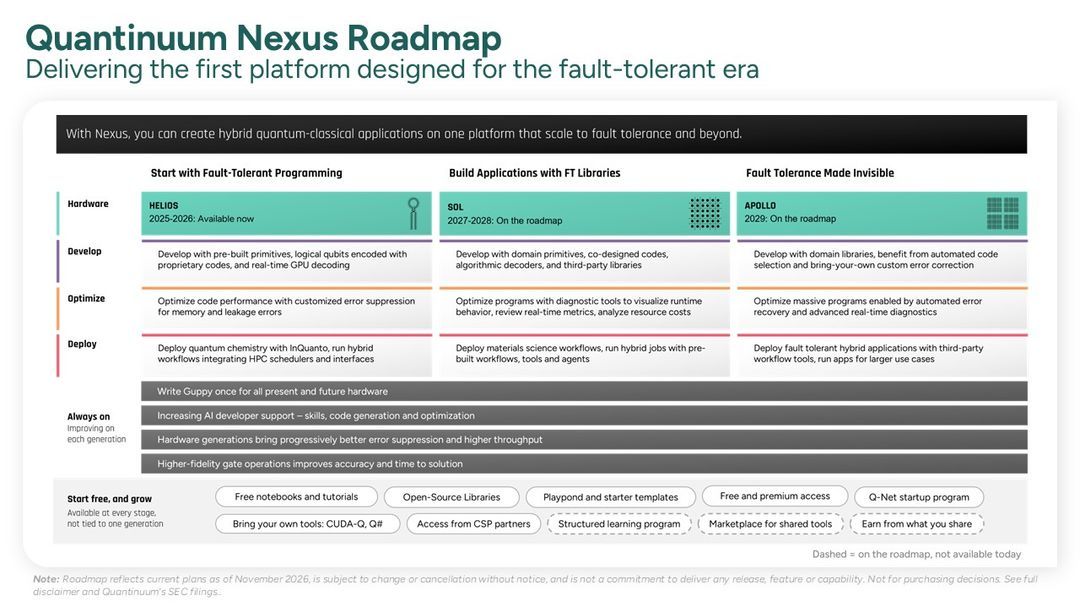
Image: Quantinuum — the official Nexus roadmap graphic from Quantinuum's roadmaps page (official platform visual).
TL;DR: Quantinuum Nexus roadmap explained in short: Quantinuum has published a roadmap to turn Nexus into the first developer platform built for fault-tolerant quantum computing, with new releases running through to Apollo, its universal fault-tolerant machine planned for 2029. Developers can already build error-corrected programs on today's Helios system — but Apollo's date is a company target, not a guarantee.
📌 Key Highlights
- Quantinuum unveiled the Nexus roadmap on 5 November 2026: Nexus is designed to be the first developer platform that combines automated error-correction encoding, execution on Quantinuum hardware, and hybrid quantum-classical workflow orchestration.
- The roadmap runs in three stages — develop, optimise, deploy — with each release tied to a hardware generation, from today's Helios through Sol in 2027 to Apollo in 2029.
- Developers can already write programs in standard Guppy, have them automatically encoded for error correction, test them in emulation, and run them on Helios.
- Nexus already serves more than 200 organisations, up 45% in 2026, and job submissions rose tenfold in the year to August 2026.
- The next release is expected in December 2026, adding expanded hybrid workflows, more supported error-correction codes and execution analytics.
What happened on 5 November?
Quantinuum, the quantum computing company listed on Nasdaq as QNT, published a roadmap for Nexus, its platform as a service for building and running quantum applications. Nexus itself is not new — it launched in 2024 and has grown from managing cloud-based quantum workflows into an end-to-end environment for programming, validating, compiling and executing quantum programs. What is new is the direction: Quantinuum says Nexus will progressively take over the hardest parts of fault-tolerant computing, so developers can work at the level of the application instead of the physics.
The timing matters because the hardware is moving on a published schedule too. Helios, Quantinuum's current trapped-ion system, is already running error-corrected programs. Sol, the next generation, is due in 2027. Apollo, the machine Quantinuum describes as its first universal, fully fault-tolerant quantum computer, is planned for 2029. The Nexus roadmap is the software side of that same plan: each hardware generation gets matching platform capabilities, so work built today is meant to carry forward rather than be rewritten.
Quantinuum Nexus roadmap explained: develop, optimise, deploy
The roadmap is organised around the three stages of an application's life. In the develop stage, Nexus offers pre-built primitives, fault-tolerant libraries and domain-specific tools, and it will progressively automate error-correction encoding, compilation and resource management. The idea is that a developer writes an ordinary program and the platform handles turning it into a form that survives errors on real hardware.
That is already partly real. In September 2026 Quantinuum released Guppy FT and Guppy Algorithms inside Nexus. Guppy FT lets error-correction experts define a fault-tolerant architecture once, while application developers keep writing in standard Guppy; the framework then translates the program into its encoded, fault-tolerant form automatically. Guppy Algorithms adds composable building blocks for common quantum routines. Developers can already apply supported error-correction techniques to a program and run it on Helios, or test it in emulation first.
In the optimise stage, the roadmap promises tools to analyse runtime behaviour, resource needs and application performance, with more error suppression, real-time diagnostics and increasingly automated error recovery in future releases. In the deploy stage, Nexus is being designed to coordinate quantum and classical computing across Quantinuum processors, high-performance computing systems, cloud infrastructure and third-party tools — so a quantum step can sit inside an existing workflow instead of living in a separate silo.
| Generation | Status | What Nexus does on it |
|---|---|---|
| Helios | Current system (launched 2025) | Developers can already auto-apply supported error-correction techniques and run programs; Guppy FT and Guppy Algorithms available since September 2026 |
| Sol | Next generation, due 2027 | More capable implementations of the same applications, with deeper error correction |
| Apollo | Planned for 2029 (company target) | Universal, fully fault-tolerant quantum computer; Nexus aims to run larger fault-tolerant applications on it without developers rewriting their work |

Image: National Institute of Standards and Technology (NIST), via Wikimedia Commons (public domain). Illustrative image: an ion trap of the kind used in trapped-ion quantum computers.
Why it matters — and where to stay sceptical
Quantum computing's central problem is not building qubits; it is keeping them honest. Qubits are fragile, and without error correction a long calculation drowns in noise. That is why the most important race in the field is not about qubit counts but about fault tolerance — and why a developer platform matters. If writing error-corrected programs stays a specialist skill, only a handful of teams can use these machines. Nexus is Quantinuum's bet that the complexity can be absorbed by software, the way compilers once absorbed the complexity of machine code. The early evidence that the bet has users: more than 200 organisations on the platform, with job submissions up tenfold in a year.
Real work is already running through it. Qubit Pharmaceuticals and Singapore's Centre for Quantum Technologies used Nexus for quantum Monte Carlo experiments on Quantinuum's H2 and Helios systems. Researchers at RIKEN and the University of Tokyo simulated atomic nuclei on Reimei using Nexus, and used it to wire hybrid quantum-HPC workflows. Cambridge researchers used its compilation tools for quantum chemistry circuits, Maastricht researchers simulated a quantum particle-tracking algorithm, and the Unitary Foundation's Metriq gym uses Nexus for reproducible benchmarking across platforms. Quantinuum is also integrating Nexus into Oracle Cloud Infrastructure, to support on-premises deployment of Helios inside OCI's cloud offering.
The sceptical half of the story is just as important. "First developer platform for the fault-tolerant era" is Quantinuum's own description of its aim, not an independent verdict — rivals such as IBM are building toward the same 2029 fault-tolerance horizon with their own platforms, as our coverage of IBM, AMD and Oak Ridge's quantum error-correction platform shows. Apollo's 2029 date is a company target, and quantum roadmaps have slipped before. And the December release — expanded hybrid workflows, more error-correction codes, execution analytics — is expected, not shipped. The honest way to read this announcement is as a plan with a working starting point, not a finished product.
For Indian readers, there is no India-specific element in the announcement — no Indian pricing, partnership or availability date. Nexus is cloud-based and sign-up is open at nexus.quantinuum.com, so Indian developers, students and researchers can register for access the same way as anyone else. The relevance is indirect but real: India is building its own quantum research base under the National Quantum Mission, and the skills this platform is trying to lower the barrier to — writing error-corrected quantum programs — are the same skills Indian quantum teams will need. The December release is the next concrete date to watch; until then, what exists is Helios access plus the Guppy FT tooling. Related work in the same field includes IQM and Volkswagen's quantum battery simulation, and for a different kind of research explainer, see how researchers are verifying AI agents.
Should you care?
✅ Yes, if you build quantum algorithms, study quantum computing, or follow the fault-tolerance race — Nexus is now the clearest statement of how Quantinuum wants developers to work, and the Guppy FT tooling is usable today on Helios. ⏳ Hold off, if you are waiting for proven fault-tolerant computing at scale: Apollo is a 2029 target, the roadmap's later stages are promises, and no pricing has been published — treat this as a plan to track, not a product to buy into yet.
FAQs
What is Quantinuum Nexus?
Nexus is Quantinuum's all-in-one quantum computing platform. Launched in 2024, it brings programming, validation, compilation and execution of quantum programs into one environment, with managed access to Quantinuum's hardware, emulators and tools such as InQuanto for quantum chemistry. It works in the cloud and on-premises.
What is Quantinuum Apollo?
Apollo is Quantinuum's planned universal, fully fault-tolerant quantum computer — a machine designed to run any quantum algorithm with errors detected and corrected as it goes, at a scale useful for real applications. It is the endpoint of the company's hardware roadmap, after Helios and Sol.
When will Quantinuum Apollo launch?
Quantinuum plans Apollo for 2029. That is the company's stated target, not a guaranteed date — it depends on the Sol generation arriving in 2027 and on error-correction performance holding up as systems scale. The next milestone to watch is the Nexus release expected in December 2026.
What is the difference between Helios, Sol and Apollo?
They are three generations of Quantinuum's trapped-ion hardware. Helios is the current system, launched in 2025, on which developers can already run error-corrected programs through Nexus. Sol is the next generation, due in 2027, with more capable implementations. Apollo, planned for 2029, is intended to be the first universal, fully fault-tolerant machine — the one the whole roadmap is building toward.
Takeaway: Quantinuum's Nexus roadmap is a credible, dated plan to make fault-tolerant quantum programming something ordinary developers can do — with working tools on Helios today and a 2029 Apollo target that is still, honestly, a promise. If you work in quantum, the December release is the next thing worth checking; the roadmap page itself is the best place to track it.
If you build quantum algorithms, open Quantinuum's roadmap page and compare the December release notes against this plan when they land — that is where the roadmap stops being a promise and starts being a record.
Sources
- Quantinuum Unveils Nexus Roadmap to Deliver the First Developer Platform Designed for the Fault-Tolerant Quantum Era — PRNewswire press release, 5 November 2026
- Quantinuum roadmaps page — quantinuum.com
- Quantinuum Overcomes Last Major Hurdle to Deliver Scalable Universal Fault-Tolerant Quantum Computers by 2029 — Quantinuum blog, June 2025
- Quantinuum Unveils Nexus Roadmap to Deliver the First Developer Platform Designed for the Fault-Tolerant Quantum Era — AIThority, 5 November 2026
- Quantinuum Says It Launches Nexus Platform For Fault-tolerant Quantum Apps — Quantum Zeitgeist
Comments
Post a Comment