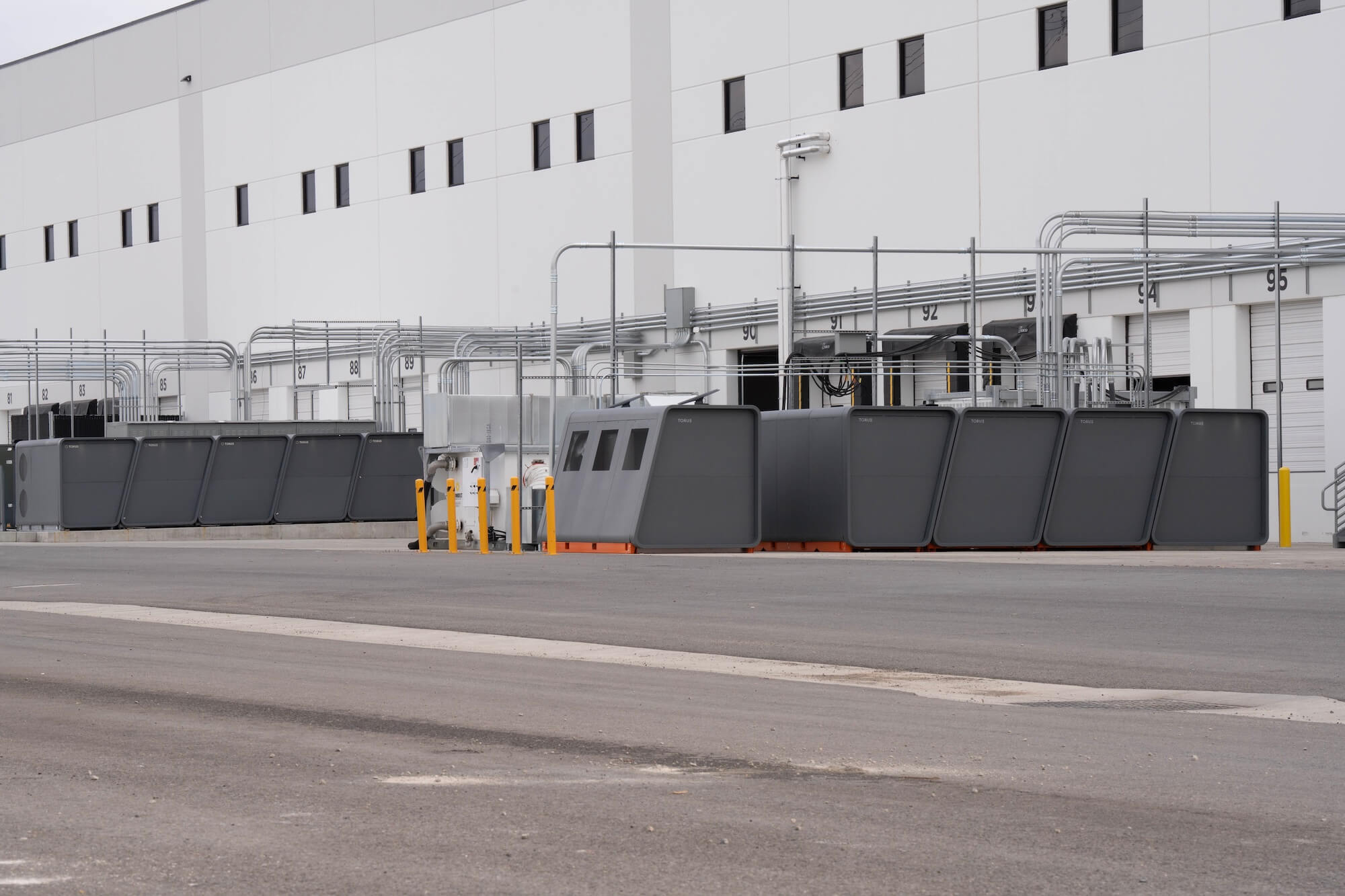
Image: Torus — Torus Foundry units installed outside GigaOne, the company's Salt Lake City manufacturing plant (official product image, photo: Ken Hovley, Torus).
TL;DR: Utah startup Torus raised $500 million, led by Magnetar, to build Foundry — prefabricated, container-sized AI data centres that run on spare electricity already available at factories and business sites. Each unit delivers 1–20 MW of AI inference capacity and goes from contract to running workloads in 12–16 weeks, instead of the years a traditional hyperscale campus takes. Torus has not disclosed a valuation.
Key Highlights
- $500 million in growth capital announced 11 November 2026, led by Magnetar, with ICONIQ, Origin Ventures, Ridgeline Partners and Trinity Capital. Funding trackers classify it as a Series C round; Torus has not disclosed a valuation.
- Foundry is a modular AI inference system: power, storage, cooling, networking and compute in one prefabricated unit, built at Torus's GigaOne factory in Salt Lake City.
- 1–20 MW per site, live in 12–16 weeks: site preparation takes about a week and installation one to two days, with no building construction and no new grid infrastructure.
- First customers are Hydra Host and a second, unnamed AI cloud provider; Torus says thousands of GPUs are already deployed, with a target of more than 47,000 by the end of 2027.
- The pitch is "bring the chips to the power": Foundry plugs into unused capacity at existing sites instead of waiting years for new power lines and substations.
What happened?
On 11 November 2026, Torus — a Salt Lake City manufacturer of distributed power and compute infrastructure — launched Foundry, its modular AI infrastructure product, and announced $500 million in growth capital led by Magnetar. The round's other participants are ICONIQ, Origin Ventures, Ridgeline Partners and Trinity Capital. Funding databases including Dealroom and Fireround classify the raise as a Series C round, although Torus's own announcement describes it as growth capital and the company has not disclosed a valuation.
The money will fund the expansion of GigaOne, Torus's 545,000-square-foot manufacturing facility in Salt Lake City, and the deployment of Foundry and Torus Reserve units across the United States. It follows a $200 million investment from Magnetar in September 2025 for Torus's modular power-plant business — so Magnetar has now backed the company twice in just over a year.
The announcement lands in a week of very large AI infrastructure funding. A day earlier, British AI chip startup Fractile raised $720 million at a $7 billion valuation, and Torus's raise sits in the same wave of capital flowing into the physical side of AI: not models, but the power and hardware that run them. Our explainer on Fractile's $720 million Series C at a $7 billion valuation covers that deal in detail.
Torus Foundry 500 Million Funding Explained: How Foundry Works
Foundry is built for AI inference — the work of running a trained AI model every time someone uses it — rather than training new models. Torus's argument is that inference does not need one giant campus: it needs smaller blocks of compute in many places, close to where demand is, and it needs them fast.
Each Foundry unit is a prefabricated system that packages five things together: power, energy storage, cooling, networking and compute. It is installed behind the meter — on the customer's side of the utility connection — and uses available headroom at individual transformers, the spare capacity that already exists between substations and commercial or industrial buildings. Torus says this means no new grid infrastructure, no years-long interconnection queue, and no infrastructure upgrades that push up electricity rates for everyone else.
Every Foundry unit is paired with Torus Reserve, the company's energy-storage and management system. AI inference loads are spiky — Torus compares them to an EKG — and Reserve smooths them out with battery and inertial flywheel storage, so the grid sees steady, flexible demand. It also provides backup power during grid outages, letting more compute run on the same connection. A third layer, Torus Protect, adds integrated networking and security, and Torus provides ongoing operations and maintenance, so each deployment is turnkey.
"Most providers are bringing power to the chips. Foundry brings the chips to power," said Nate Walkingshaw, Torus's founder and CEO. "Inference doesn't have to wait."
Foundry at a Glance
| Specification | What Torus says |
|---|---|
| Capacity per site | 1–20 MW of AI inference compute |
| Time to running workloads | 12–16 weeks from contract to token |
| Site preparation | About a week; installation and commissioning take 1–2 days |
| Smallest unit | Roughly the size of a small cargo van; no building construction required |
| GPUs deployed | Thousands today; target of more than 47,000 by end of 2027 |
| Manufacturing | GigaOne, Salt Lake City (545,000 sq ft); Foundry line rated at 500 MW of IT load, expanding to 1 GW |
| Cooling | Waterless closed-loop system, using 95% less water than evaporative coolers |
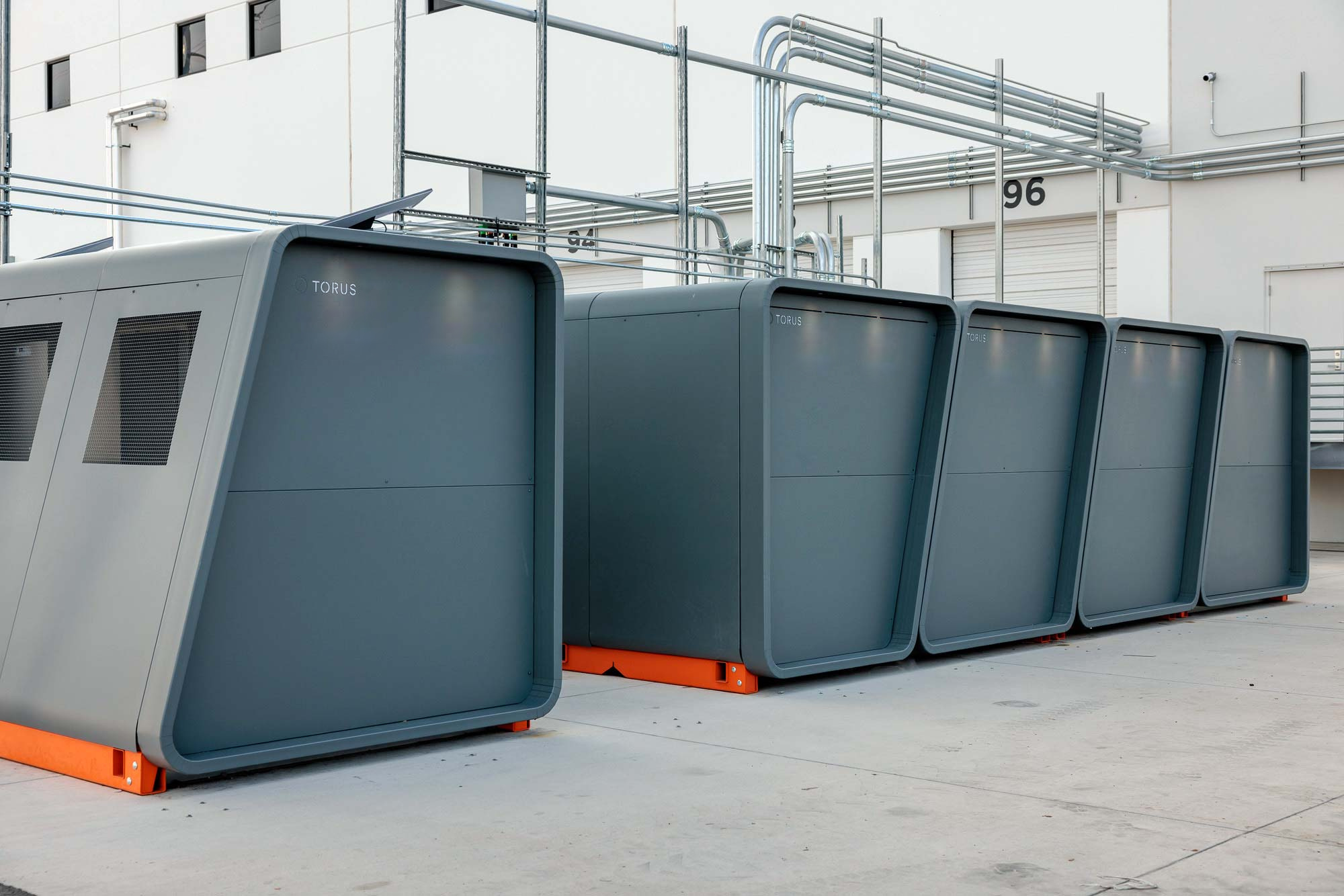
Image: Torus — a close view of Torus Foundry modular units at GigaOne (official product image).
The Three Ways to Buy Foundry
Torus is launching Foundry in three models, aimed at different customers:
| Model | What you get | Best for |
|---|---|---|
| Strategic | Powered shell — power and enclosure, without GPUs | Customers who bring their own compute hardware |
| Partner | Turnkey bare-metal unit — power, enclosure and GPUs included | AI cloud providers that want ready-to-run capacity |
| Direct | Sovereign inference capacity, single-tenant hardware allocated to one company's workloads | Enterprises that need control over where their workloads run |
The first customers are Hydra Host, an AI infrastructure provider, and a second AI cloud provider Torus has not named. That matters: one named customer and one unnamed one is a thin customer list for a $500 million bet, and the 47,000-GPU figure is a target for the end of 2027, not a number already achieved.
Why the Money Matters: the Inference Power Crunch
The funding case rests on a shift in where AI demand is growing. Torus's announcement cites McKinsey figures: data-centre demand for AI inference is projected to grow 35% a year through 2030, compared with 22% a year for training. Training a model is a one-off, concentrated job; inference runs continuously, serves users in real time, and can be spread across many smaller sites.
The bottleneck, Torus argues, is not generating more electricity but getting it to the chips. New hyperscale campuses can wait years for grid connections, substations and transmission lines. Foundry's answer is to skip the queue entirely by using capacity that already exists — a claim that depends on how much genuinely usable headroom sits at real sites, which will only be proven as deployments scale.
Magnetar's Dave Snyderman, the round's lead investor, put it this way: "One of the biggest challenges in scaling AI infrastructure is access to power, and the solution isn't simply generating more of it, but making better use of what's already available." Torus's manufacturing claims are also part of the pitch: GigaOne opened its first production line in early 2026 and, the company says, has opened a new production line every 21 days this year, with nearly 400 employees on site. The Foundry production line is rated at 500 MW of IT load, with plans to expand to 1 GW.
This is not Torus's first time in the spotlight: the company lists a TIME Best Invention award, a 2025 R&D 100 Award, a 2026 Energy Storage award from Reuters, Fast Company's Next Best Thing in Tech 2026, and 2026 Battery Manufacturer of the Year. Awards are not revenue, though — and Torus has disclosed no revenue figures, no valuation and no independent benchmarks for Foundry's performance. Those are the numbers to watch next.
Why It Matters for India Readers
Torus has announced no India deployment, no Indian customer and no India pricing — Foundry's rollout is in the United States, starting from its Western Interconnection base. Indian readers should not expect to buy or use one soon.
The relevance is the problem, not the product. India is building AI data-centre capacity at speed — Indian AI infrastructure companies such as Neysa and Yotta raised large rounds of their own this year — and they face the same constraint Torus is selling against: power connections that take years, not months. If the modular, behind-the-meter model works at scale in the US, expect Indian data-centre and energy companies to copy it, and expect global AI cloud providers serving Indian customers to look for the same shortcut. The question to track is whether Torus's 47,000-GPU target for the end of 2027 is met, and whether a second named customer appears — those two milestones will show whether this is a real deployment model or a well-funded prototype. For context on how much capital is chasing this problem, see our explainer on Nominal's $240 million Series C for hardware intelligence, and for the other end of the AI infrastructure stack, Amazon's AI-built local cloud emulator.
Should You Care?
✅ Worth watching, not worth hyping yet. The idea is genuinely useful — AI inference needs power in weeks, and the grid has spare capacity in awkward places. The $500 million, the Magnetar repeat backing and the GigaOne production line are real signals. But the proof points are all ahead of Torus: 47,000 GPUs by end-2027, a second named customer, and any independent evidence that Foundry units perform as claimed. Track those three; ignore the valuation talk until the company discloses one.
FAQs
What is Torus Foundry?
Torus Foundry is a modular AI infrastructure system that packages power, energy storage, cooling, networking and compute into one prefabricated unit. It delivers 1–20 MW of AI inference capacity per site and is installed at existing commercial or industrial sites, using electricity the site already has, instead of waiting for a new data-centre campus to be built.
How much did Torus raise in its Series C funding?
Torus announced $500 million in growth capital on 11 November 2026, led by Magnetar, with participation from ICONIQ, Origin Ventures, Ridgeline Partners and Trinity Capital. Funding databases classify the round as a Series C; Torus has not disclosed a valuation.
How fast can a Torus Foundry unit be deployed?
Torus says a Foundry unit goes from contract to running AI workloads in 12–16 weeks. Site preparation takes about a week and installation and commissioning take one to two days, with no building construction required.
What are the three Torus Foundry models?
Strategic is a powered shell with power and enclosure but no GPUs; Partner is a turnkey bare-metal unit that includes GPUs; Direct provides sovereign inference capacity with single-tenant hardware allocated exclusively to one enterprise customer's workloads.
How many GPUs will Torus deploy by 2027?
Torus says thousands of GPUs are already deployed in Foundry units and plans to have more than 47,000 GPUs deployed by the end of 2027. That is a company target, not a figure already achieved.
Takeaway
Torus raised $500 million to put AI compute where the power already is — and if Foundry hits its 47,000-GPU target by the end of 2027, the modular model could change how fast AI capacity gets built. Until then, it is a well-funded idea with real hardware on the ground.
For the other big AI infrastructure raise this week, read our Fractile $720 million Series C explainer — the chip-side answer to the same power problem.
Sources
- Torus — Introducing Torus Foundry: AI Compute Where the Power Already Is
- BusinessWire — Torus Launches Modular AI Infrastructure, Foundry, to Meet Surging AI Inference Demand and Secures $500M in Funding
- Dealroom — Torus raises $500M Series C for modular AI data centers
- Black Ridge Research — Torus Raises $500 Million for Modular AI Compute in the US
- The Tech Capital — Torus raises $500 million to expand modular AI data centre production
- VentureBurn — Torus Raises $500 Million To Build Modular AI Data Centers
- The Outpost — Torus Raises $500M for AI Computing Units at Existing Sites
Comments
Post a Comment