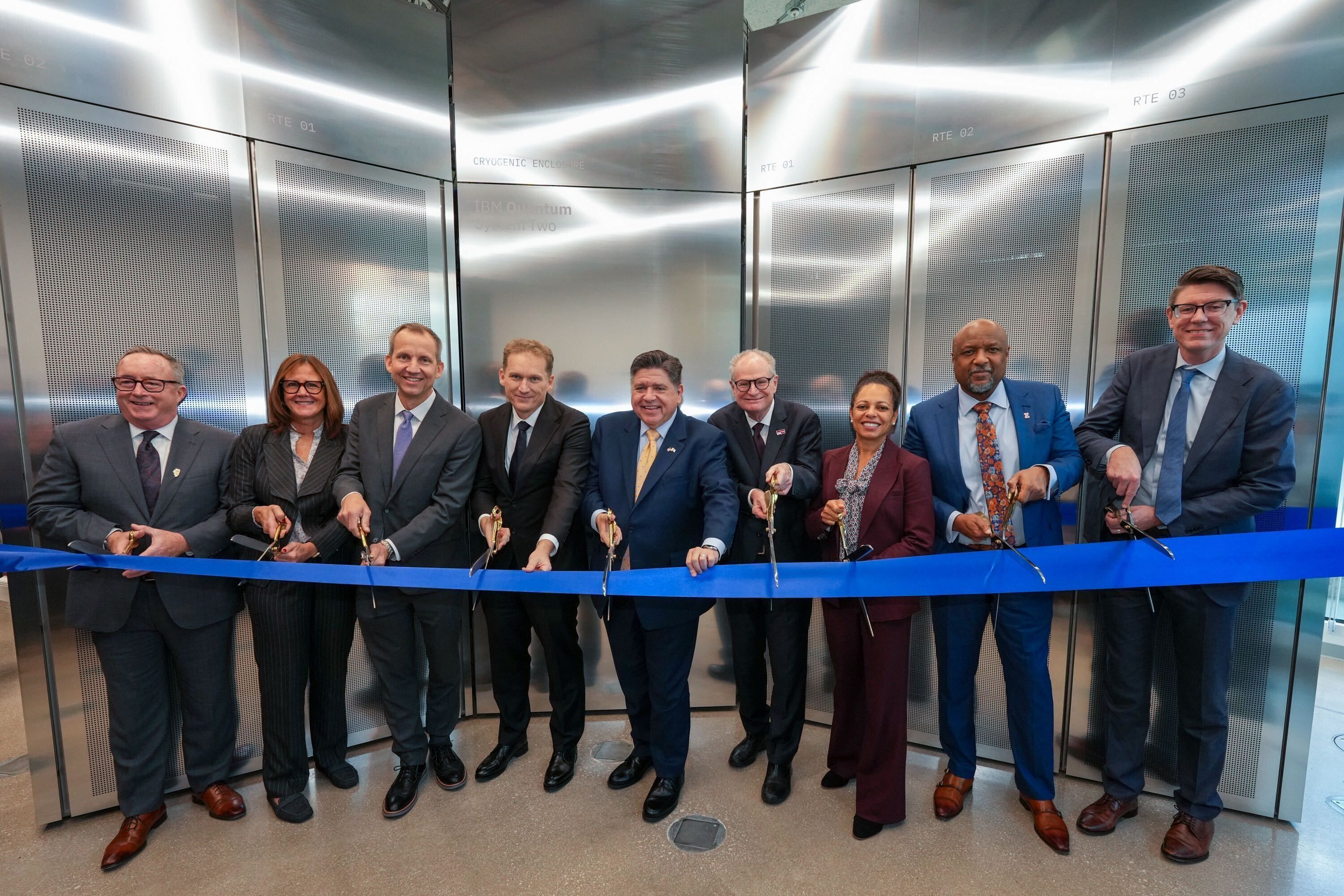
Image: IBM — IBM Quantum System Two at the University of Chicago's Hyde Park Labs (official photo).
📌 KEY HIGHLIGHTS
- Unveiled on 6 November 2026 at the University of Chicago's Hyde Park Labs (5207 S. Harper Ave) — IBM's first quantum computer in Illinois.
- Powered by the Nighthawk r2 processor: 120 qubits linked by 218 tunable couplers. IBM says it runs more than 100,000 quantum circuits per second, about 25 times the throughput of its Heron generation.
- It anchors the National Quantum Algorithm Center (NQAC), created by the State of Illinois in 2024, and will move to the Illinois Quantum and Microelectronics Park (IQMP) once the $500 million campus is complete.
- First projects: Deloitte and AbbVie with Northwestern University on quantum molecular simulations for drug discovery, and EPRI with the University of Illinois on quantum optimisation for power grids.
- Illinois put $25 million behind the deployment, and IBM's FutureNow Chicago centre will add 750 jobs in AI, cybersecurity, data science and quantum.
What happened?
On 6 November 2026, IBM, the University of Chicago, the State of Illinois and the Illinois Quantum and Microelectronics Park (IQMP) unveiled an IBM Quantum System Two in Chicago. It is IBM's first quantum computer in Illinois and, in IBM's words, the most advanced system the company offers. Governor JB Pritzker, University of Chicago President Paul Alivisatos and IBM CEO Arvind Krishna led the ribbon cutting.
The machine sits on the ground floor of Hyde Park Labs, a research building at 5207 S. Harper Ave that opened in 2025, behind floor-to-ceiling windows facing the street. IQMP CEO Harley Johnson calls it "probably the most publicly visible quantum computer in the world" — students from a public high school a block away walk past it every day.
The Hyde Park address is temporary: the system will operate at the University of Chicago while the IQMP campus is built on the former US Steel South Works site on Chicago's Southeast Side, then move there as its permanent home — and as the anchor machine of the National Quantum Algorithm Center.
IBM Quantum System Two Chicago explained: the machine inside
System Two is IBM's modular quantum computing platform — the cryostat, control electronics and wiring that house the processor. The Chicago unit runs IBM Quantum Nighthawk r2, which IBM describes as the most powerful quantum chip it has ever built. Nighthawk connects 120 qubits through 218 tunable couplers in a square lattice, linking each qubit to its four nearest neighbours. That denser connectivity lets users run more complex circuits while keeping error rates low, according to the University of Chicago.
IBM says Nighthawk r2 can execute more than 100,000 quantum circuits per second — roughly 25 times the throughput of its Heron generation — with about 30% greater circuit complexity than Heron-class processors. Those are IBM's own figures; no independent performance test has been published. Note that 120 qubits is fewer than the 127 on IBM's earlier Eagle chip: the race has moved from qubit counts to speed and circuit quality.
| IBM Quantum System Two, Chicago | Detail |
|---|---|
| Unveiled | 6 November 2026 |
| Current location | Hyde Park Labs, 5207 S. Harper Ave, University of Chicago |
| Processor | IBM Quantum Nighthawk r2 |
| Qubits / couplers | 120 qubits, 218 tunable couplers, square lattice |
| Throughput (IBM's figure) | More than 100,000 circuits per second, ~25x Heron |
| Permanent home | Illinois Quantum and Microelectronics Park (IQMP), former US Steel South Works site |
| Anchor programme | National Quantum Algorithm Center (NQAC) |
| State support | $500M for IQMP; $25M grant for this deployment |

Image: Wikimedia Commons — IBM Quantum System One on display at O'Hare International Airport, Chicago. Illustrative image: this is a System One, not the new System Two in Hyde Park.
What is the National Quantum Algorithm Center?
The NQAC is why this machine is in Chicago rather than an IBM lab. Created by the State of Illinois with the IQMP and announced in 2024, it brings researchers from universities, national laboratories, startups and industry together with IBM scientists to develop quantum algorithms and turn them into practical applications. IBM is an anchor partner.
Its Grand Challenge programme funds postdoctoral researchers building quantum applications for real industry problems, pairing an Illinois academic group with a quantum computing company and an end user. The first five awards were announced in April 2026, and IBM is the quantum partner on two of them: Deloitte and AbbVie, working with IBM and Northwestern University on quantum molecular simulation for drug discovery, and EPRI with the University of Illinois, exploring how quantum optimisation could make power grids more efficient. Its sectors span drug discovery, advanced manufacturing, energy, finance and logistics.
The partnership is already producing results. In July 2026, a joint University of Chicago and IBM team demonstrated quantum advantage on a structured computational task — 70 logical qubits, about 15 minutes, with a built-in way to verify the answer, where leading classical approaches faced prohibitive runtimes. The same collaboration computed the properties of Cu3C6O6, a strongly correlated kagome-lattice metal, using the DeltaAI supercomputer integrated with IBM Quantum systems, with results to be presented at the SC26 conference in November. A UChicago team also published LASSQD in the Proceedings of the National Academy of Sciences in July, a method that hands the hardest part of a chemistry calculation to a quantum computer.
This is a long build, not a one-day announcement. The Illinois partnership dates to December 2024, and the state has committed $500 million to the IQMP campus, plus a $25 million grant to the University of Illinois Board of Trustees for this deployment. IBM and the University of Chicago also run a $100 million, 10-year initiative launched at the 2023 G7 summit with the University of Tokyo to design a quantum-centric supercomputer powered by 100,000 qubits, and are working with universities in Japan and South Korea to prepare 40,000 students for quantum careers over the next decade.
Why it matters for readers in India
India is building toward the same idea. The Union Cabinet approved the National Quantum Mission on 19 April 2023 with an outlay of ₹6,003.65 crore for 2023-24 to 2030-31, run by the Department of Science and Technology. It targets intermediate-scale quantum computers with 50 to 1,000 physical qubits within eight years, working through four thematic hubs, including IISc Bengaluru on sensing and metrology.
Chicago's model is the one to watch: an algorithm centre, industry-funded Grand Challenges, and a flagship machine the public can see through a window, all in one place. India has no IBM System Two announced, and no Indian city has a machine of this class on the ground yet — Indian researchers access IBM's quantum hardware through its cloud-based services. The Chicago deployment shows what the next stage looks like once the hardware exists: the hard work shifts from building the computer to building the algorithms, the workforce and the companies around it.
One more distinction matters. A day earlier, IBM announced a different quantum project — IBM's quantum error-correction platform with AMD and Oak Ridge — which pairs a Nighthawk processor with a supercomputer to attack quantum errors. Chicago is a deployment and an algorithm centre, not an error-correction experiment. Both feed the same US Department of Energy goal of a scientifically useful quantum computer by late 2028, the backdrop to Quantinuum's Nexus roadmap to fault-tolerant quantum computing.
Should you care?
FAQs
Where is IBM's new quantum computer located?
It is running at Hyde Park Labs, hosted by the University of Chicago at 5207 S. Harper Ave in Chicago, at street level behind floor-to-ceiling windows. It will later move to the Illinois Quantum and Microelectronics Park once that campus is complete.
What is IBM Quantum System Two?
It is IBM's modular quantum computing platform — the cryostat, control electronics and wiring that house a quantum processor. The Chicago unit is IBM's first System Two in Illinois and, according to IBM, the most advanced system the company offers.
What chip powers IBM Quantum System Two in Chicago?
The IBM Quantum Nighthawk r2 processor, with 120 qubits connected through 218 tunable couplers in a square lattice. IBM says it can run more than 100,000 quantum circuits per second, about 25 times the throughput of its Heron generation.
What is the National Quantum Algorithm Center?
The NQAC is a Chicago-based centre created by the State of Illinois in 2024, where universities, national laboratories, startups and industry work with IBM scientists to develop quantum algorithms for drug discovery, power grids, manufacturing, energy, finance and logistics. The Chicago System Two is its anchor machine.
Takeaway: IBM's most advanced quantum computer now has a street address in Chicago — and a job: anchoring a state-backed algorithm centre that has to prove quantum computers can do useful work. The hardware is real; the algorithms are the next test.
If you want the technical backstory, read our explainer on IBM's quantum error-correction platform with AMD and Oak Ridge — it explains the Nighthawk chip and the 2028 fault-tolerance target this Chicago machine is now working toward. And for a different kind of quantum milestone, see how the AI system that proved the Aaronson–Ambainis conjecture used machine-checked proofs to settle a problem open since 2008.
Sources
IBM Quantum Blog — Chicago's bid to lead the country in quantum computing (6 Nov 2026)
University of Chicago News — IBM's most advanced quantum computer unveiled at UChicago's Hyde Park Labs (6 Nov 2026)
Office of Governor JB Pritzker — Gov. Pritzker Unveils IBM's Quantum System Two Computer (6 Nov 2026)
PR Newswire (IBM release) — IBM Unveils Its Most Advanced Quantum Computer in Chicago (6 Nov 2026)
Quantum Zeitgeist — IBM Launches Quantum System Two in Chicago, Its Most Advanced Quantum Computer (6 Nov 2026)
The Hindu — Union Cabinet gives nod for ₹6,003 crore Quantum Mission (19 Apr 2023)
Comments
Post a Comment