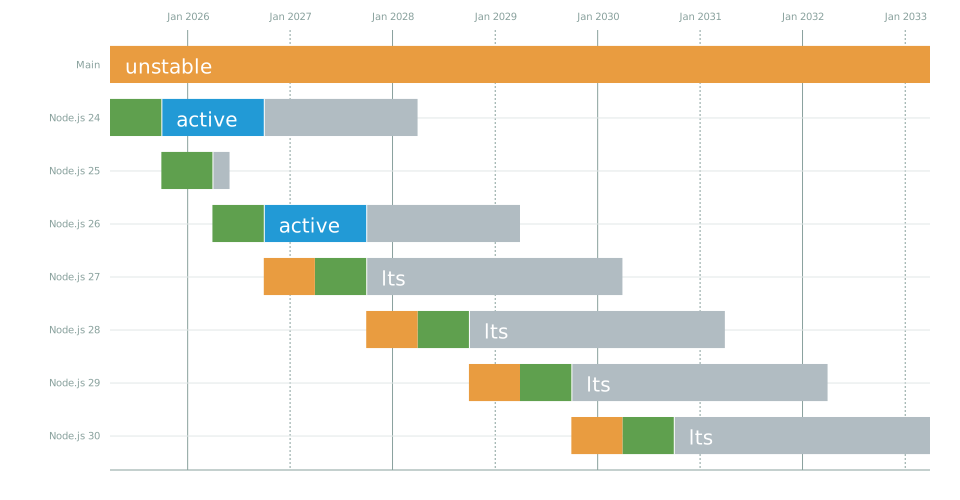
Image: Node.js — the new annual release schedule diagram (official image, via the Node.js blog "Evolving the Node.js Release Schedule"). The diagram shows one major release per year, each becoming LTS.
TL;DR: Node.js 27 alpha release explained in one line: published on 29 October 2026, version 27.0.0-alpha.0.0.0 is the first test build under Node's new one-major-a-year model — every release now becomes LTS — packing V8 15.6, an OpenSSL 4.1 crypto overhaul and breaking changes library authors should test now, while everyone else stays on Node 26 LTS.
📌 KEY HIGHLIGHTS
- First alpha of the new era: Node 27.0.0-alpha.0.0.0 shipped on 29 October 2026, the first release under the annual schedule announced in June 2026.
- One major a year, every line LTS: the old odd/even split is gone — Node 26 is the last release under the old model.
- The timeline is fixed: Node 27.0.0 arrives in April 2027, enters LTS in October 2027 and reaches end of life around April 2030.
- Big engine upgrades: V8 jumps from 14.6 to 15.6.75.13, and OpenSSL moves to 4.1.0 with the bundled FIPS provider and legacy backends removed.
- Not for production: this is an early-testing alpha — APIs may still change, and the project's own guidance is aimed at library authors and CI pipelines, not live servers.
Node.js 27 alpha release explained: what shipped?
Node.js is the open-source JavaScript runtime built on Google's V8 engine, maintained by the OpenJS Foundation — the runtime behind countless web servers, APIs and build tools, including much of India's startup backend stack. The alpha was published by Rafael Gonzaga, a Node.js Technical Steering Committee member who leads the Release Team, and it is the first real test of a schedule overhaul debated since July 2025 in nodejs/Release#1113.
The change is about how Node ships, not just what ships. For a decade Node released twice a year: even-numbered lines became LTS, odd-numbered lines lived briefly and were mostly skipped. The project says odd releases saw minimal adoption, the distinction confused newcomers, and maintaining four or five concurrent lines had become hard to sustain for a largely volunteer-run project. The new model is simpler: one major release per year, and every single one becomes LTS.
| Phase | Duration | What happens |
|---|---|---|
| Alpha | 6 months (Oct–Mar) | Early testing; breaking (semver-major) changes allowed |
| Current | 6 months (Apr–Oct) | Stabilisation, no breaking changes |
| LTS | ~30 months | Long-term support with security fixes |
| Node 27 milestones | Apr 2027 → Oct 2027 → Apr 2030 | 27.0.0 release → LTS promotion → end of life |
Version numbers now track the calendar year of a release's first Current phase: 27.0.0 in 2027, 28.0.0 in 2028, and so on. One honest caveat from the project itself: the schedule is not final and may be amended, and an alpha may not contain every change from the main branch.
What is actually inside the alpha
Two upgrades dominate. First, V8 jumps to 15.6.75.13. Default-enabled features include Math.sumPrecise(), new Iterator helpers (join, includes, zip, zipKeyed) and Intl.Locale.prototype.variants; behind flags sit import defer, immutable ArrayBuffer and RegExp buffer boundaries. The V8 bump also changes behaviour developers must watch: the default heap limit, when --max-old-space-size is unset, is now half of physical memory clamped between 256 MB and 4 GB, and memory held by Buffer and ArrayBuffer now counts toward that cap. The serialisation format used by v8.serialize(), structuredClone() and postMessage() has changed too, so data written by this alpha cannot be read by older Node releases — cached data and compile caches will invalidate more often.

Illustrative image: server racks at NERSC (Wikimedia Commons, CC0). Node.js powers the servers behind web apps and APIs — the alpha is a preview of the runtime those servers will run in 2027.
Second, the crypto overhaul led by Filip Skokan: Node upgrades to OpenSSL 4.1.0 and will require OpenSSL 3 or later at build time. The bundled FIPS provider build is gone, the legacy ncrypto backend is gone, and OpenSSL engine support across crypto, https and tls is ending. Several old deprecations (DEP0093, DEP0198, DEP0203/DEP0204) have moved to end-of-life. Code depending on removed engines or OpenSSL 1.x-era behaviour will break — that is the point of an alpha, but it is a real migration task.
| Change | Who it affects |
|---|---|
| NODE_MODULE_VERSION bumped to 153 | Native module authors — rebuild against Node 27 |
| New heap limit + Buffer memory counted | Apps that relied on old defaults — may need --max-old-space-size set |
| Serialisation format change | Anyone caching serialised data or compile caches across versions |
| OpenSSL engines + FIPS provider removed | Crypto-heavy services, FIPS-mode deployments |
| Native fs glob()/globSync(), fs.mkstemp(), experimental net/promises | Library authors — fewer third-party dependencies needed |
| http keepAliveTimeout now 65s; domain module runtime-deprecated | Server authors; legacy domain users |
| CVE-2026-58042 (dns resolveAny) fixed | Security — large DNS replies memory-safety issue |
Around the edges: npm rises to 12.1.0 with engine checks patched to accept alpha versions, the in-memory virtual file system (vfs) used for Secure Executable Archives is now unflagged and stable, and Intel macOS support is downgraded to experimental, with the Intel build marked "coming soon" while Apple Silicon ships now. Downloads cover Windows (64-bit and ARM64), macOS (Apple Silicon), Linux (x64, arm64, ppc64le, s390x, x64-musl) and AIX, with PGP-signed checksums.
Why it matters for India readers
India is now the world's second-largest developer community on GitHub at 32 million developers, behind only the United States — a figure from GitHub's own Octoverse 2026 report, which our GitHub Octoverse 2026 AI agents pull requests explainer covered in detail. A large share of those developers write JavaScript, and Node runs behind a huge slice of Indian startups, SaaS products and service-company backends. For that audience, the alpha is an early-warning system, not an upgrade prompt: the project's blunt guidance is to integrate alpha releases into CI as early as possible, because testing only on LTS means finding breakage after it reaches users.
The practical read for Indian teams is threefold. Library and tool maintainers should start a Node 27 alpha job in CI now and expect native-module rebuilds. Product teams should stay on Node 26 LTS — our Node.js 26 LTS October 28 2026 explainer remains the supported-line guide, with support running to April 2029. And anyone planning hiring or training should note the calmer cadence: one major a year means one planned upgrade a year, with the alpha channel as the place breaking changes surface first — the same agent-friendly tooling wave our VS Code 1.143 Copilot default explainer described from the editor side.
Should you care?
✅ Verdict: Yes, if you maintain a library, a native module or a Node-based service — this alpha tells you exactly what will break in 2027, six months early. ⏳ Wait before installing: if you run production on LTS, do not touch this build — stay on Node 26 LTS, and treat the alpha as a CI test target only. APIs may still change between alpha releases, and the schedule itself is not final.
FAQs
What is the Node.js 27 alpha?
It is the first pre-release test build of the Node 27 line, version 27.0.0-alpha.0.0.0, published on 29 October 2026. Alphas are signed and tested builds for early feedback on breaking changes — they are not production releases, and their APIs may change before the stable release.
When will Node.js 27 become LTS?
Node 27.0.0 is scheduled for April 2027, enters LTS in October 2027 and reaches end of life around April 2030. Under the new model every major release becomes LTS, so there is no longer a short-lived odd-numbered line to skip.
Should I install Node.js 27 alpha?
Only to test your own code and libraries in CI. For production, stay on an LTS line — Node 26 LTS is the current supported line. The alpha changes the heap limit, the serialisation format and the crypto layer, so untested apps can break in ways that only show up under load.
What is new in Node.js 27 compared with Node 26?
The headline changes are V8 15.6 (up from 14.6), OpenSSL 4.1 with FIPS provider and engine support removed, native fs glob functions, a new heap-limit default, and the end of the odd/even release model itself. Node 26 was the last release under the old schedule; Node 27 is the first under the annual one.
Takeaway: Node 27's alpha is less about today's features and more about tomorrow's calendar — one major a year, every line LTS, and a six-month early warning for breaking changes. Test it in CI now; ship on it in 2027.
Follow World Tech on TechByCountry for tomorrow's update.
📸 Get tech in the last 24 hours on Instagram — follow @_techinlast24hrs for daily posts (9 AM–9 PM) and reels at 12:30 PM & 8:30 PM.
Comments
Post a Comment